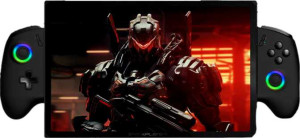
The Onexplayer X1 is driven by an octa-core CPU running at 8 x 3.3 GHz with multithreading support, paired with 64 GB of DDR5 RAM at 7500 MHz. The GPU clocks at 2700 MHz with 768 shading units and 32 render output units, delivering 4.1 TFLOPS of floating-point performance with ray tracing support. Storage is handled by an NVMe SSD, and the device can also connect to an external drive for additional capacity. The display refreshes at 120Hz, rounding out a performance profile oriented toward demanding real-time workloads.
The Onexplayer X1 is a handheld console with a 1600p display and output resolution, using an IPS LED-backlit LCD panel rated at 540 nits of typical brightness. It measures 252 x 163 mm at 13 mm thick and weighs 789 g, with a volume of approximately 534 cm³. The device houses 4096 GB of internal storage on a replaceable hard drive, an internal power supply, and a 65.02 Wh (16890 mAh) battery. It is region free and has no optical disc drive.
The Onexplayer X1 connects wirelessly via Wi-Fi 6E (with backward compatibility down to Wi-Fi 4) and Bluetooth 5.2, and offers 3 USB 4.0 Type-C ports for wired connectivity alongside an external memory slot and a 3.5 mm headphone jack. There is no HDMI output, no RJ45 port, no NFC, and no cellular module, and DLNA certification and connectivity between home and portable devices are also not supported.
The Onexplayer X1 features a 10.95″ touchscreen with a pixel density of 275 ppi and stereo speakers with 2-channel sound output, using flash storage internally. It supports quick resume, Discord voice chat, playing games while they download, achievement and high score tracking, and includes a child lock. Dolby Vision, 3D audio, VR support, backwards compatibility, voice commands, optical tracking, and stereoscopic 3D are not supported, and there is no front camera, secondary screen, autostereoscopic display, or Blu-ray playback capability of any kind.
The Onexplayer X1 supports up to 4 controllers and includes a wireless controller with 2 analog sticks and 14 buttons, along with compatibility for motion-sensing controllers. Adaptive triggers, dual force feedback, and an integrated touchpad are not supported.