Palit GeForce RTX 3050 KalmX 6GB specifications and in-depth review

Palit GeForce RTX 3050 KalmX 6GB

Manufacturer: Palit

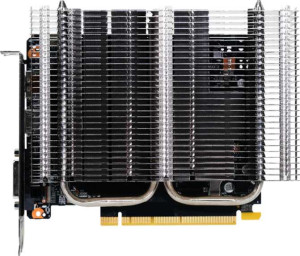
The Palit GeForce RTX 3050 KalmX 6GB is a graphics card built on NVIDIA's Ampere architecture and notable for its fully passive cooling solution, meaning it operates without any active fans. Fabricated on an 8nm process with 8700 million transistors, it runs within a 70W TDP envelope that makes fanless operation feasible while still delivering a modern feature set for light to moderate workloads.

The card's GPU clocks at 1042 MHz base and 1470 MHz turbo, with 2304 shading units generating 6.774 TFLOPS of floating-point performance and a texture rate of 105.8 GTexels/s across 72 TMUs and 32 ROPs. Memory consists of 6GB of GDDR6 VRAM on a 96-bit bus running at an effective 14000 MHz, delivering up to 168 GB/s of bandwidth with ECC support included. The feature set covers DirectX 12 Ultimate, OpenGL 4.6, OpenCL 3, ray tracing, DLSS, stereoscopic 3D, and Intel Resizable BAR, with display output handled by one HDMI 2.1 port, one DisplayPort, and one DVI connector supporting up to three monitors.

Pros
  • Fully passive cooling means the card produces no fan noise whatsoever, making it suitable for noise-sensitive environments such as home theater PCs or quiet workstations
  • A 70W TDP keeps power consumption low enough to operate without supplementary power connectors in many system configurations
  • Support for ray tracing, DLSS, and DirectX 12 Ultimate delivers a current-generation feature set within a silent, low-power design
  • ECC memory support extends usability to reliability-sensitive compute workloads where memory error correction is a requirement
  • Intel Resizable BAR compatibility allows the CPU broader access to GPU memory, benefiting rendering performance on supported platforms
  • The DVI output alongside HDMI 2.1 and DisplayPort gives users with older display hardware a direct connection option without an adapter
Cons
  • The 96-bit memory bus restricts bandwidth headroom, which can limit sustained performance in resolution-heavy or texture-intensive scenarios
  • 6GB of VRAM imposes a ceiling that may prove insufficient for modern workloads involving large assets or higher-resolution targets
  • Passive cooling performance is inherently dependent on case airflow; in poorly ventilated enclosures, thermal throttling becomes a realistic concern
  • With only 32 ROPs, pixel fill rate is constrained, which can affect rendering throughput in complex or high-resolution scenes
  • No USB-C or mini DisplayPort outputs limits compatibility with certain modern monitors and display adapters
  • The absence of RGB lighting offers no visual customization for users building systems with coordinated lighting setups
Who is this for?

The Palit GeForce RTX 3050 KalmX 6GB is purpose-built for users where silent operation is a priority — home theater PC builds, recording studios, libraries, or any environment where fan noise is unacceptable. Its 70W TDP and fully passive cooling make it a natural fit for systems with good chassis airflow that can sustain the card's thermal needs without active fans. Users who also want a modern API and feature set — including ray tracing, DLSS, DirectX 12 Ultimate, and ECC memory support — for light to moderate 1080p workloads or reliability-sensitive compute tasks will find it well-matched to those demands.

Who is this NOT for?

The KalmX 6GB is not suited to users who need sustained performance at 1440p or 4K, as the 96-bit memory bus and 6GB VRAM ceiling impose real constraints on high-resolution rendering and large texture workloads. The passive cooling design also makes it a poor choice for poorly ventilated cases, where insufficient airflow around the heatsink could lead to thermal throttling during extended workloads. Users who rely on USB-C or mini DisplayPort connectivity will also find the port selection lacking, as neither interface is available on this model.

Performance:

GPU clock speed 1042 MHz
GPU turbo 1470 MHz
pixel rate 47.04 GPixel/s
floating-point performance 6.774 TFLOPS
texture rate 105.8 GTexels/s
GPU memory speed 1750 MHz
shading units 2304
texture mapping units (TMUs) 72
render output units (ROPs) 32
Has Double Precision Floating Point (DPFP)

The GPU runs at a base clock of 1042 MHz, scaling up to a turbo frequency of 1470 MHz, with 2304 shading units and 72 texture mapping units producing a texture rate of 105.8 GTexels/s and a pixel rate of 47.04 GPixel/s through 32 render output units. Floating-point throughput reaches 6.774 TFLOPS, and GPU memory operates at 1750 MHz. Double Precision Floating Point (DPFP) is supported, making the card capable of handling workloads that require 64-bit numerical precision alongside standard graphics tasks.

Memory:

effective memory speed 14000 MHz
maximum memory bandwidth 168 GB/s
VRAM 6GB
GDDR version GDDR6
memory bus width 96-bit
Supports ECC memory

The card uses 6GB of GDDR6 VRAM with an effective memory speed of 14000 MHz, transmitted over a 96-bit bus to deliver a maximum bandwidth of 168 GB/s. The 96-bit interface width is consistent with the card's low-power design philosophy, keeping heat and energy draw in check. ECC memory support is present, offering hardware-level error correction for workloads where data accuracy cannot be compromised.

Features:

DirectX version DirectX 12 Ultimate
OpenGL version 4.6
OpenCL version 3
Supports multi-display technology
supports ray tracing
Supports 3D
supports DLSS
has XeSS (XMX)
AMD SAM / Intel Resizable BAR Intel Resizable BAR
has LHR
has RGB lighting
supported displays 3

Feature support covers DirectX 12 Ultimate, OpenGL 4.6, and OpenCL 3, providing compatibility across modern graphics rendering and general-purpose compute workloads. Hardware ray tracing and DLSS are both active, with stereoscopic 3D and multi-display support for up to three screens also included. Intel Resizable BAR is supported for systems that can take advantage of it. XeSS (XMX), LHR, and RGB lighting are not part of this card's specification.

Ports:

has an HDMI output
HDMI ports 1
HDMI version HDMI 2.1
DisplayPort outputs 1
USB-C ports 0
DVI outputs 1
mini DisplayPort outputs 0

Display output is handled by three ports: one HDMI 2.1, one DisplayPort, and one DVI output. USB-C and mini DisplayPort connections are not available on this model, keeping the rear bracket straightforward and focused on the three most commonly encountered display interfaces.

General info:

GPU architecture Ampere
Thermal Design Power (TDP) 70W
PCI Express (PCIe) version 4
semiconductor size 8 nm
number of transistors 8700 million
Has air-water cooling
width 166.3 mm
height 137 mm

The card is built on the Ampere architecture, manufactured using an 8nm process that integrates 8700 million transistors, and interfaces with the host system over PCIe 4. Its 70W TDP is the key enabler of the card's passive thermal design, and no active air or water cooling solution is fitted — heat dissipation relies entirely on the heatsink assembly. Physically, the card measures 166.3 mm in width and 137 mm in height, giving it a modest dual-slot form factor that fits standard ATX and many smaller chassis configurations.

Final Verdict

The Palit GeForce RTX 3050 KalmX 6GB occupies a narrow but well-defined niche: it is one of the few graphics cards that combines a fully modern feature set with completely silent, fanless operation. The 70W TDP is what makes this possible, and it also means the card fits comfortably into low-power system configurations without demanding a high-wattage power supply. Ray tracing, DLSS, DirectX 12 Ultimate, and ECC memory support round out a specification sheet that goes well beyond what a passive card might typically offer. That said, the 96-bit bus and 6GB VRAM mean it is a card with clear performance boundaries, and users should approach it with realistic expectations around resolution and workload intensity. For its intended audience — those building silent systems where acoustic comfort is as important as graphical output — the KalmX 6GB is a focused and technically coherent choice that delivers where it matters most.