Palit GeForce RTX 4070 Super Dual OC specifications and in-depth review

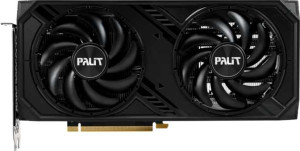
Palit GeForce RTX 4070 Super Dual OC

Manufacturer: Palit

The Palit GeForce RTX 4070 Super Dual OC is a graphics card built on NVIDIA's Ada Lovelace architecture, fabricated on a 5 nm process with 35,800 million transistors. It carries 12GB of GDDR6X VRAM running at an effective 21,000 MHz across a 192-bit bus, producing up to 504 GB/s of memory bandwidth. Feature support includes ray tracing, DLSS, DirectX 12 Ultimate, and Intel Resizable BAR, with RGB lighting and multi-display capability rounding out its overall configuration.

The card operates at a base clock of 1980 MHz, with the factory overclock pushing the turbo frequency to 2550 MHz, translating to 36.56 TFLOPS of floating-point performance and a texture rate of 571.2 GTexels/s. Its 7,168 shading units work alongside 224 texture mapping units and 80 render output units, while ECC memory support is also present. Output connectivity consists of three DisplayPort outputs and one HDMI 2.1a port, supporting up to four displays, and the card connects via PCIe 4 with a 220W TDP, measuring 269.1 mm wide and 127.5 mm tall.

Pros
  • The factory overclock raises the turbo clock to 2550 MHz, delivering 36.56 TFLOPS of floating-point performance without any manual tuning required
  • 12GB of GDDR6X memory with 504 GB/s of bandwidth gives the card substantial headroom for texture-heavy workloads and large frame buffers
  • Support for ray tracing and DLSS enables more detailed rendering with hardware-accelerated upscaling built in
  • Up to four displays can be driven simultaneously through three DisplayPort outputs and one HDMI 2.1a port, making it a practical choice for multi-monitor configurations
  • ECC memory support helps maintain data integrity during prolonged or error-sensitive compute tasks
  • RGB lighting allows the card to integrate visually with illuminated system builds
Cons
  • The 192-bit memory bus is narrower than what some cards in this class offer, which can constrain sustained memory throughput under heavy load
  • A 220W TDP places notable demands on both the power supply and case airflow
  • No USB-C output is present, limiting direct compatibility with displays or devices that require that connection
  • DVI and mini DisplayPort outputs are absent, making older monitors using those interfaces incompatible without an adapter
  • Air-water cooling is not supported, so users who want liquid cooling integration will need to source an alternative solution
Who is this for?

The Palit GeForce RTX 4070 Super Dual OC is well suited to users who want a factory-overclocked card ready to handle ray tracing and DLSS-enabled workloads without manual configuration. Its 12GB of GDDR6X memory and 504 GB/s bandwidth make it a capable option for content creators and compute users who work with large datasets or memory-intensive rendering tasks. Those running multi-monitor setups of up to four displays will also find the combination of three DisplayPort outputs and one HDMI 2.1a port a practical fit, and ECC memory support adds reliability for longer, error-sensitive sessions.

Who is this NOT for?

Users with constrained power supplies or limited case airflow may struggle to accommodate the card's 220W TDP without additional investment in their system infrastructure. Those who depend on USB-C, DVI, or mini DisplayPort connections will find no native support for any of these, making the card a poor match for workflows tied to such interfaces. Additionally, users looking to integrate liquid cooling will need to look elsewhere, as air-water cooling is not supported by this model.

Performance:

GPU clock speed 1980 MHz
GPU turbo 2550 MHz
pixel rate 204 GPixel/s
floating-point performance 36.56 TFLOPS
texture rate 571.2 GTexels/s
GPU memory speed 1313 MHz
shading units 7168
texture mapping units (TMUs) 224
render output units (ROPs) 80
Has Double Precision Floating Point (DPFP)

The card runs at a base clock of 1980 MHz, with the factory overclock lifting the turbo frequency to 2550 MHz, resulting in 36.56 TFLOPS of floating-point performance, a texture rate of 571.2 GTexels/s, and a pixel rate of 204 GPixel/s. These figures are driven by 7,168 shading units, 224 texture mapping units, and 80 render output units, with GPU memory operating at 1313 MHz. Double Precision Floating Point is supported, extending the card's utility to compute workloads that require it.

Memory:

effective memory speed 21000 MHz
maximum memory bandwidth 504 GB/s
VRAM 12GB
GDDR version GDDR6X
memory bus width 192-bit
Supports ECC memory

The card features 12GB of GDDR6X VRAM operating at an effective speed of 21,000 MHz over a 192-bit memory bus, delivering a maximum memory bandwidth of 504 GB/s. ECC memory support is included, providing an added layer of data integrity for workloads where memory error correction is a consideration.

Features:

DirectX version DirectX 12 Ultimate
OpenGL version 4.6
OpenCL version 3
Supports multi-display technology
supports ray tracing
Supports 3D
supports DLSS
has XeSS (XMX)
AMD SAM / Intel Resizable BAR Intel Resizable BAR
has LHR
has RGB lighting
supported displays 4

On the software and feature side, the card supports DirectX 12 Ultimate, OpenGL 4.6, and OpenCL 3, alongside hardware ray tracing, DLSS, and stereoscopic 3D. Multi-display technology enables up to four simultaneous outputs, and Intel Resizable BAR is supported to help streamline data transfers between system and GPU memory. RGB lighting is present, while XeSS and LHR are not included on this model.

Ports:

has an HDMI output
HDMI ports 1
HDMI version HDMI 2.1a
DisplayPort outputs 3
USB-C ports 0
DVI outputs 0
mini DisplayPort outputs 0

Display output is handled through three DisplayPort outputs and a single HDMI 2.1a port, giving a total of four available connections. DVI, mini DisplayPort, and USB-C outputs are absent from this card's I/O configuration.

General info:

GPU architecture Ada Lovelace
Thermal Design Power (TDP) 220W
PCI Express (PCIe) version 4
semiconductor size 5 nm
number of transistors 35800 million
Has air-water cooling
width 269.1 mm
height 127.5 mm

The card is founded on the Ada Lovelace architecture, built using a 5 nm process that integrates 35,800 million transistors, and connects to the motherboard via PCIe 4. It has a Thermal Design Power of 220W and measures 269.1 mm in width and 127.5 mm in height. Air-water cooling is not supported, and the card relies solely on its standard cooling solution.
Final Verdict

The Palit GeForce RTX 4070 Super Dual OC presents a coherent and well-rounded specification set for users who want a factory-tuned Ada Lovelace card without the need for manual overclocking. Its 2550 MHz turbo clock delivering 36.56 TFLOPS, paired with 12GB of GDDR6X memory and broad feature support including ray tracing, DLSS, and DirectX 12 Ultimate, gives it genuine versatility across both gaming and compute-oriented workloads. The four-display output capability and ECC memory support further extend its practical reach, though users should be mindful of its power requirements and the absence of USB-C or liquid cooling support when planning a system build around it. For those whose setup aligns with its strengths, the RTX 4070 Super Dual OC is a technically solid and capable graphics card that delivers on its overclocked promise without compromise in its core feature set.