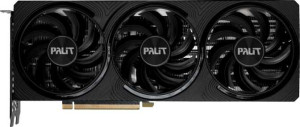
Palit GeForce RTX 4070 Super Infinity 3 OC specifications and in-depth review

Palit GeForce RTX 4070 Super Infinity 3 OC

Manufacturer: Palit

The Palit GeForce RTX 4070 Super Infinity 3 OC is a graphics card based on NVIDIA's Ada Lovelace architecture, manufactured on a 5 nm process with 35,800 million transistors. It operates at a base clock of 1980 MHz, reaching a boost clock of 2640 MHz, and delivers 37.85 TFLOPS of floating-point performance across its 7168 shading units.

On the memory side, the card carries 12GB of GDDR6X across a 192-bit bus, with an effective speed of 21,000 MHz and a peak bandwidth of 504 GB/s. It supports DirectX 12 Ultimate, OpenGL 4.6, ray tracing, and DLSS, and connects to up to four displays via one HDMI 2.1a port and three DisplayPort outputs. The card has a rated TDP of 245W and dimensions of 294 mm by 116 mm.

Pros
  • Boost clock reaches 2640 MHz, offering a high operating frequency for demanding rendering tasks
  • 37.85 TFLOPS of floating-point performance supported by 7168 shading units gives this card substantial compute throughput
  • 12GB of GDDR6X memory running at 21,000 MHz effective speed with 504 GB/s bandwidth suits memory-intensive workloads well
  • Supports ray tracing and DLSS, enabling more advanced rendering techniques in compatible applications
  • Four simultaneous display outputs via one HDMI 2.1a and three DisplayPort connections provide flexible multi-monitor setups
  • ECC memory support adds data integrity protection useful for compute-oriented use cases
Cons
  • 192-bit memory bus width is narrower than what some cards in this category offer, which can limit memory throughput scaling
  • 245W TDP places notable demands on system power delivery and cooling capacity
  • No USB-C output limits connectivity options for users with displays or devices that rely on that interface
  • Air-water cooling is not supported, restricting thermal management to the card's built-in air cooling solution
  • No RGB lighting for users who factor visual customization into their build aesthetics
Who is this for?

This card is well-suited to users who engage in demanding 3D rendering and gaming workloads, where the combination of 37.85 TFLOPS, 7168 shading units, and a 2640 MHz boost clock can handle complex scenes with relative ease. The 12GB of GDDR6X memory with 504 GB/s bandwidth makes it a reasonable fit for content creators working with high-resolution textures or GPU-accelerated compute tasks, while ECC memory support adds reliability for those running precision-sensitive workloads. Users who need multi-monitor setups of up to four displays will also find the output configuration — one HDMI 2.1a and three DisplayPort connections — practical for productivity or simulation environments.

Who is this NOT for?

Users working in environments with strict power constraints may find the 245W TDP problematic, as it requires a well-specced power supply and adequate case airflow, and the absence of air-water cooling support limits thermal headroom in tightly configured builds. The 192-bit memory bus may also fall short for workloads that push very high memory bandwidth demands simultaneously, making this card a less ideal fit for large-scale machine learning tasks or professional visualization pipelines that benefit from wider bus configurations. Additionally, users who rely on USB-C display connectivity will need to look elsewhere, as no such output is present on this card.

Performance:

GPU clock speed 1980 MHz
GPU turbo 2640 MHz
pixel rate 211.2 GPixel/s
floating-point performance 37.85 TFLOPS
texture rate 591.4 GTexels/s
GPU memory speed 1313 MHz
shading units 7168
texture mapping units (TMUs) 224
render output units (ROPs) 80
Has Double Precision Floating Point (DPFP)

The GPU runs at a base clock of 1980 MHz, scaling up to a boost clock of 2640 MHz, and delivers 37.85 TFLOPS of floating-point performance with double precision floating point support included. Its 7168 shading units work alongside 224 texture mapping units and 80 render output units, producing a texture rate of 591.4 GTexels/s and a pixel rate of 211.2 GPixel/s. The GPU memory operates at 1313 MHz, rounding out a performance profile oriented toward demanding rendering workloads.

Memory:

effective memory speed 21000 MHz
maximum memory bandwidth 504 GB/s
VRAM 12GB
GDDR version GDDR6X
memory bus width 192-bit
Supports ECC memory

The card is equipped with 12GB of GDDR6X VRAM running at an effective speed of 21,000 MHz across a 192-bit memory bus, yielding a maximum memory bandwidth of 504 GB/s. ECC memory support is also included, adding a layer of data integrity for workloads that require it.

Features:

DirectX version DirectX 12 Ultimate
OpenGL version 4.6
OpenCL version 3
Supports multi-display technology
supports ray tracing
Supports 3D
supports DLSS
has XeSS (XMX)
AMD SAM / Intel Resizable BAR Intel Resizable BAR
has LHR
has RGB lighting
supported displays 4

This card supports DirectX 12 Ultimate, OpenGL 4.6, and OpenCL 3, covering a broad range of graphics and compute APIs. Ray tracing and DLSS are both supported, along with stereoscopic 3D and multi-display technology spanning up to four screens simultaneously. Intel Resizable BAR is enabled, while XeSS (XMX) and LHR are not present. The card does not include RGB lighting.

Ports:

has an HDMI output
HDMI ports 1
HDMI version HDMI 2.1a
DisplayPort outputs 3
USB-C ports 0
DVI outputs 0
mini DisplayPort outputs 0

The card's output configuration consists of one HDMI 2.1a port and three DisplayPort outputs, offering a total of four display connections. There are no USB-C, DVI, or mini DisplayPort outputs present on this model.

General info:

GPU architecture Ada Lovelace
Thermal Design Power (TDP) 245W
PCI Express (PCIe) version 4
semiconductor size 5 nm
number of transistors 35800 million
Has air-water cooling
width 294 mm
height 116 mm

Built on the Ada Lovelace architecture using a 5 nm process, the GPU integrates 35,800 million transistors and connects via PCIe 4. It carries a rated TDP of 245W and does not include air-water cooling. The card measures 294 mm in width and 116 mm in height.

Final Verdict

The Palit GeForce RTX 4070 Super Infinity 3 OC is a capable graphics card that brings together a strong set of specifications under the Ada Lovelace architecture, with its 37.85 TFLOPS of floating-point performance and 12GB of GDDR6X memory making it a practical choice for users tackling demanding rendering, gaming, and GPU-accelerated workloads. Ray tracing, DLSS, ECC memory support, and a four-display output configuration further round out its feature set for both creative and productivity-oriented use cases. That said, the 245W TDP and 192-bit bus width are factors worth weighing carefully depending on system configuration and workload profile. Overall, this card occupies a well-defined position for users who need dependable compute throughput and modern feature support without requiring enterprise-grade specifications.