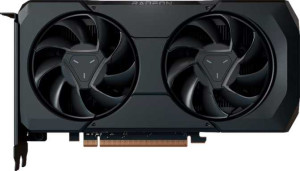
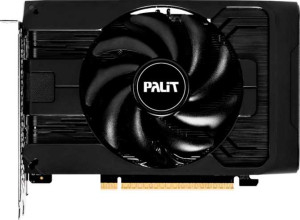
Palit GeForce RTX 5050 StormX specifications and in-depth review

Palit GeForce RTX 5050 StormX

Manufacturer: Palit

The Palit GeForce RTX 5050 StormX is a compact graphics card based on NVIDIA's Blackwell architecture, manufactured on a 5nm process with 16,900 million transistors. It ships with 8GB of GDDR6 memory across a 128-bit bus, delivering a maximum memory bandwidth of 320 GB/s at an effective speed of 20,000 MHz. With dimensions of 169.9mm by 118mm and a thermal design power of 130W, it fits a restrained physical footprint without active liquid cooling.

On the performance side, the card operates at a base GPU clock of 2,317 MHz, boosting up to 2,572 MHz, with 2,560 shading units, 80 texture mapping units, and 32 render output units contributing to a texture rate of 205.8 GTexels/s and a pixel rate of 82.3 GPixel/s. Floating-point performance reaches 13.17 TFLOPS. The card supports DirectX 12 Ultimate, OpenGL 4.6, OpenCL 3, ray tracing, DLSS, and Intel Resizable BAR, alongside up to four simultaneous displays through its single HDMI 2.1b port and three DisplayPort outputs. It connects via PCIe 5 and includes ECC memory support.

Pros
  • Supports ray tracing and DLSS, enabling hardware-accelerated visual effects and upscaling without additional configuration
  • Four display outputs — one HDMI 2.1b and three DisplayPort — allow connection of up to four monitors simultaneously
  • ECC memory support adds a degree of data integrity for workloads sensitive to memory errors
  • PCIe 5 interface ensures the card uses a current-generation connection standard
  • Compact dimensions of 169.9mm by 118mm make it suitable for smaller form factor builds
  • DirectX 12 Ultimate, OpenGL 4.6, and OpenCL 3 support covers a wide range of graphics and compute applications
Cons
  • 128-bit memory bus width is narrow and limits memory throughput scaling for more demanding workloads
  • No USB-C output is available, restricting compatibility with displays or devices that rely on that connection type
  • Cooling is air-only with no liquid cooling option, which may limit thermal headroom under sustained loads
  • No RGB lighting for users who prioritise chassis aesthetics
  • XeSS (XMX) is not supported, leaving that upscaling path unavailable
Who is this for?

This card is well-suited to users building compact desktop systems who need a capable GPU within a modest physical footprint, given its dimensions of 169.9mm by 118mm and a 130W TDP that keeps power draw manageable. The combination of ray tracing and DLSS support makes it a reasonable fit for gamers playing titles that leverage these technologies at moderate resolutions. It also serves users with multi-monitor setups, as four simultaneous display outputs are available, and those who require ECC memory or OpenCL 3 support for light compute or workstation-adjacent tasks will find the necessary capabilities present.

Who is this NOT for?

Users looking to run graphically intensive workloads at high resolutions will likely find the 128-bit memory bus a bottleneck, as it constrains memory throughput in scenarios that demand sustained bandwidth. The card is also not well-matched for those who rely on USB-C display connectivity, since no such output is available. Additionally, users who depend on XeSS upscaling — or those building systems that require liquid cooling integration — will find neither feature supported here, making this card a poor fit for those specific requirements.

Performance:

GPU clock speed 2317 MHz
GPU turbo 2572 MHz
pixel rate 82.3 GPixel/s
floating-point performance 13.17 TFLOPS
texture rate 205.8 GTexels/s
GPU memory speed 2500 MHz
shading units 2560
texture mapping units (TMUs) 80
render output units (ROPs) 32
Has Double Precision Floating Point (DPFP)

The Palit GeForce RTX 5050 StormX runs at a base GPU clock of 2,317 MHz, climbing to 2,572 MHz in turbo mode, while its 2,560 shading units are complemented by 80 texture mapping units and 32 render output units. These combine to deliver a texture rate of 205.8 GTexels/s and a pixel rate of 82.3 GPixel/s, with overall floating-point performance reaching 13.17 TFLOPS. GPU memory operates at 2,500 MHz, and the card includes support for Double Precision Floating Point (DPFP).

Memory:

effective memory speed 20000 MHz
maximum memory bandwidth 320 GB/s
VRAM 8GB
GDDR version GDDR6
memory bus width 128-bit
Supports ECC memory

The card is equipped with 8GB of GDDR6 VRAM running across a 128-bit memory bus, reaching an effective memory speed of 20,000 MHz and a maximum memory bandwidth of 320 GB/s. ECC memory support is also included, adding a layer of data integrity for workloads that benefit from error correction.

Features:

DirectX version DirectX 12 Ultimate
OpenGL version 4.6
OpenCL version 3
Supports multi-display technology
supports ray tracing
Supports 3D
supports DLSS
has XeSS (XMX)
AMD SAM / Intel Resizable BAR Intel Resizable BAR
has LHR
has RGB lighting
supported displays 4

The card supports DirectX 12 Ultimate, OpenGL 4.6, and OpenCL 3, covering a broad range of graphics and compute workloads. Ray tracing and DLSS are both supported, alongside stereoscopic 3D and multi-display technology spanning up to four screens. Intel Resizable BAR is included, while XeSS (XMX) and LHR are not present. The card does not feature RGB lighting.

Ports:

has an HDMI output
HDMI ports 1
HDMI version HDMI 2.1b
DisplayPort outputs 3
USB-C ports 0
DVI outputs 0
mini DisplayPort outputs 0

The card's display outputs consist of one HDMI 2.1b port and three DisplayPort outputs, providing a total of four connection options. There are no USB-C, DVI, or mini DisplayPort outputs present on this card.

General info:

GPU architecture Blackwell
Thermal Design Power (TDP) 130W
PCI Express (PCIe) version 5
semiconductor size 5 nm
number of transistors 16900 million
Has air-water cooling
width 169.9 mm
height 118 mm

Built on the Blackwell architecture and fabricated using a 5nm process, the card integrates 16,900 million transistors and connects via PCIe 5. It carries a Thermal Design Power of 130W and relies solely on air cooling, with no liquid cooling option. The card measures 169.9mm in width and 118mm in height, and does not include air-water cooling.
Final Verdict

The Palit GeForce RTX 5050 StormX presents itself as a compact, low-power graphics card built on the Blackwell architecture, bringing ray tracing, DLSS, and DirectX 12 Ultimate support into a physically restrained form factor with a 130W TDP. Its four display outputs and broad API compatibility make it practical for multi-monitor setups and mixed workloads, while ECC memory support adds a degree of reliability for users with compute-adjacent needs. The card's most notable constraint is its 128-bit memory bus, which naturally narrows its ceiling under sustained, bandwidth-intensive workloads. Overall, the RTX 5050 StormX is best positioned for users who prioritise small system footprints and moderate feature coverage over raw throughput capacity.

Popular Comparisons

Palit GeForce RTX 5050 StormX
VS
Gigabyte Radeon RX 7600 XT Gaming OC
Palit GeForce RTX 5050 StormX
VS
AMD Radeon RX 7600 XT