Patriot Viper Elite 5 RGB TUF Gaming Alliance DDR5-6600 C34 32GB (2x16GB) specifications and in-depth review

Patriot Viper Elite 5 RGB TUF Gaming Alliance DDR5-6600 C34 32GB (2x16GB)

Manufacturer: Patriot

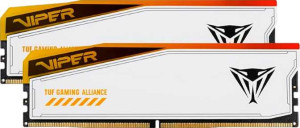
The Patriot Viper Elite 5 RGB TUF Gaming Alliance DDR5-6600 is a dual-channel desktop memory kit designed for DDR5 platforms, offering a total capacity of 32GB across two 16GB modules in a standard 288-pin DIMM form factor. It features integrated RGB lighting and a built-in heatsink, standing 44mm tall, making it a visually notable option for compatible systems.

Running at a tested speed of 6600 MHz with a CAS latency of 34 and a true latency of 10.3 ns, the kit uses subtimings of tRCD 40, tRP 40, and tRAS 84. It operates at 1.35V and supports Intel XMP 3.0 for straightforward profile-based configuration. The SPD default speed is 4800 MHz, ECC is not supported, and the modules do not use Samsung B-Die.

Pros
  • Tested speed of 6600 MHz offers headroom well above the 4800 MHz SPD default for capable platforms
  • Intel XMP 3.0 support allows straightforward frequency profile activation without manual timing configuration
  • Integrated heatsink aids thermal management during sustained operation
  • RGB lighting is included for users who want visual customization in their build
  • True latency of 10.3 ns at the rated speed reflects a reasonably tight result for the frequency
Cons
  • CAS latency of 34 is relatively high, which may matter on latency-sensitive workloads
  • Does not use Samsung B-Die, which some users specifically seek for manual overclocking flexibility
  • ECC memory is not supported, ruling this kit out for error-correction-dependent use cases
  • At 44mm tall, the modules may cause clearance issues with certain CPU coolers
Who is this for?

This kit suits desktop users building DDR5 systems who want to push beyond standard SPD speeds, as the 6600 MHz tested frequency with XMP 3.0 support makes configuration straightforward on compatible motherboards. The included heatsink and RGB lighting also make it a reasonable fit for enthusiast builds where both thermal management and visual aesthetics matter. Users comfortable running high-frequency profiles without manually tuning every timing will find the plug-and-play XMP approach practical.

Who is this NOT for?

Users who prioritize low absolute latency over raw clock speed may find the CL34 timing less appealing, as tighter latency profiles are available at lower frequencies. The lack of ECC support makes this kit unsuitable for workstation or server environments where memory error correction is a requirement. Additionally, builders working with tall air coolers in compact cases should verify clearance, as the 44mm module height can create fitment conflicts in constrained setups.

Performance:

true latency 10.3 ns
memory speed (Tested Speed) 6600
memory speed (SPD) 4800 MHz
DDR memory version 5
CAS Latency (CL) 34
tRAS timing 84
tRCD timing 40
tRP timing 40

This kit operates on DDR5 and is rated at a tested speed of 6600 MHz, while its SPD default sits at 4800 MHz. The primary timings are CL34, tRCD 40, tRP 40, and tRAS 84, which translate to a true latency of 10.3 ns at the rated frequency.

General info:

form factor 288-pin DIMM
memory size (total) 2 x 16GB
has Samsung B-Die
voltage 1.35V
height 44 mm
memory size 16GB

The kit comes in a standard 288-pin DIMM form factor and consists of two 16GB modules for a total capacity of 32GB. It runs at 1.35V and stands 44mm tall, while Samsung B-Die is not used in these modules.

Features:

Intel XMP / AMD EXPO Intel XMP 3.0
Supports ECC memory
Has an integrated heatsink
has RGB lighting

The modules include an integrated heatsink and RGB lighting, and they support Intel XMP 3.0 for straightforward frequency profile activation. ECC memory is not supported by this kit.

Benchmarks:

Final Verdict

The Patriot Viper Elite 5 RGB TUF Gaming Alliance DDR5-6600 is a DDR5 kit built around a clear proposition: high-frequency operation with minimal setup friction, backed by Intel XMP 3.0 at 6600 MHz and an integrated heatsink for thermal confidence. It fits well within enthusiast desktop builds where clock speed and visual appeal take priority, though users with specific demands around tight absolute latency or error-correcting memory will find its specification set less aligned with their needs. Taken as a whole, it represents a straightforward DDR5 upgrade path for XMP-capable platforms where raw frequency headroom and ease of configuration are the primary goals.