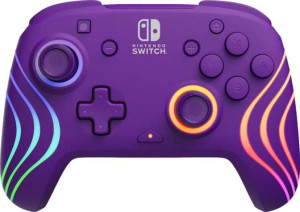
PDP Afterglow Wave specifications and in-depth review

PDP Afterglow Wave

Manufacturer: PDP

The PDP Afterglow Wave is a Nintendo Switch game controller built around an asymmetrical joystick layout, offering 16 buttons alongside paddle buttons and full button mapping support. It connects via 2.4GHz wireless or USB and runs on an internal rechargeable battery, making it a self-contained option for untethered play.

On the feature side, the Afterglow Wave includes dual force feedback and gyroscopic aiming, adding both tactile response and motion-based input to gameplay. Thumbsticks are analog in type, though interchangeable thumbsticks and hall effect triggers are not part of the package. The controller also lacks adaptive triggers, a touchpad, and any onboard audio hardware such as a 3.5mm jack, built-in speaker, or microphone.

Pros
  • Includes paddle buttons alongside full button mapping, giving users meaningful control customization
  • Gyroscopic aiming adds a motion-based input option for supported games
  • Dual force feedback provides tactile rumble response during gameplay
  • Connects via both 2.4GHz wireless and USB, offering flexibility in how it is used
  • Powered by an internal rechargeable battery, eliminating the need for disposable batteries
  • 16 buttons offer a broad range of inputs for varied gameplay scenarios
Cons
  • No hall effect triggers, which can affect long-term trigger precision
  • Thumbsticks are not interchangeable, limiting physical customization options
  • No 3.5mm headset jack means audio accessories cannot be connected directly to the controller
  • Adaptive triggers are absent, restricting more advanced haptic trigger functionality
  • No charging dock is included, so the controller must be charged by other means
  • No built-in speaker or microphone limits standalone communication and audio feedback options
Who is this for?

This controller is a solid fit for Nintendo Switch players who want more control flexibility than a standard gamepad offers. The inclusion of paddle buttons and button mapping makes it particularly well-suited to users who prefer to remap inputs to match personal play styles or genre-specific needs. Players who enjoy motion-based gameplay will also benefit from gyroscopic aiming, and the dual force feedback adds a tactile layer that suits action or racing game enthusiasts. The wireless connectivity via 2.4GHz is practical for those who prefer an untethered setup at home.

Who is this NOT for?

Users who prioritize advanced trigger technology will find this controller lacking, as it features neither hall effect triggers nor adaptive triggers, which may be a drawback for those seeking precision input or nuanced haptic feedback. The absence of a 3.5mm headset jack makes it unsuitable for players who rely on wired audio during sessions, particularly in shared or competitive environments. Additionally, the lack of interchangeable thumbsticks means it is not the right fit for users who want to tailor the physical feel of their analog inputs for different game types.

Design:

Joystick positioning Asymmetrical
has textured triggers/bumpers

The Design section of the PDP Afterglow Wave centers on an asymmetrical joystick layout, positioning the thumbsticks in an offset configuration rather than a mirrored one. The controller does not feature textured triggers or bumpers, opting instead for a smooth surface finish on those input areas.

Buttons:

number of buttons 16
has paddle buttons
has button mapping
Thumbstick type Analog
has hall effect triggers
has interchangeable thumbsticks
has adaptive triggers
has an integrated touchpad

The PDP Afterglow Wave offers a total of 16 buttons, and notably includes paddle buttons along with full button mapping support, giving users some flexibility in how inputs are configured. Thumbsticks are analog in type, though the controller does not support interchangeable thumbsticks. On the trigger side, hall effect triggers and adaptive triggers are both absent, and there is no integrated touchpad.

Power & Connectivity:

Power type Internal rechargeable battery
connection type 2.4GHz wireless, USB
compatibility Nintendo Switch

The PDP Afterglow Wave is powered by an internal rechargeable battery, removing the need for disposable cells. It connects via 2.4GHz wireless or USB, offering both a cable-free experience and a wired fallback. The controller is compatible with Nintendo Switch.

Features:

has gyroscopic aiming
includes a charging dock
travel bag is included
Has dual force feedback
has a built-in speaker
has a built-in microphone
has a socket for a 3.5 mm audio jack

The PDP Afterglow Wave includes gyroscopic aiming and dual force feedback as its two standout active features, adding motion-based input and tactile rumble to gameplay. On the audio side, there is no built-in speaker, built-in microphone, or 3.5mm headset jack. The controller also ships without a charging dock or a travel bag.

Final Verdict

The PDP Afterglow Wave is a Nintendo Switch controller that carves out a clear niche for players seeking expanded input options without stepping into high-end territory. Its paddle buttons with full button mapping stand out as the most practical differentiator, giving users genuine customization that goes beyond what a stock controller typically allows. Gyroscopic aiming and dual force feedback round out a feature set that serves motion-oriented and immersive gameplay reasonably well. That said, the absence of hall effect triggers, adaptive triggers, interchangeable thumbsticks, and any onboard audio output means it will fall short for users with more specialized demands. For Nintendo Switch players who want a step up in control flexibility and tactile feedback without requiring audiophile-grade or precision-hardware features, the Afterglow Wave represents a practical and purposeful option.