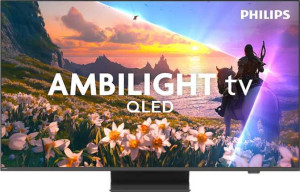
The 65-inch OLED panel renders a 4K UHD resolution of 3840 x 2160 pixels at 68 ppi, with 10-bit color depth and a color range of up to 1,070 million shades. It operates at a 120Hz refresh rate and supports adaptive synchronization through Nvidia G-Sync, AMD FreeSync, and AMD FreeSync Premium. HDR coverage is comprehensive, spanning HDR10, HDR10+, Dolby Vision, and HLG. An anti-reflection coating and ambient light sensor help manage picture quality across different lighting conditions, while maximum horizontal and vertical viewing angles of 178 degrees ensure a consistent image from a wide range of seating positions.
The Philips 65OLED769/12 offers a well-rounded wired and wireless connectivity setup, with four HDMI 2.1 ports, two USB ports, a single RJ45 ethernet jack, and a 3.5mm headphone socket. Wireless options cover Wi-Fi 4 and Wi-Fi 5 alongside Bluetooth 5.2 and Miracast for screen mirroring. Broadcast reception is handled across DVB-C, DVB-S, DVB-S2, DVB-T, and DVB-T2, covering terrestrial, cable, and satellite signals. There is no external memory slot, VGA connector, or DVI connector.
Audio output is delivered through a stereo speaker system rated at 2 x 10W, without a built-in subwoofer and without support for SRS TheaterSound HD or Dolby Virtual. The set supports a broad range of audio formats including Dolby Atmos, Dolby Audio, Dolby Digital, Dolby Digital Plus, and DTS:X, alongside Digital Out for routing sound externally. Both HDMI ARC and HDMI eARC are available, providing flexible options for connecting a soundbar or AV receiver.
The Philips 65OLED769/12 measures 1,450 mm wide, 833 mm tall, and 58 mm thick, with a total volume of approximately 70,055.3 cm³ and a weight of 24,400 g. VESA mount support is included for wall installation flexibility. The set is rated to operate within a temperature range of 5 °C to 35 °C, defining the environmental conditions under which it is designed to function.
The built-in smart TV platform supports voice commands and is compatible with Google Assistant and Amazon Alexa, though Siri and Apple HomeKit are not supported. A smartphone can be used as a remote control, but the physical remote is not rechargeable. Practical features include USB recording, a sleep timer, a child lock, and a built-in web browser. Operating power consumption is rated at 96W, with standby draw dropping to 0.5W, and the set carries an EU energy label of F.