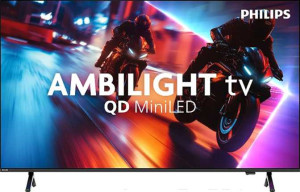
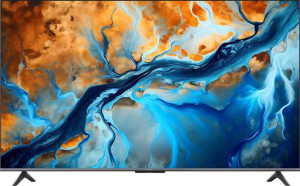
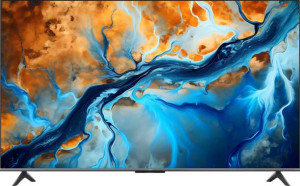
The Philips 85MLED910/12 features an 85″ QLED Mini-LED LCD panel with a 3840 x 2160 pixel (4K UHD) resolution at 52 ppi, rendering up to 1070 million colors at 10-bit depth. Its 144Hz refresh rate is paired with AMD FreeSync and AMD FreeSync Premium adaptive sync, making it suitable for fast-moving content. HDR support covers HDR10, HDR10+, and HLG, though Dolby Vision is not included. The display offers wide 178° viewing angles both horizontally and vertically, and comes with an anti-reflection coating and an ambient light sensor to help adapt brightness to the surrounding environment.
The Philips 85MLED910/12 offers a well-rounded connectivity setup built around four HDMI 2.1 ports, two USB ports, and a single RJ45 ethernet port for wired networking. Wireless options include Wi-Fi 4 (802.11n) and Wi-Fi 5 (802.11ac), along with Bluetooth 5.2 and Miracast support for screen casting. A 3.5mm headphone jack is also present, while there is no external memory slot, VGA connector, or DVI connector. For broadcast reception, the TV supports a broad range of DVB standards: DVB-T, DVB-T2, DVB-C, DVB-S, and DVB-S2.
The Philips 85MLED910/12 delivers audio through a stereo speaker system rated at 4 x 10W of total output power, with no built-in subwoofer. Dolby support is extensive, covering Dolby Digital, Dolby Digital Plus, Dolby Audio, and Dolby Atmos, though Dolby Virtual and SRS TheaterSound HD are not included. Digital Out is supported for connecting external audio equipment, and the TV provides both HDMI ARC and HDMI eARC for streamlined audio routing to compatible soundbars or receivers.
The Philips 85MLED910/12 measures 1894 mm wide, 1099 mm tall, and 96 mm thick, with a total volume of 199,824.576 cm³. It supports VESA mounting for wall installation flexibility. The unit is rated to operate within a temperature range of 5 °C to 35 °C.
The Philips 85MLED910/12 includes a built-in smart TV platform with an integrated web browser, voice command support, and compatibility with both Google Assistant and Amazon Alexa, though Siri and Apple HomeKit are not supported. Smartphones can be used as a remote, while the physical remote control is not rechargeable. Practical utilities include USB recording, a sleep timer, and a child lock. Standby power consumption sits at 0.5W, and the TV carries an EU energy label of F.