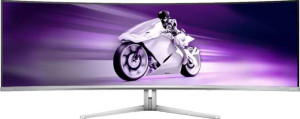
Philips Evnia 49M2C8900 49" specifications and in-depth review

Philips Evnia 49M2C8900 49"

Manufacturer: Philips

The Philips Evnia 49M2C8900 is a 49″ ultrawide gaming monitor built around a QD-OLED display panel that delivers a contrast ratio of 15,000,000:1 alongside a rated brightness of 450 nits. The screen spans 48.9″ at a 5120x1440 resolution, translating to a pixel density of roughly 108.77 ppi, and the panel supports 10-bit color depth with coverage exceeding the sRGB and Adobe RGB color spaces. A remote control and picture-in-picture functionality are included, and the integrated speaker system provides four channels at 7.5W each.

On the performance side, the 49M2C8900 operates at a 240Hz refresh rate with a 0.03ms response time, and adaptive sync support spans both Nvidia G-Sync and AMD FreeSync. Connectivity includes two HDMI 2.1 ports, one DisplayPort 1.4 output, Thunderbolt, USB Type-C, and five USB 3.1 ports. The stand offers tilt, swivel, and height adjustment up to 12 cm, and the monitor is also VESA mount compatible. Operating power consumption is rated at 163.35W, with a standby draw of 0.5W.

Pros
  • The QD-OLED panel delivers a contrast ratio of 15,000,000:1, making dark and bright content appear distinctly defined
  • A 240Hz refresh rate combined with a 0.03ms response time makes the display well-suited for fast-paced gaming
  • Adaptive sync support covers both Nvidia G-Sync and AMD FreeSync, offering compatibility across major GPU platforms
  • The stand supports tilt, swivel, and 12 cm of height adjustment, providing a reasonable range of ergonomic positioning
  • Color space coverage exceeds both sRGB and Adobe RGB standards, and factory color calibration support is included
  • With two HDMI 2.1 ports, one DisplayPort 1.4 output, Thunderbolt, and USB Type-C, the monitor accommodates a wide variety of source devices
Cons
  • At 13,960g, the monitor is quite heavy, which may complicate repositioning or single-person installation
  • Portrait mode is not supported, limiting flexibility for certain productivity workflows
  • There is no 3.5mm headset jack, so users cannot connect headphones directly to the monitor
  • Wi-Fi, Ethernet, and AirPlay are all absent, restricting the monitor to wired signal sources only
  • The EU energy label rating of G indicates relatively high power consumption for everyday use
Who is this for?

This monitor is well-matched to users who spend significant time on competitive or immersive gaming, where the 240Hz refresh rate and 0.03ms response time provide a smooth, responsive experience across fast-moving content. The ultrawide 5120x1440 resolution and expansive 48.9″ screen also make it a strong fit for content creators and professionals working with color-critical workflows, given the wide color space coverage and factory-supported color calibration. The broad connectivity options — including HDMI 2.1, Thunderbolt, and USB Type-C — further suit users who need to connect multiple devices or high-bandwidth sources from a single workstation setup.

Who is this NOT for?

Users with limited desk space or who frequently reposition their setup will likely find the monitor's large physical footprint and 13,960g weight impractical to manage. Those who rely on portrait mode orientation for reading, coding, or document work will find this monitor unsuitable, as that capability is not supported. Additionally, users in wireless-first environments will be restricted by the absence of Wi-Fi, Ethernet, and AirPlay, making this a poor fit for anyone expecting network or wireless audio connectivity from their display.

Display:

Display type QD-OLED, OLED/AMOLED
response time 0.03 ms
screen size 48.9"
resolution 5120 x 1440 px
pixel density 108.77 ppi
Adaptive synchronization Nvidia G-Sync, AMD FreeSync, Nvidia G-Sync Compatible
has anti-glare coating
refresh rate 240Hz
maximum horizontal viewing angle 178º
maximum vertical viewing angle 178º
has a matte panel
has a glossy panel
has a touch screen

The display uses a QD-OLED panel measuring 48.9″ with a resolution of 5120x1440 pixels at a density of 108.77 ppi. It operates at a 240Hz refresh rate with a response time of just 0.03ms, and supports adaptive sync through both Nvidia G-Sync and AMD FreeSync. Horizontal and vertical viewing angles each reach 178°, and an anti-glare coating is present, though the panel is neither strictly matte nor glossy. The display does not support touch input.

General info:

Type Ultrawide, Gaming
EU energy label G
supports total tilt
Has a swivel stand
Supports VESA mount
height 369 mm
width 1195 mm
thickness 181 mm
weight 13960 g
supports portrait mode
maximum operating temperature 40 °C
lowest potential operating temperature 0 °C
volume 79812.855 cm³

This ultrawide gaming monitor carries an EU energy label of G and has physical dimensions of 1195mm wide, 369mm tall, and 181mm thick, with a total weight of 13,960g. The stand supports both tilt and swivel adjustments, and the monitor is compatible with VESA mounting, though portrait mode is not supported. Operating temperatures range from 0°C to a maximum of 40°C, and the total volume is approximately 79,812.855 cm³.

Colors:

brightness (typical) 450 nits
supports color calibration
display colors 1070 million
bit depth 10-bit
contrast ratio 15000000:1
Adobe RGB coverage 125.2%
sRGB coverage 153.1%

The monitor delivers a typical brightness of 450 nits and a contrast ratio of 15,000,000:1, supported by a 10-bit panel capable of reproducing up to 1,070 million colors. Color space coverage is notably wide, reaching 125.2% of Adobe RGB and 153.1% of sRGB, and the display supports color calibration for those who require precise color accuracy.

Connectivity:

HDMI ports 2
supports Thunderbolt
DisplayPort outputs 1
DisplayPort version DisplayPort 1.4
has a socket for a 3.5 mm audio jack
has a DVI connector
USB ports 5
USB version 3.1
Has USB Type-C
HDMI version HDMI 2.1
supports Ethernet
supports Wi-Fi
has AirPlay
mini DisplayPort outputs 0
has a VGA connector

The monitor offers a solid range of video inputs, including two HDMI 2.1 ports and one DisplayPort 1.4 output, with no mini DisplayPort, DVI, or VGA connectors present. Thunderbolt is supported, and USB connectivity spans five USB 3.1 ports with USB Type-C also included. There is no 3.5mm headset jack, and wireless options such as Wi-Fi, Ethernet, and AirPlay are not available on this model.

Power:

operating power consumption 163.35W
standby power consumption 0.5W

During normal operation, the monitor draws 163.35W, while power consumption drops to just 0.5W in standby mode.

Features:

has PiP
has stereo speakers
has built-in smart TV
audio output power 4 x 7.5W
has a remote control
supports Dolby Digital
supports Dolby Digital Plus
has DTS Surround
has an ambient light sensor
has a front camera

The monitor includes stereo speakers with a total audio output of 4 x 7.5W, along with picture-in-picture (PiP) support and a remote control. It does not feature Dolby Digital, Dolby Digital Plus, or DTS Surround audio formats, and there is no ambient light sensor or front camera. Built-in smart TV functionality is also absent.

Miscellaneous:

height adjustment range 12 cm

The stand provides a height adjustment range of 12 cm, allowing for vertical positioning flexibility to suit different desk setups and user preferences.

Final Verdict

The Philips Evnia 49M2C8900 is a large-format ultrawide monitor that brings together a compelling set of specifications for users who demand both visual fidelity and fast display performance. Its QD-OLED panel with a 240Hz refresh rate, 0.03ms response time, and expansive color space coverage make it a well-rounded option for gaming and color-sensitive work alike, while the range of connectivity options adds practical versatility. Those with space constraints or a need for wireless connectivity and portrait flexibility will find certain limitations, but for users whose environment accommodates a monitor of this scale, the Evnia 49M2C8900 represents a technically thorough offering within the ultrawide gaming monitor category.

Popular Comparisons

Philips Evnia 49M2C8900 49"
VS
MSI MPG 491CQP QD-OLED 49"
Philips Evnia 49M2C8900 49"
VS
Samsung Odyssey OLED G9 (G91SD) 49"
Philips Evnia 49M2C8900 49"
VS
Samsung Odyssey OLED G95SC 49"
Philips Evnia 49M2C8900 49"
VS
Samsung Odyssey OLED G9 49" (G93SC)