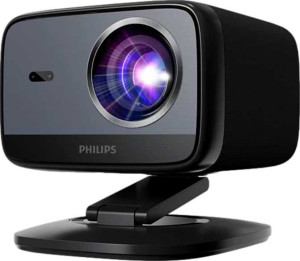
The Philips NeoPix 450 uses a traditional lamp light source rather than laser, with a lamp life of 30,000 hours in eco mode, offering an extended operational lifespan under standard usage. The unit measures 190 mm wide, 200 mm tall, and 220 mm deep, giving it a total volume of 8,360 cm³. At 2,500 g, it sits in a mid-range weight class for a projector of its dimensions.
The Philips NeoPix 450 outputs at 1080p resolution with 500 ANSI lumens of brightness and a contrast ratio of 1000:1, operating at an 8-bit color depth. It can project images up to 100″ in size from a minimum throw distance of 1 metre. Focus is handled via a motorized mechanism, while zoom adjustment is manual; there is no manual focus option. The projector does not support 3D content, and HDR formats including HDR10, HDR10+, HLG, and Dolby Vision are not supported.
The Philips NeoPix 450 offers a solid mix of wired and wireless connectivity options. On the wireless side, it supports Wi-Fi 6, Wi-Fi 5, and Wi-Fi 4, along with Bluetooth, AirPlay, Chromecast built-in, Miracast, and DLNA certification, covering a wide range of streaming and device-pairing scenarios. For wired connections, it includes one HDMI port, one USB port, and a DVI connector, though there is no VGA connector, no RJ45 ethernet port, and no S/PDIF audio output.
The Philips NeoPix 450 includes a built-in smart TV platform and comes with a remote control for navigation. Audio is handled by built-in stereo speakers delivering 2 x 5W of output power, and a 3.5 mm headphone jack is available for private listening, though there are no audio input ports and Dolby Atmos is not supported. The projector does not offer vertical or horizontal lens shift, has no external memory slot, and does not support voice commands.