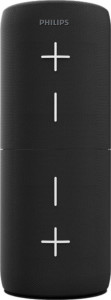
The Philips TAS4400 has a physical footprint of 200 mm in height and 80 mm in both width and thickness, with a total volume of 1280 cm³ and a weight of 750 g. It carries an IPX5 ingress protection rating, confirming water resistance against low-pressure jets from any direction. The speaker features a detachable cable and an on-device control panel for straightforward operation, while a neodymium magnet, touch screen, RGB lighting, remote control, and travel bag are not part of the package.
The Philips TAS4400 delivers 2 x 20W of audio output power and covers a full frequency range spanning from 20 Hz to 20000 Hz. The speaker operates as a mono unit, as it does not include stereo speakers, and there is no subwoofer or passive radiator present in the design. It also lacks a noise-canceling microphone and magnetic shielding.
The Philips TAS4400 is powered by a built-in 1800 mAh rechargeable battery that supports up to 8 hours of playback on a full charge, with a charge time of approximately 3 hours. A battery level indicator is included to keep track of remaining power during use. The battery is not removable, and wireless charging is not supported.
The Philips TAS4400 connects wirelessly via Bluetooth 5.0 with a maximum range of 10 m, and also includes an AUX input and a USB Type-C port for wired connectivity and charging. An external memory slot adds another option for local audio playback. NFC pairing, Wi-Fi, Ethernet, AirPlay, Chromecast, DLNA, and Auracast are not supported, and the speaker does not include a 3.5 mm audio jack socket, a 3.5 mm male connector, or a microphone input. On the codec side, none of the advanced Bluetooth audio formats are available, including aptX, aptX HD, aptX Adaptive, aptX Lossless, aptX Low Latency, LDAC, AAC, or Bluetooth LE Audio.
The Philips TAS4400 can be used wirelessly and supports remote smartphone control, allowing playback management from a paired device. It includes voice prompts for audio feedback during operation, and a sleep timer is available for scheduled shutoff. Fast pairing, voice commands, a mute function, radio reception, and power bank functionality are not part of the feature set.
The Philips TAS4400 does not support stereo pairing, meaning it cannot be paired with a second unit to create a stereo sound setup.