PNY GeForce RTX 4070 Super Verto OC Dual Fan specifications and in-depth review

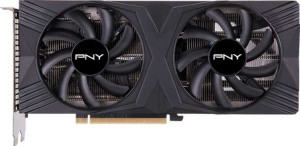
PNY GeForce RTX 4070 Super Verto OC Dual Fan

Manufacturer: PNY

The PNY GeForce RTX 4070 Super Verto OC Dual Fan is a graphics card from PNY built around Nvidia's Ada Lovelace architecture and fabricated on a 5 nm process node. It houses 35,800 million transistors within a relatively compact frame — 247.4 mm wide and 120.4 mm tall — making it a more physically manageable option than many cards in its class. With 35.7 TFLOPS of floating-point performance, it supports modern rendering features including ray tracing, DLSS, and DirectX 12 Ultimate, along with stereoscopic 3D and multi-display output for up to four screens simultaneously.

The card is equipped with 12 GB of GDDR6X VRAM running on a 192-bit memory bus, reaching an effective memory speed of 21,000 MHz and a maximum bandwidth of 504 GB/s. Its 7,168 shading units work alongside 224 texture mapping units and 80 render output units, with the GPU clocked at a base of 1,980 MHz and a turbo frequency of 2,490 MHz. ECC memory support and Double Precision Floating Point capability are both present, adding utility for compute workloads beyond standard graphics use. Connectivity is handled through three DisplayPort outputs and one HDMI 2.1a port, with Intel Resizable BAR support also included. The card carries a TDP of 220W and connects via PCIe 4.0, while air-water cooling integration is not supported.

Pros
  • At 247.4 mm wide and 120.4 mm tall, the card's compact dimensions make it easier to fit into cases where longer or taller cards would not clear
  • A 220W TDP places relatively modest power demands on the system, reducing strain on the power supply and case cooling
  • Ray tracing and DLSS are both natively supported, enabling access to current rendering techniques without additional configuration
  • ECC memory support adds data integrity protection for error-sensitive or compute-oriented tasks
  • Intel Resizable BAR is included, allowing the CPU to access the full VRAM pool more efficiently during operation
  • Up to four displays can be driven simultaneously through three DisplayPort outputs and one HDMI 2.1a port
Cons
  • The 192-bit memory bus width limits the maximum memory bandwidth to 504 GB/s, which may become a bottleneck in heavily memory-bound workloads
  • 12 GB of VRAM may prove insufficient for certain professional or content creation tasks that require larger memory allocations
  • Air-water cooling integration is not supported, ruling out custom liquid cooling loop configurations that connect directly to the GPU
  • XeSS (XMX) is not supported, leaving that upscaling option unavailable for applications that rely on it
Who is this for?

This card is a practical fit for users working within space-constrained builds, as its compact 247.4 mm x 120.4 mm footprint allows installation in cases that cannot accommodate full-length cards. Its 220W TDP also makes it manageable for systems without high-capacity power supplies, suiting builders who want capable graphics output without extensive infrastructure changes. The support for ray tracing, DLSS, and DirectX 12 Ultimate makes it appropriate for gamers and creators who want access to current rendering features, while ECC memory and DPFP support extend its relevance to users running compute or data-sensitive workloads alongside standard graphics tasks. Those who need multi-monitor setups of up to four displays will also find the port layout practical through its three DisplayPort and single HDMI 2.1a outputs.

Who is this NOT for?

Users engaged in heavily memory-bound workloads — such as large-scale 3D rendering, high-resolution texture work, or training sizable machine learning models — may find the 12 GB VRAM and 192-bit bus width limiting, as the resulting 504 GB/s bandwidth ceiling could become a bottleneck under sustained load. The card is also a poor match for enthusiasts planning a custom liquid cooling loop that integrates directly with the GPU, since air-water cooling is not supported. Additionally, users who depend on XeSS (XMX) upscaling in their applications will need to look elsewhere, as that feature is absent from this card's specification set.

Performance:

GPU clock speed 1980 MHz
GPU turbo 2490 MHz
pixel rate 199.2 GPixel/s
floating-point performance 35.7 TFLOPS
texture rate 557.8 GTexels/s
GPU memory speed 1313 MHz
shading units 7168
texture mapping units (TMUs) 224
render output units (ROPs) 80
Has Double Precision Floating Point (DPFP)

The GPU runs at a base clock of 1,980 MHz and boosts up to 2,490 MHz, backed by 7,168 shading units, 224 texture mapping units, and 80 render output units. These translate to a texture rate of 557.8 GTexels/s and a pixel rate of 199.2 GPixel/s, with overall compute throughput sitting at 35.7 TFLOPS of floating-point performance. GPU memory operates at 1,313 MHz, and Double Precision Floating Point (DPFP) is supported, extending the card's utility to workloads that require higher numerical precision.

Memory:

effective memory speed 21000 MHz
maximum memory bandwidth 504 GB/s
VRAM 12GB
GDDR version GDDR6X
memory bus width 192-bit
Supports ECC memory

The card features 12 GB of GDDR6X VRAM on a 192-bit memory bus, with an effective memory speed of 21,000 MHz delivering a maximum bandwidth of 504 GB/s. ECC memory support is included, providing error-correction capability that benefits compute-oriented and data-sensitive workloads.

Features:

DirectX version DirectX 12 Ultimate
OpenGL version 4.6
OpenCL version 3
Supports multi-display technology
supports ray tracing
Supports 3D
supports DLSS
has XeSS (XMX)
AMD SAM / Intel Resizable BAR Intel Resizable BAR
has LHR
has RGB lighting
supported displays 4

The card supports DirectX 12 Ultimate, OpenGL 4.6, and OpenCL 3, providing broad API coverage for both graphics and compute applications. Ray tracing, DLSS, and stereoscopic 3D are all supported, while multi-display technology allows connection of up to four screens simultaneously. Intel Resizable BAR is included to enable more efficient CPU access to GPU memory, whereas XeSS (XMX) and LHR are not present on this card. RGB lighting is also featured, and there are no hash rate limitations applied.

Ports:

has an HDMI output
HDMI ports 1
HDMI version HDMI 2.1a
DisplayPort outputs 3
USB-C ports 0
DVI outputs 0
mini DisplayPort outputs 0

Display output is handled through three DisplayPort outputs and a single HDMI 2.1a port, totaling four available connections. DVI, mini DisplayPort, and USB-C outputs are not present on this card.

General info:

GPU architecture Ada Lovelace
Thermal Design Power (TDP) 220W
PCI Express (PCIe) version 4
semiconductor size 5 nm
number of transistors 35800 million
Has air-water cooling
width 247.4 mm
height 120.4 mm

The GPU is based on the Ada Lovelace architecture and manufactured on a 5 nm process, integrating 35,800 million transistors. It connects to the system via PCIe 4.0 and carries a TDP of 220W, with dimensions of 247.4 mm in width and 120.4 mm in height making it a relatively compact card for its class. Air-water cooling integration is not supported, so thermal management relies entirely on the card's own cooling solution.
Final Verdict

The PNY GeForce RTX 4070 Super Verto OC Dual Fan presents a well-rounded specification set for users who need a capable Ada Lovelace-based graphics card without the physical and power demands of larger models. Its compact dimensions and 220W TDP make it genuinely accessible for a wider range of builds, while support for ray tracing, DLSS, DirectX 12 Ultimate, and ECC memory covers both gaming and compute use cases effectively. The 12 GB GDDR6X VRAM and 192-bit bus will satisfy most mainstream workloads, though users with particularly demanding memory requirements should weigh those constraints carefully before committing. For builders prioritizing a manageable card with a modern feature set and flexible multi-display output, this PNY model is a solid and practical choice.

Popular Comparisons

PNY GeForce RTX 4070 Super Verto OC Dual Fan
VS
Inno3D GeForce RTX 5080 X3 OC