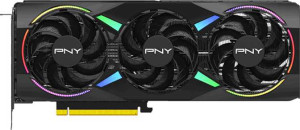
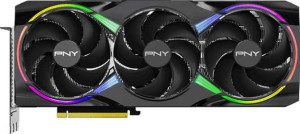
PNY GeForce RTX 5070 ARGB Epic-X Triple Fan specifications and in-depth review

PNY GeForce RTX 5070 ARGB Epic-X Triple Fan

Manufacturer: PNY

PNY's GeForce RTX 5070 ARGB Epic-X Triple Fan is a desktop graphics card that pairs Nvidia's Blackwell GPU architecture with a triple-fan cooling solution and addressable RGB lighting. Running at a base clock of 2325 MHz with a turbo ceiling of 2512 MHz, the card is equipped with 6144 shading units and delivers 30.87 TFLOPS of single-precision floating-point throughput, alongside support for ray tracing and DLSS.

On the memory side, the card carries 12GB of GDDR7 VRAM across a 192-bit bus, reaching an effective speed of 28000 MHz and a peak bandwidth of 672 GB/s. Display connectivity consists of one HDMI port and three DisplayPort outputs, supporting up to four screens simultaneously. The card conforms to PCIe 5.0, is manufactured on a 5nm process node housing 31.1 billion transistors, and carries a three-year warranty.

Pros
  • Supports up to four simultaneous display outputs through one HDMI port and three DisplayPort connections
  • 12GB of GDDR7 VRAM with a 192-bit bus delivers 672 GB/s of memory bandwidth
  • Ray tracing and DLSS are both supported, expanding rendering options
  • RGB lighting is built in, adding visual customization without requiring separate hardware
  • ECC memory support adds data integrity for accuracy-sensitive workloads
  • Backed by a three-year warranty
Cons
  • No USB-C output is available, limiting connectivity options for certain modern displays
  • The 250W TDP places notable demands on system power delivery
  • Water cooling is not supported; the card relies solely on air cooling
  • At 299.7 mm in length, the card may not fit in smaller or compact cases
Who is this for?

This card is well-suited for desktop users who demand substantial rendering throughput, given its 30.87 TFLOPS of floating-point performance and full ray tracing and DLSS support, making it a solid fit for visually demanding applications and modern game titles. The 12GB GDDR7 VRAM with 672 GB/s of bandwidth also makes it a reasonable choice for creators working with GPU-accelerated compute workloads, particularly where ECC memory support adds value. Users who run multi-monitor setups of up to four displays will find the four-output configuration practical for both productivity and immersive environments.

Who is this NOT for?

Users working within space-constrained builds may find the 299.7 mm card length problematic, as smaller and compact cases are unlikely to accommodate it comfortably. The 250W TDP means systems with modest or aging power supplies will need an upgrade to support stable operation, making it a poor fit for users with limited PSU headroom. Additionally, anyone requiring a USB-C display output or water-cooling compatibility will find neither available on this model, which could be a meaningful limitation for specific workstation or enthusiast configurations.

Performance:

GPU clock speed 2325 MHz
GPU turbo 2512 MHz
pixel rate 201 GPixel/s
floating-point performance 30.87 TFLOPS
texture rate 482.3 GTexels/s
GPU memory speed 1750 MHz
shading units 6144
texture mapping units (TMUs) 192
render output units (ROPs) 80
Has Double Precision Floating Point (DPFP)

The card's GPU runs at a base clock of 2325 MHz, boosting up to 2512 MHz under load, while the GPU memory operates at 1750 MHz. Compute throughput reaches 30.87 TFLOPS of floating-point performance, backed by a pixel rate of 201 GPixel/s and a texture rate of 482.3 GTexels/s. The rendering pipeline is built around 6144 shading units, 192 texture mapping units, and 80 render output units, and the card also supports Double Precision Floating Point (DPFP) for workloads that require it.

Memory:

effective memory speed 28000 MHz
maximum memory bandwidth 672 GB/s
VRAM 12GB
GDDR version GDDR7
memory bus width 192-bit
Supports ECC memory

The card is equipped with 12GB of GDDR7 VRAM running across a 192-bit memory bus, achieving an effective memory speed of 28000 MHz and a peak bandwidth of 672 GB/s. ECC memory support is also included, adding a layer of data integrity for workloads where memory accuracy is a concern.

Features:

DirectX version DirectX 12 Ultimate
OpenGL version 4.6
OpenCL version 3
Supports multi-display technology
supports ray tracing
Supports 3D
supports DLSS
has XeSS (XMX)
AMD SAM / Intel Resizable BAR Intel Resizable BAR
has LHR
has RGB lighting
supported displays 4

The card supports DirectX 12 Ultimate, OpenGL 4.6, and OpenCL 3, covering a broad range of graphics and compute APIs. Ray tracing and DLSS are both supported, while XeSS (XMX) is not included. Multi-display technology is on board with support for up to four simultaneous outputs, and stereoscopic 3D is also available. Intel Resizable BAR is supported, whereas LHR is not present. The card features RGB lighting, rounding out its hardware capabilities.

Ports:

has an HDMI output
HDMI ports 1
DisplayPort outputs 3
USB-C ports 0
DVI outputs 0
mini DisplayPort outputs 0

The card's output configuration consists of one HDMI port and three DisplayPort outputs, offering a total of four display connections. There are no USB-C, DVI, or mini DisplayPort outputs present on this model.

General info:

GPU architecture Blackwell
Thermal Design Power (TDP) 250W
PCI Express (PCIe) version 5
semiconductor size 5 nm
number of transistors 31100 million
warranty period 3 years
Has air-water cooling
width 299.7 mm
height 120.1 mm

Built on the Blackwell architecture and fabricated on a 5nm process node, the GPU integrates 31,100 million transistors and connects via PCIe 5.0. It carries a thermal design power of 250W and relies on air cooling, as water cooling is not supported. The card measures 299.7 mm in width and 120.1 mm in height, and comes with a three-year warranty.
Final Verdict

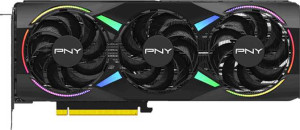
The PNY GeForce RTX 5070 ARGB Epic-X Triple Fan is a well-specified desktop graphics card that brings together Blackwell architecture, ray tracing, DLSS support, and a capable memory subsystem in a single package. Its 12GB of GDDR7 VRAM paired with 672 GB/s of bandwidth gives it meaningful headroom for both visually demanding applications and GPU-accelerated workloads, while ECC memory support and a three-year warranty add a degree of reliability assurance. Prospective users should account for its 250W power requirement and 299.7 mm length when planning a build, but for those with a system that can accommodate it, this card delivers a broad and coherent feature set for modern desktop use.

Popular Comparisons

PNY GeForce RTX 5070 ARGB Epic-X Triple Fan
VS
Gainward GeForce RTX 5070 Python III OC
PNY GeForce RTX 5070 ARGB Epic-X Triple Fan
VS
PNY GeForce RTX 5070 ARGB Epic-X OC Triple Fan
PNY GeForce RTX 5070 ARGB Epic-X Triple Fan
VS
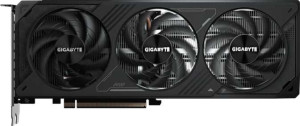
Gigabyte GeForce RTX 5070 WindForce OC SFF
PNY GeForce RTX 5070 ARGB Epic-X Triple Fan
VS
AX Gaming Rebel GeForce RTX 5070 X3W
PNY GeForce RTX 5070 ARGB Epic-X Triple Fan
VS
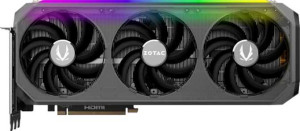
Zotac Gaming GeForce RTX 5070 Ti AMP Extreme Infinity
PNY GeForce RTX 5070 ARGB Epic-X Triple Fan
VS
PNY GeForce RTX 5080 ARGB Epic-X OC Triple Fan