Portronics Beem 560 specifications and in-depth review

Portronics Beem 560

Manufacturer: Portronics

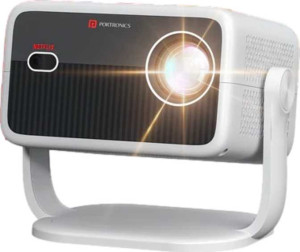
The Portronics Beem 560 is a compact projector designed for home and personal use, measuring 125 × 196 × 125 mm with a volume of 3062.5 cm³. It ships with a dedicated smartphone app and a remote control, and its built-in smart TV functionality means users can access content directly without needing an external streaming device.

On the connectivity side, the Beem 560 covers a broad range of wireless standards, including Wi-Fi, Bluetooth, Chromecast, AirPlay, Miracast, and DLNA certification, alongside one HDMI port and one USB port for wired connections. It delivers a 1080p output resolution with a maximum projection size of 100″ and includes a built-in mono speaker rated at 3W. The unit carries a one-year warranty.

Pros
  • Supports a wide range of wireless casting options including AirPlay, Chromecast built-in, Miracast, and DLNA, covering most common streaming setups
  • Built-in smart TV removes the need for an external streaming device
  • Can project images up to 100″, offering a large viewing area from a compact unit
  • Dedicated smartphone app provides an additional control method beyond the included remote
  • 1080p output resolution ensures full HD image quality
  • Compact dimensions make it easy to position or move between spaces
Cons
  • Single built-in speaker with only 3W output and no stereo configuration limits audio quality
  • No 3.5 mm headset jack means external audio devices cannot be connected directly
  • Lacks vertical and horizontal lens shift, reducing flexibility in projector placement
  • No HDR support of any kind — HDR10, HDR10+, Dolby Vision, and HLG are all absent
  • No ethernet port, so wired network connections are not possible
  • No external memory slot, preventing direct playback from memory cards or similar storage
Who is this for?

This projector is a good fit for casual home viewers who want a straightforward setup for movie nights or streaming sessions, thanks to its built-in smart TV functionality and broad wireless casting support via AirPlay, Chromecast, and Miracast. Its 1080p output and 100″ maximum projection size make it well-suited for living room or bedroom use where a large screen experience is desired without a dedicated home theater. Users who prefer controlling devices through multiple options will also appreciate the combination of a remote control and a dedicated smartphone app.

Who is this NOT for?

Users who prioritize high-quality audio output will find the single 3W mono speaker inadequate for immersive sound, and the absence of a 3.5 mm jack limits options for connecting external audio gear directly. Those who require precise image alignment will be frustrated by the lack of vertical or horizontal lens shift, which restricts flexible projector positioning. Additionally, viewers who regularly consume HDR content will be underserved, as the projector offers no support for HDR10, HDR10+, Dolby Vision, or HLG, meaning high dynamic range material will not be rendered as intended.

General info:

has laser light source
release date January 2026
width 125 mm
height 196 mm
thickness 125 mm
Has a dedicated smartphone app
volume 3062.5 cm³
warranty period 1 years

The Portronics Beem 560 has a compact physical footprint, measuring 125 mm in width, 196 mm in height, and 125 mm in thickness, with a total volume of 3062.5 cm³. It does not use a laser light source. The unit supports a dedicated smartphone app, adding a layer of convenience for device control, and comes with a one-year warranty.

Projection quality:

output resolution 1080p
maximum projection size 100"
supports HDR10+
supports Dolby Vision
supports HDR10
supports HLG

The Beem 560 delivers a 1080p output resolution and supports a maximum projection size of 100″, making it capable of producing a sizeable image. On the HDR side, the projector does not support HDR10, HDR10+, Dolby Vision, or HLG, so all content is rendered without any of those high dynamic range formats.

Connectivity:

HDMI ports 1
has AirPlay
Has Bluetooth
supports Wi-Fi
USB ports 1
has Chromecast built-in
has a VGA connector
is DLNA-certified
has a DVI connector
supports Miracast
RJ45 ports 0
Has S/PDIF Out port

The Beem 560 offers a well-rounded connectivity set, with wireless options including Wi-Fi, Bluetooth, AirPlay, Chromecast built-in, Miracast, and DLNA certification covering most common streaming and casting scenarios. For wired connections, it provides one HDMI port and one USB port, while there is no RJ45 ethernet port, VGA connector, DVI connector, or S/PDIF output available.

Features:

has stereo speakers
has lens shift (vertical)
has lens shift (horizontal)
has a remote control
has built-in smart TV
has a built-in speaker
audio output power 1 x 3W
has a socket for a 3.5 mm audio jack
has Dolby Atmos
has an external memory slot
has voice commands

The Beem 560 includes built-in smart TV functionality and comes with a remote control, allowing for straightforward content navigation without additional hardware. Audio is handled by a single built-in speaker rated at 1 x 3W, with no stereo speaker configuration or Dolby Atmos support; there is also no 3.5 mm headset jack available. The projector lacks vertical and horizontal lens shift, an external memory slot, and voice command support.
Final Verdict

The Portronics Beem 560 is a compact projector that covers the essentials well for casual home viewing — its built-in smart TV with broad wireless casting support (AirPlay, Chromecast, Miracast, and DLNA) makes it genuinely convenient to set up and use without additional streaming hardware. The 1080p output and 100″ maximum projection size deliver a reasonably capable image for everyday entertainment, though the absence of any HDR format support and a single 3W mono speaker signal clear trade-offs for users with higher audio-visual expectations. For viewers who simply want a fuss-free, wirelessly connected projector for standard streaming use, the Beem 560 represents a focused, no-frills option — but those seeking precision placement flexibility or richer content rendering will need to look elsewhere.