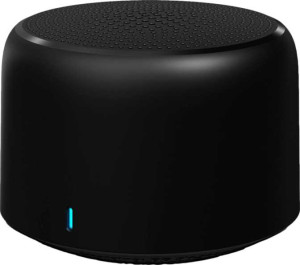
The Portronics Pico has a compact physical footprint, measuring 42mm in height with a width and thickness of 55mm each, and a total volume of 127.05 cm³. It weighs just 50g, making it easy to carry around. The speaker houses a single driver and includes a detachable cable, along with a control panel placed directly on the device for convenient access. It does not feature a neodymium magnet, water resistance, RGB lighting, a touch screen, a remote control, or a travel bag, and it is not a neckband-style speaker. The product carries a warranty period of 1 year.
The Portronics Pico delivers 5W of mono audio output through a single channel, with no stereo speakers, subwoofer, or passive radiator present. It includes one built-in microphone to support hands-free use, though it does not feature noise cancellation. Magnetic shielding is also absent from this speaker's design.
The Portronics Pico is equipped with a rechargeable battery rated for up to 4 hours of playback, and a battery level indicator is included to let users monitor remaining charge at a glance. The battery is not removable, and the speaker does not support wireless charging.
The Portronics Pico connects wirelessly via Bluetooth with a maximum range of 5.3 meters, and includes one USB Type-C port for wired connectivity and charging. It does not support NFC pairing, Wi-Fi, Ethernet, AirPlay, Chromecast, Auracast, or Bluetooth LE Audio, and no advanced audio codecs such as aptX, aptX HD, aptX Adaptive, aptX Lossless, aptX Low Latency, LDAC, or AAC are present. There is no 3.5mm audio jack socket, AUX input, 3.5mm male connector, external memory slot, microphone input, and the device is not DLNA-certified.
The Portronics Pico can be used wirelessly and supports smartphone remote control, allowing users to manage playback from their phone. It includes voice prompts for audio feedback and a sleep timer for scheduled shutoff. Fast pairing, voice commands, a mute function, radio, and power bank functionality are not supported.
The Portronics Pico does not support stereo pairing, meaning it cannot be paired with a second unit to produce stereo sound.