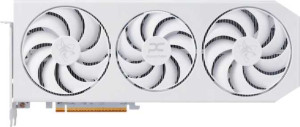
PowerColor Hellhound Spectral White Radeon RX 9070 XT specifications and in-depth review

PowerColor Hellhound Spectral White Radeon RX 9070 XT

Manufacturer: PowerColor

The PowerColor Hellhound Spectral White Radeon RX 9070 XT is a graphics card from PowerColor built around AMD's RDNA 4.0 architecture. It operates at a base GPU clock of 1660 MHz with a turbo frequency that reaches 3010 MHz, and the card is fabricated on a 4 nm process node housing approximately 53,900 million transistors. RGB lighting is included, and the design supports up to four simultaneous displays.

On the memory side, the card carries 16GB of GDDR6 VRAM across a 256-bit bus with an effective speed of 20,000 MHz, yielding a maximum bandwidth of 644.6 GB/s. Compute throughput is rated at 49.32 TFLOPS, supported by 4096 shading units, 256 TMUs, and 128 ROPs. The card supports DirectX 12, OpenGL 4.6, ray tracing, and AMD FSR4, while connectivity is handled through one HDMI 2.1b port and three DisplayPort outputs. Its thermal design power is rated at 304W, and it connects via a PCIe 5 interface.

Pros
  • The 16GB GDDR6 VRAM across a 256-bit bus with 644.6 GB/s of bandwidth gives this card substantial headroom for memory-intensive workloads
  • A turbo clock of 3010 MHz combined with 49.32 TFLOPS of floating-point throughput places this card firmly in high-end compute territory
  • Support for ray tracing and AMD FSR4 together means visually demanding scenes can be rendered with hardware-accelerated lighting while upscaling helps maintain frame rates
  • Four simultaneous display outputs — one HDMI 2.1b and three DisplayPort — offer flexible multi-monitor configurations without the need for adapters
  • ECC memory support adds a degree of data integrity useful for workloads that require accurate memory operations
  • RGB lighting is built in, and the absence of an LHR limiter means compute workloads are fully unrestricted
Cons
  • A TDP of 304W places notable demands on system power delivery and case airflow, requiring a well-specced PSU and adequate chassis ventilation
  • At 340 mm in length, physical fitment may be a concern in smaller or mid-tower cases
  • There is no USB-C output, which limits direct connectivity to displays or devices that rely solely on that interface
  • Water cooling is not supported, so thermal management is entirely dependent on the card's air-cooling solution
  • DLSS and XeSS are not supported, meaning users reliant on those specific upscaling technologies will need to use FSR4 as the sole alternative
Who is this for?

This card is well suited to users who run demanding graphics workloads at high resolutions, where the combination of 16GB GDDR6 VRAM, 644.6 GB/s of memory bandwidth, and 49.32 TFLOPS of floating-point throughput can be fully leveraged. The inclusion of ray tracing, AMD FSR4, and a turbo clock of 3010 MHz makes it a strong fit for users who prioritize visually rich rendering alongside upscaling flexibility. It also serves well in multi-display setups, given its four-output configuration, and the presence of ECC memory support and DPFP capability makes it relevant to users engaged in compute-oriented or precision-sensitive workloads alongside traditional graphics tasks.

Who is this NOT for?

Users working within a compact or small-form-factor build may find the 340 mm card length difficult to accommodate, and the 304W TDP demands a power supply and cooling setup that not every system can readily support. Those with a strong dependency on DLSS or XeSS upscaling will find neither is available here, making this card a poor fit for workflows or gaming setups built around those specific technologies. Additionally, users looking for USB-C display output or water-cooling compatibility will need to look elsewhere, as neither is offered on this model.

Performance:

GPU clock speed 1660 MHz
GPU turbo 3010 MHz
pixel rate 385.3 GPixel/s
floating-point performance 49.32 TFLOPS
texture rate 770.6 GTexels/s
GPU memory speed 2518 MHz
shading units 4096
texture mapping units (TMUs) 256
render output units (ROPs) 128
Has Double Precision Floating Point (DPFP)

The Performance section of this card centers on a GPU base clock of 1660 MHz that boosts up to 3010 MHz under load, backed by a floating-point throughput of 49.32 TFLOPS. The 4096 shading units work alongside 256 texture mapping units and 128 render output units to deliver a texture rate of 770.6 GTexels/s and a pixel rate of 385.3 GPixel/s. GPU memory operates at 2518 MHz, and the card includes support for Double Precision Floating Point (DPFP), rounding out a compute profile suited to both graphics and general-purpose workloads.

Memory:

effective memory speed 20000 MHz
maximum memory bandwidth 644.6 GB/s
VRAM 16GB
GDDR version GDDR6
memory bus width 256-bit
Supports ECC memory

This card is equipped with 16GB of GDDR6 VRAM running across a 256-bit memory bus, with an effective memory speed of 20,000 MHz that translates to a maximum bandwidth of 644.6 GB/s. ECC memory support is also present, adding a layer of data integrity for workloads where memory accuracy is a consideration.

Features:

DirectX version DirectX 12
OpenGL version 4.6
OpenCL version 2.2
Supports multi-display technology
supports ray tracing
Supports 3D
supports DLSS
has FSR4
has XeSS (XMX)
AMD SAM / Intel Resizable BAR AMD SAM
has LHR
has RGB lighting
supported displays 4

The card supports DirectX 12, OpenGL 4.6, and OpenCL 2.2, covering a broad range of graphics and compute workloads. Ray tracing is supported, as is stereoscopic 3D and multi-display output across up to four screens simultaneously. On the upscaling side, AMD FSR4 is available, while DLSS and XeSS (XMX) are not supported. AMD SAM (Smart Access Memory) is included for memory access optimization, and there is no hardware limiter (LHR) present. RGB lighting is built in, rounding out the feature set.

Ports:

has an HDMI output
HDMI ports 1
HDMI version HDMI 2.1b
DisplayPort outputs 3
USB-C ports 0
DVI outputs 0
mini DisplayPort outputs 0

The card's output configuration consists of one HDMI 2.1b port and three DisplayPort outputs, providing a total of four video connections. There are no USB-C, DVI, or mini DisplayPort outputs present on this model.

General info:

GPU architecture RDNA 4.0
Thermal Design Power (TDP) 304W
PCI Express (PCIe) version 5
semiconductor size 4 nm
number of transistors 53900 million
Has air-water cooling
width 340 mm
height 142 mm

This card is built on the RDNA 4.0 architecture, fabricated using a 4 nm process and packing 53,900 million transistors onto the die. It connects via PCIe 5 and carries a thermal design power rating of 304W. The card measures 340 mm in width and 142 mm in height, and relies solely on air cooling, as water cooling is not supported.

Final Verdict

The PowerColor Hellhound Spectral White Radeon RX 9070 XT brings together a well-rounded specification set built around AMD's RDNA 4.0 architecture, with its 49.32 TFLOPS of floating-point performance, 16GB GDDR6 VRAM, and hardware ray tracing support forming the core of its appeal. FSR4 upscaling, ECC memory, DPFP capability, and a four-display output setup further broaden its utility beyond pure gaming scenarios. Its 304W TDP and 340 mm length do require a suitably equipped system, and the absence of DLSS, XeSS, and USB-C output will matter to some users — but within its intended scope, this card represents a technically complete and capable option for users running high-resolution workloads in a well-specced desktop environment.