PowerColor Radeon AI Pro R9700 specifications and in-depth review

PowerColor Radeon AI Pro R9700

Manufacturer: PowerColor

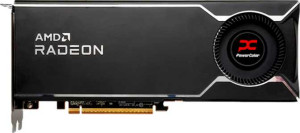
The PowerColor Radeon AI Pro R9700 is a workstation-oriented graphics card based on AMD's RDNA 4.0 architecture, fabricated on a 4nm process with 53.9 billion transistors. It carries 32GB of GDDR6 VRAM across a 256-bit memory bus, and supports ECC memory alongside AMD SAM, reflecting a design oriented toward professional and compute-intensive workloads.

The card operates at a base GPU clock of 1660 MHz with a boost up to 2920 MHz, delivering 47.84 TFLOPS of floating-point performance and a texture rate of 747.5 GTexels/s. Its 4096 shading units are paired with 256 TMUs and 128 ROPs, while effective memory speed reaches 20,000 MHz for a peak bandwidth of 644.6 GB/s. Connectivity is handled exclusively through four DisplayPort outputs, supporting up to four displays simultaneously, with the card drawing 300W via a PCIe 5.0 interface and measuring 280mm in length.

Pros
  • 32GB of GDDR6 VRAM provides substantial memory capacity for memory-intensive workloads
  • ECC memory support adds data integrity protection suitable for reliability-sensitive professional tasks
  • Four DisplayPort outputs allow simultaneous connection of up to four displays
  • AMD FSR4 upscaling support extends rendering flexibility
  • Double Precision Floating Point (DPFP) support broadens suitability for compute-oriented applications
  • AMD SAM support enables more efficient memory access between the GPU and compatible systems
Cons
  • No HDMI output limits compatibility with displays and devices that lack DisplayPort connectivity
  • Absence of USB-C and DVI outputs restricts legacy and alternative display connectivity options
  • 300W TDP demands adequate system power delivery and case airflow
  • No air-water cooling solution included, leaving thermal management entirely dependent on the system environment
  • No RGB lighting for users who prefer visual customization in their builds
Who is this for?

This card is well-matched for users running compute-intensive professional workloads such as AI inference, scientific simulation, or data processing tasks that benefit from Double Precision Floating Point support and ECC memory. The 32GB of GDDR6 VRAM across a 256-bit bus also makes it a practical fit for large-dataset GPU computing and multi-display workstation setups, where the four DisplayPort outputs and AMD SAM support can be put to direct use. Environments that demand consistent memory reliability will particularly benefit from the built-in ECC functionality.

Who is this NOT for?

Users seeking a card primarily for consumer gaming or home entertainment will find the absence of an HDMI output limiting, as most consumer monitors and displays rely on it. The 300W TDP also makes this a poor fit for compact or low-power system builds where thermal headroom and power delivery are constrained. Additionally, users who require legacy display connectivity through DVI or flexible output options via USB-C will find the port selection too restrictive for their setup.

Performance:

GPU clock speed 1660 MHz
GPU turbo 2920 MHz
pixel rate 373.8 GPixel/s
floating-point performance 47.84 TFLOPS
texture rate 747.5 GTexels/s
GPU memory speed 2518 MHz
shading units 4096
texture mapping units (TMUs) 256
render output units (ROPs) 128
Has Double Precision Floating Point (DPFP)

The PowerColor Radeon AI Pro R9700 runs at a base GPU clock of 1660 MHz, boosting up to 2920 MHz under load, while delivering 47.84 TFLOPS of floating-point performance alongside a pixel rate of 373.8 GPixel/s and a texture rate of 747.5 GTexels/s. Its 4096 shading units work in tandem with 256 texture mapping units and 128 render output units, supported by a GPU memory speed of 2518 MHz. The card also includes Double Precision Floating Point (DPFP) support, which broadens its suitability for compute-oriented tasks beyond standard rendering workloads.

Memory:

effective memory speed 20000 MHz
maximum memory bandwidth 644.6 GB/s
VRAM 32GB
GDDR version GDDR6
memory bus width 256-bit
Supports ECC memory

The card is equipped with 32GB of GDDR6 VRAM running across a 256-bit memory bus, reaching an effective memory speed of 20,000 MHz and a maximum memory bandwidth of 644.6 GB/s. ECC memory support is also included, adding a layer of data integrity protection suited to reliability-sensitive workloads.

Features:

DirectX version DirectX 12 Ultimate
OpenGL version 4.6
OpenCL version 2.2
Supports multi-display technology
supports ray tracing
Supports 3D
has FSR4
has XeSS (XMX)
AMD SAM / Intel Resizable BAR AMD SAM
has LHR
has RGB lighting
supported displays 4

The card supports DirectX 12 Ultimate, OpenGL 4.6, and OpenCL 2.2, covering a broad range of graphics and compute APIs. Ray tracing, stereoscopic 3D, and multi-display technology are all supported, with up to four displays usable simultaneously. AMD FSR4 is included for upscaling, while XeSS (XMX) is not supported. Memory access is aided by AMD SAM (Smart Access Memory), and the card does not feature LHR (Lite Hash Rate) restrictions or RGB lighting.

Ports:

has an HDMI output
DisplayPort outputs 4
USB-C ports 0
DVI outputs 0
mini DisplayPort outputs 0

The card's output configuration consists exclusively of four DisplayPort outputs, with no HDMI, DVI, USB-C, or mini DisplayPort connectors present.

General info:

GPU architecture RDNA 4.0
Thermal Design Power (TDP) 300W
PCI Express (PCIe) version 5
semiconductor size 4 nm
number of transistors 53900 million
Has air-water cooling
width 280 mm
height 127 mm

Built on the RDNA 4.0 architecture and manufactured using a 4nm process, the card packs 53,900 million transistors and connects via a PCIe 5.0 interface. It carries a Thermal Design Power of 300W and does not include air-water cooling. Physically, it measures 280mm in width and 127mm in height.
Final Verdict

The PowerColor Radeon AI Pro R9700 is a workstation-class graphics card that makes a clear case for itself in professional and compute-driven environments. With 32GB of ECC-supported GDDR6 VRAM, Double Precision Floating Point capability, and a compute throughput of 47.84 TFLOPS, it is built for tasks that demand both memory capacity and computational reliability. Its port configuration — four DisplayPort outputs with no HDMI or USB-C — and 300W power draw signal that this card is designed for purpose-built professional workstations rather than general consumer use. For users whose workflows align with those requirements, the R9700 presents a well-specified and focused option; for anyone outside that scope, its constraints become apparent quickly.

Popular Comparisons

PowerColor Radeon AI Pro R9700
VS
Nvidia GeForce RTX 5090
PowerColor Radeon AI Pro R9700
VS
MSI GeForce RTX 5060 Ti Vanguard SOC 16GB