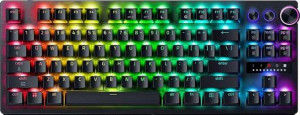
The Razer Huntsman V3 Pro 8KHz TKL is a wired gaming mechanical keyboard in a tenkeyless (80%) layout with a standard profile, connecting to a system via USB with the added convenience of a detachable cable. It is not designed for Mac. Its standout connectivity specification is the 8000 Hz polling rate, which means the keyboard reports input to the host system up to eight thousand times per second. Physically, it measures 363 mm wide, 139 mm tall, and 39 mm thick, with a total weight of 719.5 g. The keyboard is backed by a 2-year warranty.
The keyboard features a backlit layout with RGB lighting, giving users control over per-key illumination. Its case is constructed from a combination of aluminum and plastic, while the switch plate uses aluminum throughout, and the entire unit is available in either black or white. A wrist rest is included in the package, and adjustable feet allow the typing angle to be modified to personal preference.
This keyboard uses the Razer Analog Optical Switch Gen-2, an optical switch with a linear feel and an actuation force of 40 g. The actuation point is adjustable across a range of 0.1 mm to 4 mm, with a total travel distance of 4.5 mm. The switches are not hot-swappable, meaning they cannot be replaced without soldering.
The keyboard includes a notable set of input-focused features: it supports analog input, rapid trigger, dual actuation, and adjustable actuation, giving users considerable control over how and when keypresses are registered. Full N-key rollover (NKRO) is also present, ensuring every simultaneous keypress is detected without conflict. On the other hand, the keyboard does not offer USB passthrough, has no built-in display, and lacks support for QMK, ZMK, or VIA firmware customization.
The keyboard uses an ANSI (United States) layout with a standard key arrangement and double-shot PBT keycaps in an OEM profile, offering a familiar typing surface with durable legends. Media controls are handled through dedicated media keys rather than a function layer, and a rotary dial is also present for on-the-fly input adjustments.