Samsung Galaxy Book4 360 15.6" Intel Core 5 120U 1.4GHz / 16GB RAM / 512GB SSD specifications and in-depth review

Samsung Galaxy Book4 360 15.6" Intel Core 5 120U 1.4GHz / 16GB RAM / 512GB SSD

Manufacturer: Samsung

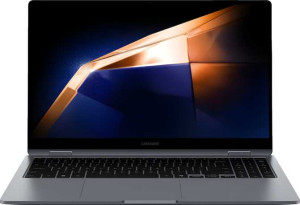
Samsung's Galaxy Book4 360 15.6″ is a convertible productivity laptop built around a 15.6″ OLED touchscreen with a 1920 x 1080 resolution, 120Hz refresh rate, and 400-nit typical brightness. Running on an Intel Core 5 120U processor paired with 16GB of DDR5 RAM and a 512GB NVMe SSD, the machine is designed to handle everyday computing tasks while remaining relatively slim at 13.7mm thick and weighing 1,460g.

On the connectivity side, the Galaxy Book4 360 15.6″ offers two Thunderbolt 4 ports alongside one USB 3.2 Gen 2 Type-A port, an HDMI output, and an external memory card slot, with wireless covered by Wi-Fi 6E and Bluetooth 5.3. The Intel Iris Xe Graphics 80EU integrated GPU supports up to four external displays and reaches a turbo frequency of 1,250MHz, while the CPU's turbo speed climbs to 5GHz across its 12-thread, big.LITTLE architecture. Additional features include a fingerprint scanner, 3D facial recognition, Dolby Atmos audio, a 2MP front camera, and a backlit keyboard.

Pros
  • The 15.6″ OLED/AMOLED touchscreen with a 120Hz refresh rate and anti-reflection coating makes for a comfortable, responsive display experience in varied lighting conditions
  • Two Thunderbolt 4 ports provide high-bandwidth connectivity and support for up to four external displays, offering strong flexibility for multi-monitor or docking setups
  • Both a fingerprint scanner and 3D facial recognition are included, giving users two distinct hardware-level authentication options
  • The NVMe SSD running on PCIe 4.0 ensures fast storage access, and DDR5 RAM with a maximum speed of 6,400MHz keeps memory throughput modern
  • Wi-Fi 6E support along with Bluetooth 5.3 puts the machine on current wireless standards for both network and peripheral connectivity
  • The inclusion of a gyroscope and accelerometer alongside a touchscreen is well-suited to a convertible form factor, enabling orientation-aware interaction
Cons
  • There is no RJ45 Ethernet port, so wired network connections require an adapter
  • The maximum RAM is capped at 16GB with no option to expand beyond that amount
  • No DisplayPort output is available, and the single HDMI port is the only dedicated video output besides the Thunderbolt 4 connections
  • Sleep-and-charge functionality is absent, meaning USB ports cannot charge connected devices when the laptop is powered down or sleeping
  • At 141.21 ppi, the 1920x1080 resolution on a 15.6″ panel results in a relatively modest pixel density for an OLED display at this screen size
  • The 400-nit typical brightness may be limiting in bright outdoor environments
Who is this for?

This machine is well-matched for everyday productivity users who spend significant time on tasks like document editing, video calls, and light content creation, where the 15.6″ OLED touchscreen with a 120Hz refresh rate and convertible form factor add genuine day-to-day utility. The two Thunderbolt 4 ports and support for up to four external displays make it a reasonable fit for professionals who regularly connect to multi-monitor docking setups in an office environment. The combination of 3D facial recognition, a fingerprint scanner, and Wi-Fi 6E also suits users who prioritize convenient, modern security and wireless performance in a business or home-office setting.

Who is this NOT for?

Users who rely on dedicated graphics performance for tasks such as gaming, 3D rendering, or GPU-accelerated workloads will find the integrated Iris Xe Graphics 80EU insufficient, as it lacks ray tracing and DLSS support and is not designed for sustained graphical demand. The 15W TDP and the absence of expandable RAM — capped firmly at 16GB — make this a poor fit for heavy multitasking or memory-intensive workflows such as large-scale video editing or running multiple virtual machines simultaneously. Those who need a reliable wired network connection without carrying adapters will also find the lack of an RJ45 port a meaningful limitation in certain work environments.

Design:

Type Productivity
weight 1460 g
Uses a fanless design
Has a backlit keyboard
volume 1110.12744 cm³
width 355.4 mm
height 228 mm
thickness 13.7 mm
is weather-sealed (splashproof)
has a rugged build

The Samsung Galaxy Book4 360 15.6″ is classified as a productivity laptop with a slim profile of 13.7mm and overall dimensions of 355.4 x 228mm, occupying a total volume of around 1,110cm³. It weighs 1,460g, keeping it reasonably portable for daily use. The machine includes a backlit keyboard but does not use a fanless design, meaning it relies on active cooling. It is neither weather-sealed nor built to a rugged standard, positioning it as a conventional indoor-use device.

Display:

screen size 15.6"
resolution 1920 x 1080 px
pixel density 141.21 ppi
Display type OLED/AMOLED
has a touch screen
brightness (typical) 400 nits
refresh rate 120Hz
has anti-reflection coating
supported displays 4

The Galaxy Book4 360 15.6″ features a 15.6″ OLED/AMOLED touchscreen with a 1920 x 1080 resolution and a pixel density of 141.21 ppi, delivering a full HD panel with the contrast characteristics typical of OLED technology. It runs at a 120Hz refresh rate and reaches a typical brightness of 400 nits, while an anti-reflection coating helps reduce glare under various lighting conditions. The display system supports up to four simultaneous external screens, giving users considerable flexibility for multi-monitor setups.

Performance:

RAM 16GB
Uses flash storage
internal storage 512GB
CPU speed 2 x 1.4 & 8 x 0.9 GHz
CPU threads 12 threads
Is an NVMe SSD
uses multithreading
maximum memory amount 16GB
DDR memory version 5
turbo clock speed 5GHz
GPU turbo 1250 MHz
PCI Express (PCIe) version 4
semiconductor size 10 nm
Supports 64-bit

The Galaxy Book4 360 15.6″ runs on a CPU configured with two cores at 1.4GHz and eight cores at 0.9GHz, spanning 12 threads with multithreading enabled and a turbo clock speed reaching 5GHz. The processor is built on a 10nm semiconductor process and supports 64-bit computing. System memory stands at 16GB of DDR5 RAM — which is also the maximum supported — while storage comes in the form of a 512GB NVMe SSD using PCIe 4.0, offering fast flash-based read and write performance. The integrated GPU reaches a turbo frequency of 1,250MHz.

Benchmarks:

PassMark result 16666
PassMark result (single) 3703

In PassMark testing, the Galaxy Book4 360 15.6″ scores 16,666 in the multi-core benchmark, reflecting its overall multi-threaded processing capability, while the single-core result of 3,703 indicates its per-core computational throughput.

Connectivity:

USB 3.2 Gen 2 ports (USB-C) 0
USB 3.2 Gen 2 ports (USB-A) 1
USB 4 20Gbps ports 0
USB 4 40Gbps ports 2
Thunderbolt 4 ports 2
USB 3.2 Gen 1 ports (USB-C) 0
USB 3.2 Gen 1 ports (USB-A) 0
Thunderbolt 3 ports 0
has an HDMI output
Has USB Type-C
supports Wi-Fi
Wi-Fi version Wi-Fi 4 (802.11n), Wi-Fi 5 (802.11ac), Wi-Fi 6 (802.11ax), Wi-Fi 6E (802.11ax)
has an external memory slot
Bluetooth version 5.3
RJ45 ports 0
HDMI ports 1
DisplayPort outputs 0
USB 2.0 ports 0
has AirPlay
mini DisplayPort outputs 0
has a VGA connector

The Galaxy Book4 360 15.6″ offers a focused but capable port selection, headlined by two Thunderbolt 4 ports — which also function as USB 4 40Gbps connections — alongside one USB 3.2 Gen 2 Type-A port and a single HDMI output. There are no USB 3.2 Gen 1, USB 2.0, DisplayPort, mini DisplayPort, VGA, or RJ45 ports, though an external memory card slot is present. Wireless connectivity covers Wi-Fi 4 through Wi-Fi 6E (802.11n/ac/ax), and Bluetooth 5.3 is also included. AirPlay is not supported.

Battery:

Has sleep-and-charge USB ports
Has a MagSafe power adapter

On the power side, the Galaxy Book4 360 15.6″ does not include sleep-and-charge USB ports, meaning connected devices cannot be charged while the laptop is in a low-power state, and it does not use a MagSafe power adapter for charging.

Features:

has stereo speakers
has a socket for a 3.5 mm audio jack
megapixels (front camera) 2MP
supports ray tracing
supports DLSS
has Dolby Atmos
Has a fingerprint scanner
number of microphones 2
Uses 3D facial recognition
has voice commands
has a front camera
Has S/PDIF Out port
has a gyroscope
has GPS
has an accelerometer
has a compass
Has an optical disc drive

The Galaxy Book4 360 15.6″ includes stereo speakers with Dolby Atmos support, a 3.5mm headset jack, and two built-in microphones, while an S/PDIF output and optical disc drive are absent. For security and authentication, it offers both a fingerprint scanner and 3D facial recognition, and voice commands are also supported. The 2MP front camera handles video calls, and sensors include a gyroscope and accelerometer, though GPS and a compass are not present. Ray tracing and DLSS are not supported on this machine.

Miscellaneous:

clock multiplier 14
PassMark result (overclocked) 16923
GPU name Iris Xe Graphics 80EU
Type Laptop
instruction sets MMX, F16C, FMA3, AES, AVX, AVX2, SSE 4.1
L3 cache 12 MB
Has an unlocked multiplier
Has NX bit
CPU temperature 100 °C
OpenCL version 3
OpenGL version 4.6
GPU execution units 80
Has integrated graphics
Supports ECC memory
memory channels 2
RAM speed (max) 6400 MHz
Thermal Design Power (TDP) 15W
Uses big.LITTLE technology

The laptop CPU carries a clock multiplier of 14, a 15W TDP, and a maximum operating temperature of 100°C, with big.LITTLE technology in use but no unlocked multiplier available. It supports a range of instruction sets including MMX, F16C, FMA3, AES, AVX, AVX2, and SSE 4.1, along with NX bit for hardware-level security, and sits on a 12MB L3 cache across two memory channels with a maximum RAM speed of 6,400MHz; ECC memory is not supported. Graphics are handled by the integrated Intel Iris Xe Graphics 80EU, which supports OpenCL 3 and OpenGL 4.6, with the overclocked PassMark result for the overall system reaching 16,923.
Final Verdict

The Samsung Galaxy Book4 360 15.6″ is a well-defined productivity convertible that earns its place through a strong display package and a versatile connectivity lineup — most notably its dual Thunderbolt 4 ports paired with an OLED touchscreen at 120Hz — which together make it a genuinely capable daily driver for office-oriented professionals and hybrid workers. Its modern security features, DDR5 memory, and PCIe 4.0 NVMe storage round out a specification set that is current and cohesive within its intended productivity tier. That said, the fixed 16GB memory ceiling, 15W thermal envelope, and reliance on integrated graphics mean it is best understood as a focused productivity tool rather than a versatile all-rounder. Users whose needs align with that profile will find it a solid and well-equipped choice; those with more demanding workloads should look elsewhere.