Design:
| Uses a fanless design |
✕ |
| Has a backlit keyboard |
✓ |
| is weather-sealed (splashproof) |
✕ |
| has a rugged build |
✕ |
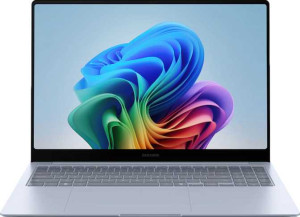
The Samsung Galaxy Book4 Edge 16″ includes a backlit keyboard, making it usable in low-light conditions, though it does not adopt a fanless design, meaning active cooling is present. The laptop is neither weather-sealed nor built to a rugged standard, so it is not rated for splashproof use or harsh physical environments.
Display:
| screen size |
16" |
| resolution |
2880 x 1800 px |
| pixel density |
212 ppi |
| has a touch screen |
✓ |
| refresh rate |
120Hz |
| has anti-reflection coating |
✓ |
| supported displays |
3 |
The display measures 16″ and renders at a 2880 x 1800 px resolution with a pixel density of 212 ppi, producing a fairly sharp visual output across the panel. It supports touch input and runs at a 120Hz refresh rate, which contributes to smoother on-screen motion during everyday use. An anti-reflection coating is also present to reduce glare, and the system can drive up to three external displays simultaneously.
Performance:
| RAM |
16GB |
| Uses flash storage |
✓ |
| internal storage |
1024GB |
| CPU speed |
12 x 3.8 GHz |
| CPU threads |
12 threads |
| Is an NVMe SSD |
✓ |
| DirectX version |
DirectX 12 |
| GPU clock speed |
500 MHz |
| uses multithreading |
✓ |
| maximum memory amount |
64GB |
| DDR memory version |
5 |
| turbo clock speed |
4.2GHz |
| GPU turbo |
1500 MHz |
| PCI Express (PCIe) version |
4 |
| semiconductor size |
4 nm |
| Supports 64-bit |
✓ |
The processor runs 12 threads at a base speed of 3.8GHz per core, with a turbo clock reaching 4.2GHz, and is manufactured on a 4nm process node with support for 64-bit computing and multithreading. The system ships with 16GB of DDR5 RAM, expandable up to a maximum of 64GB. Storage is handled by a 1024GB NVMe SSD connected over PCIe 4.0, offering flash-based performance across the full capacity. The integrated GPU has a base clock of 500MHz and a turbo frequency of 1500MHz, with DirectX 12 support rounding out the graphics capabilities.
Benchmarks:
| Geekbench 6 result (multi) |
14254 |
| Geekbench 6 result (single) |
2427 |
In Geekbench 6 testing, the Samsung Galaxy Book4 Edge 16″ recorded a multi-core score of 14,254 and a single-core score of 2,427, providing a measurable indication of how the processor handles both parallel workloads and single-threaded tasks respectively.
Connectivity:
| USB 3.2 Gen 2 ports (USB-A) |
1 |
| has an HDMI output |
✓ |
| Has USB Type-C |
✓ |
| supports Wi-Fi |
✓ |
| Wi-Fi version |
Wi-Fi 7 (802.11be), Wi-Fi 6E (802.11ax), Wi-Fi 6 (802.11ax), Wi-Fi 5 (802.11ac), Wi-Fi 4 (802.11n) |
| has an external memory slot |
✓ |
| Bluetooth version |
5.3 |
| RJ45 ports |
0 |
| HDMI ports |
1 |
| HDMI version |
HDMI 2.1 |
| DisplayPort outputs |
0 |
| has AirPlay |
✓ |
| mini DisplayPort outputs |
0 |
| has a VGA connector |
✕ |
Wireless connectivity is handled by Wi-Fi 7 (802.11be) alongside backward-compatible support for Wi-Fi 6E, 6, 5, and 4, paired with Bluetooth 5.3. For wired and display outputs, the laptop includes one USB 3.2 Gen 2 Type-A port, a USB Type-C port, and a single HDMI 2.1 output; there are no DisplayPort, mini DisplayPort, RJ45, or VGA connectors present. An external memory slot adds storage flexibility, and AirPlay is supported for wireless display streaming. The absence of an RJ45 port means wired Ethernet requires an adapter.
Battery:
| battery size |
61.8 Wh |
| Has sleep-and-charge USB ports |
✓ |
| Has a MagSafe power adapter |
✕ |
The Samsung Galaxy Book4 Edge 16″ is equipped with a 61.8 Wh battery and supports sleep-and-charge via its USB ports, allowing connected devices to be charged even when the laptop is not in active use. It does not use a MagSafe power adapter for charging.
Features:
| has stereo speakers |
✓ |
| has a socket for a 3.5 mm audio jack |
✓ |
| megapixels (front camera) |
2MP |
| supports ray tracing |
✕ |
| supports DLSS |
✕ |
| has Dolby Atmos |
✓ |
| Stylus included |
✕ |
| Has a fingerprint scanner |
✓ |
| number of microphones |
2 |
| Uses 3D facial recognition |
✕ |
| has voice commands |
✕ |
| has a front camera |
✓ |
| Has S/PDIF Out port |
✕ |
| has a gyroscope |
✕ |
| has GPS |
✕ |
| has an accelerometer |
✕ |
| has a compass |
✕ |
| Has an optical disc drive |
✕ |
Audio is handled by stereo speakers with Dolby Atmos support, complemented by a 3.5mm headset jack and two built-in microphones. A 2MP front camera is present for video calls, though the laptop does not include 3D facial recognition, voice commands, or a stylus. Security is covered by a fingerprint scanner, while motion and location sensing features — including a gyroscope, accelerometer, compass, and GPS — are absent. On the graphics side, neither ray tracing nor DLSS is supported, and there is no S/PDIF output or optical disc drive.
Miscellaneous:
| clock multiplier |
38 |
| upload speed |
3500 MBits/s |
| download speed |
10000 MBits/s |
| GPU name |
Adreno X1 |
| has 5G support |
✓ |
| Thermal Design Power (TDP) |
23W |
| Has TrustZone |
✓ |
| Has NX bit |
✓ |
| Has integrated LTE |
✓ |
| maximum memory bandwidth |
135 GB/s |
| memory channels |
8 |
| L2 cache |
12 MB |
| Uses big.LITTLE technology |
✕ |
| render output units (ROPs) |
6 |
| shading units |
1536 |
| Has integrated graphics |
✓ |
The integrated Adreno X1 GPU features 1536 shading units and 6 render output units (ROPs), operating within a 23W TDP envelope for the processor. Memory throughput reaches 135 GB/s across 8 channels, supported by 12MB of L2 cache and a clock multiplier of 38; the platform does not use big.LITTLE architecture. On the cellular side, the device includes both integrated LTE on the SoC and 5G support, with upload and download speeds rated at 3,500 MBits/s and 10,000 MBits/s respectively. Security features include TrustZone and NX bit support, adding hardware-level protections at the silicon layer.