Design:
| Type |
Productivity |
| weight |
1230 g |
| Uses a fanless design |
✕ |
| Has a backlit keyboard |
✓ |
| volume |
810.755784 cm³ |
| width |
312.3 mm |
| height |
223.8 mm |
| thickness |
11.6 mm |
| is weather-sealed (splashproof) |
✕ |
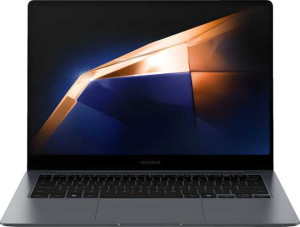
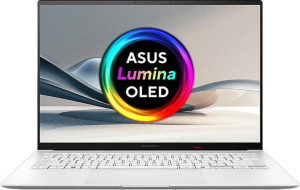
Designed as a productivity laptop, the chassis measures 312.3 mm wide, 223.8 mm tall, and just 11.6 mm thick, with a total weight of 1,230 g — a notably compact and lightweight physical form for a device in this category. It includes a backlit keyboard, but does not use a fanless cooling design and is not weather-sealed against splashes or moisture.
Display:
| screen size |
14" |
| resolution |
2880 x 1800 px |
| pixel density |
242.59 ppi |
| Display type |
OLED/AMOLED |
| has a touch screen |
✓ |
| refresh rate |
120Hz |
| has anti-reflection coating |
✓ |
| supported displays |
4 |
The 14-inch OLED/AMOLED panel resolves at 2880 x 1800 pixels with a pixel density of 242.59 ppi, producing a sharp and detailed image across the screen surface. It operates at a 120Hz refresh rate and supports touch input, while an anti-reflection coating helps manage glare in varied lighting conditions. The display configuration also supports up to four simultaneous external displays.
Performance:
| RAM |
16GB |
| Uses flash storage |
✓ |
| internal storage |
512GB |
| CPU speed |
4 x 1.2 & 8 x 0.7 GHz |
| CPU threads |
18 threads |
| Is an NVMe SSD |
✓ |
| DirectX version |
DirectX 12 |
| GPU clock speed |
300 MHz |
| uses multithreading |
✓ |
| maximum memory amount |
96GB |
| DDR memory version |
5 |
| turbo clock speed |
4.5GHz |
| GPU turbo |
2200 MHz |
| PCI Express (PCIe) version |
5 |
| semiconductor size |
7 nm |
| Supports 64-bit |
✓ |
The processor runs across 18 threads with core speeds of 4 x 1.2 GHz and 8 x 0.7 GHz, reaching a turbo clock speed of 4.5 GHz, and is built on a 7 nm process with multithreading and 64-bit support. The system ships with 16GB of DDR5 RAM expandable up to 96GB, paired with a 512GB NVMe SSD over a PCIe 5 interface using flash storage. On the graphics side, the integrated GPU has a base clock of 300 MHz boosting up to 2,200 MHz, with DirectX 12 support rounding out the compute and rendering capabilities.
Benchmarks:
| Geekbench 6 result (multi) |
10239 |
| Geekbench 6 result (single) |
2256 |
| PassMark result |
21104 |
| PassMark result (single) |
3400 |
In standardized benchmark testing, the laptop records a Geekbench 6 multi-core score of 10,239 and a single-core score of 2,256, reflecting the processor's threaded and per-core output respectively. The PassMark result stands at 21,104 overall, with a single-core PassMark score of 3,400, providing a broader picture of sustained CPU performance across varying workload types.
Connectivity:
| USB 3.2 Gen 2 ports (USB-C) |
0 |
| USB 3.2 Gen 2 ports (USB-A) |
1 |
| USB 4 20Gbps ports |
0 |
| USB 4 40Gbps ports |
2 |
| Thunderbolt 4 ports |
2 |
| USB 3.2 Gen 1 ports (USB-C) |
0 |
| USB 3.2 Gen 1 ports (USB-A) |
0 |
| Thunderbolt 3 ports |
0 |
| has an HDMI output |
✓ |
| supports Wi-Fi |
✓ |
| Wi-Fi version |
Wi-Fi 4 (802.11n), Wi-Fi 5 (802.11ac), Wi-Fi 6 (802.11ax), Wi-Fi 6E (802.11ax) |
| has an external memory slot |
✓ |
| Bluetooth version |
5.3 |
| RJ45 ports |
0 |
| HDMI ports |
1 |
| HDMI version |
HDMI 2.1 |
| DisplayPort outputs |
0 |
| USB 2.0 ports |
0 |
| has AirPlay |
✕ |
| mini DisplayPort outputs |
0 |
| has a VGA connector |
✕ |
The laptop's wired port selection includes two Thunderbolt 4 ports (which also serve as USB 4 40Gbps ports), one USB 3.2 Gen 2 Type-A port, and one HDMI 2.1 output, alongside an external memory slot for expandable storage. There are no RJ45, DisplayPort, VGA, mini DisplayPort, or USB 2.0 connections available, and AirPlay is not supported. On the wireless side, the device covers Wi-Fi 4 through Wi-Fi 6E and includes Bluetooth 5.3, providing broad compatibility across current wireless networking standards.
Battery:
| Has a MagSafe power adapter |
✕ |
Features:
| has stereo speakers |
✓ |
| has a socket for a 3.5 mm audio jack |
✓ |
| megapixels (front camera) |
2MP |
| has Dolby Atmos |
✓ |
| Has a fingerprint scanner |
✓ |
| number of microphones |
2 |
| Uses 3D facial recognition |
✓ |
| has voice commands |
✓ |
| has a front camera |
✓ |
| Has S/PDIF Out port |
✕ |
| has a gyroscope |
✕ |
| has GPS |
✕ |
| has an accelerometer |
✕ |
| has a compass |
✕ |
| Has an optical disc drive |
✕ |
The laptop includes stereo speakers with Dolby Atmos support, a 3.5 mm headset jack, and two built-in microphones, covering the core audio needs for calls and media playback. Security and authentication are handled through a fingerprint scanner and 3D facial recognition, complemented by voice command support. A 2MP front camera is present for video calls. The device does not include an S/PDIF output, optical disc drive, or motion sensors such as a gyroscope, accelerometer, or compass, and GPS is also absent.
Miscellaneous:
| clock multiplier |
36 |
| PassMark result (overclocked) |
22756 |
| render output units (ROPs) |
24 |
| texture mapping units (TMUs) |
48 |
| shading units |
768 |
| GPU execution units |
7 |
| Type |
Laptop |
| instruction sets |
MMX, F16C, FMA3, AES, AVX, AVX2, SSE 4.1, SSE 4.2 |
| L3 cache |
18 MB |
| Has an unlocked multiplier |
✕ |
| Has NX bit |
✓ |
| CPU temperature |
110 °C |
| OpenCL version |
3 |
| OpenGL version |
4.6 |
| Has integrated graphics |
✓ |
| Supports ECC memory |
✕ |
| memory channels |
2 |
| RAM speed (max) |
5600 MHz |
| Thermal Design Power (TDP) |
28W |
| Uses big.LITTLE technology |
✓ |
The laptop-class CPU operates with a clock multiplier of 36, an 18 MB L3 cache, a TDP of 28W, and a maximum rated temperature of 110 °C, using big.LITTLE technology to balance performance and efficiency across its core configuration. The multiplier is not unlocked, and ECC memory is not supported, though RAM can run at up to 5,600 MHz across two memory channels. Integrated graphics are present, with 768 shading units, 48 texture mapping units, and 24 render output units, supported by OpenCL 3 and OpenGL 4.6. The processor supports a broad set of instruction sets including AVX2, AES, FMA3, and SSE 4.2, and includes NX bit support for hardware-level memory protection. An overclocked PassMark score of 22,756 is also recorded for this configuration.