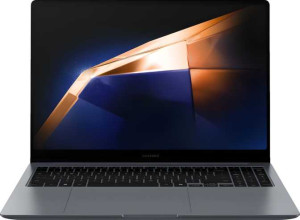
The Samsung Galaxy Book4 Ultra 16″ is classified as a productivity laptop with a physical footprint of 355.4 x 250.4 mm and a thickness of 16.5 mm, resulting in a total volume of roughly 1468.37 cm³. It weighs 1860 g and comes equipped with a backlit keyboard for comfortable use in low-light environments. The laptop does not use a fanless design and is not weather-sealed or splashproof. It carries a standard 1-year warranty.
The Galaxy Book4 Ultra 16″ features a 16″ OLED/AMOLED touchscreen with a resolution of 2880 x 1800 pixels, yielding a pixel density of 212.26 ppi for a sharp visual output. The display runs at a 120Hz refresh rate and includes an anti-reflection coating to reduce glare in brighter environments. The system supports up to 4 connected displays simultaneously, offering flexibility for multi-monitor setups.
The Galaxy Book4 Ultra 16″ is equipped with 16GB of DDR5 RAM, upgradeable to a maximum of 96GB, paired with a 1TB NVMe SSD using flash storage over a PCIe 4.0 interface. The CPU runs at speeds of 6 x 1.4 GHz and 8 x 0.9 GHz across 22 threads, with multithreading enabled and a turbo clock speed reaching 4.8GHz, built on a 4 nm semiconductor process with 64-bit support. On the graphics side, the GPU carries 6GB of GDDR6 VRAM, a base clock of 1605 MHz boosting up to 2370 MHz, and delivers 12.13 TFLOPS of floating-point performance alongside a texture rate of 204.8 GTexels/s, a pixel rate of 113.76 GPixel/s, and support for DirectX 12 Ultimate; XeSS (XMX) is not supported on this configuration.
In PassMark testing, the Galaxy Book4 Ultra 16″ achieves an overall score of 24,879, with a single-core result of 3,468 reflecting the per-core throughput of the CPU. The GPU registers a PassMark G3D score of 17,148, providing a standardized indication of its graphics processing capability.
The Galaxy Book4 Ultra 16″ offers a focused but capable port selection, headlined by two Thunderbolt 4 ports that also function as USB 4 40Gbps connections, alongside a single USB 3.2 Gen 2 Type-A port; there are no USB-C Gen 1 or Gen 2 ports, no USB 2.0 ports, and no RJ45 ethernet port. Video output is handled by one HDMI 2.1a port, while DisplayPort, mini DisplayPort, and VGA outputs are absent. Wireless connectivity covers Wi-Fi 4, 5, 6, and 6E standards along with Bluetooth 5.3, and the laptop includes an external memory slot for expandable storage. AirPlay is not supported.
The Galaxy Book4 Ultra 16″ is fitted with a 76 Wh battery to support extended use between charges. The laptop does not include a MagSafe power adapter.
The Galaxy Book4 Ultra 16″ includes stereo speakers with Dolby Atmos support and a 3.5 mm headset jack, while audio input is handled by a dual-microphone setup with voice command functionality. Security is covered through both a fingerprint scanner and 3D facial recognition. The front-facing camera captures at 2MP, and the GPU supports ray tracing and DLSS for enhanced graphics rendering. The laptop does not include an S/PDIF output, optical disc drive, or motion and location sensors such as a gyroscope, accelerometer, compass, or GPS.
The CPU in the Galaxy Book4 Ultra 16″ uses a BGA 2049 socket, a clock multiplier of 38, a 24 MB L3 cache, and a thermal design power of 115W, with a maximum operating temperature of 110°C; it supports big.LITTLE technology, NX bit, ECC memory, and instruction sets including MMX, F16C, FMA3, AES, AVX, AVX2, SSE 4.1, and SSE 4.2, though the multiplier is not unlocked. The system also features integrated graphics alongside the discrete GPU, with RAM running across 2 memory channels at up to 7467 MHz. On the GPU side, the Ada Lovelace architecture delivers 2560 shading units, 80 texture mapping units, 48 ROPs, and 8 execution units, backed by a 96-bit memory bus running at 2000 MHz with an effective speed of 16000 MHz and a maximum bandwidth of 192 GB/s; Intel Resizable BAR is supported, LHR is not present, and the GPU supports multi-display output, stereoscopic 3D, and Double Precision Floating Point. The chip is built with 18,900 million transistors and supports OpenCL 3 and OpenGL 4.6, while the overclocked PassMark result stands at 24,880.