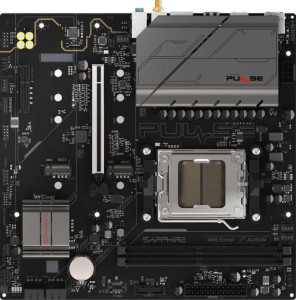
Sapphire Pulse A620AM specifications and in-depth review

Sapphire Pulse A620AM

Manufacturer: Sapphire

The Sapphire Pulse A620AM is a Micro-ATX motherboard designed for high-performance builds. It supports the AM5 CPU socket and features 64GB maximum memory capacity, making it suitable for demanding tasks.

This motherboard offers a range of technical features, including 2 M.2 sockets for fast storage and a PCIe 4.0 x16 slot for powerful graphics cards. It also supports dual-channel DDR5 memory and provides multiple USB 2.0 and 3.2 Gen 1 ports for connectivity.

Pros
  • Supports easy overclocking for users looking to enhance performance.
  • Offers 2 M.2 sockets for fast storage expansion.
  • Provides 64GB maximum memory capacity for substantial RAM support.
Cons
  • Lacks support for Wi-Fi and Bluetooth connectivity.
  • No integrated graphics, requiring a dedicated GPU for display output.
  • Does not support RAID 0+1 for users seeking redundancy or performance configurations.
  • No USB Type-C or Thunderbolt ports for faster data transfer speeds.
Who is this for?

The Sapphire Pulse A620AM motherboard is ideal for users seeking a reliable and efficient Micro-ATX platform with a focus on performance and expansion. Its easy overclocking support makes it a good choice for enthusiasts looking to boost CPU and memory speeds. Additionally, the 64GB maximum memory capacity and 2 M.2 sockets provide sufficient scalability for users working on memory-intensive tasks or high-performance storage setups.

Who is this NOT for?

This motherboard is not suitable for users who require built-in Wi-Fi, Bluetooth, or integrated graphics, as it lacks these features. It also doesn't support RAID 0+1, making it less suitable for those seeking redundancy or performance-focused storage configurations. Additionally, the absence of USB Type-C and Thunderbolt ports limits its potential for high-speed data transfer, which could be a drawback for users needing these advanced connection options.

General info:

CPU socket AM5
form factor Micro-ATX
release date April 2025
supports Wi-Fi
Has Bluetooth
Easy to overclock
has RGB lighting
Easy to reset BIOS
Has dual BIOS
CPU sockets 1
Has integrated graphics
warranty period 3 years
height 235 mm
width 244 mm
Has integrated CPU

The Sapphire Pulse A620AM motherboard is a Micro-ATX form factor model with an AM5 CPU socket, supporting a single CPU socket. It does not include integrated graphics or support Bluetooth and Wi-Fi, but it features easy overclocking capabilities. The motherboard is designed without RGB lighting or dual BIOS support, and it does not offer an easy BIOS reset. With a 3-year warranty period, this motherboard measures 235mm in height and 244mm in width.

Memory:

maximum memory amount 64GB
overclocked RAM speed 7600 MHz
memory slots 2
DDR memory version 5
memory channels 2
Supports ECC memory

The Sapphire Pulse A620AM motherboard supports a maximum memory capacity of 64GB and features 2 memory slots with dual-channel configuration. It supports DDR5 memory at speeds up to 7600 MHz, though it does not support ECC memory for error correction. This design provides flexibility for high-performance RAM configurations.

Ports:

USB 3.2 Gen 2 ports (USB-A) 0
USB 3.2 Gen 1 ports (USB-A) 2
USB 3.2 Gen 2 ports (USB-C) 0
USB 3.2 Gen 1 ports (USB-C) 0
USB 2.0 ports 4
USB 3.2 Gen 2x2 ports 0
USB 4 40Gbps ports 0
USB 4 20Gbps ports 0
Thunderbolt 4 ports 0
Thunderbolt 3 ports 0
has an HDMI output
DisplayPort outputs 1
RJ45 ports 1
Has USB Type-C
eSATA ports 0
DVI outputs 0
has a VGA connector
PS/2 ports 1

The Sapphire Pulse A620AM motherboard offers a range of ports for connectivity, including 1 HDMI output and 1 DisplayPort output for video display. It features 4 USB 2.0 ports and 2 USB 3.2 Gen 1 ports (USB-A), while lacking USB Type-C and higher-speed USB 3.2 Gen 2 or Thunderbolt ports. Additionally, it provides 1 RJ45 port for network connectivity and 1 PS/2 port for legacy peripherals.

Connectors:

USB 3.2 Gen 1 ports (through expansion) 2
USB 2.0 ports (through expansion) 4
SATA 3 connectors 4
USB 3.0 ports (through expansion) 2
M.2 sockets 2
U.2 sockets 0
Has mSATA connector
SATA 2 connectors 0

The Sapphire Pulse A620AM motherboard provides several key connectors for expansion, including 2 M.2 sockets for high-speed storage. It also offers 4 SATA 3 connectors for traditional drives and additional support for 2 USB 3.0 ports and 4 USB 2.0 ports through expansion. Notably, it lacks mSATA and U.2 connectors, which may limit certain types of storage expansion.

Expansion slots:

PCIe 4.0 x16 slots 1
PCIe 5.0 x16 slots 0
PCIe 3.0 x16 slots 0
PCIe x1 slots 0
PCI slots 0
PCIe 2.0 x16 slots 0
PCIe x4 slots 1
PCIe x8 slots 0

The Sapphire Pulse A620AM motherboard offers a variety of expansion slots, including 1 PCIe 4.0 x16 slot for high-speed graphics cards and 1 PCIe x4 slot for additional expansion cards. However, it does not include any PCIe 5.0, PCIe 3.0, PCIe 2.0 x16, PCIe x1, PCI x, or PCIe x8 slots, limiting some options for expansion.

Audio:

audio channels 5.1
Has S/PDIF Out port
audio connectors 3

The Sapphire Pulse A620AM motherboard supports 5.1 audio channels for a solid audio experience. It includes 3 audio connectors for connecting speakers or headphones, but it does not feature an S/PDIF Out port for digital audio output.

Storage:

Supports RAID 0+1

The Sapphire Pulse A620AM motherboard does not support RAID 0+1, limiting its RAID options for redundancy or performance. This may affect users seeking specific RAID configurations for storage.

Final Verdict

The Sapphire Pulse A620AM motherboard is a solid choice for users seeking a reliable Micro-ATX platform with room for performance expansion. With support for easy overclocking and a generous 64GB maximum memory capacity, it offers flexibility for enthusiasts and those requiring substantial memory support. While it lacks features like Wi-Fi, Bluetooth, and integrated graphics, it still delivers strong performance for users focused on a traditional, expandable desktop setup. Overall, it’s best suited for users who prioritize stable, high-performance computing without the need for advanced connectivity options.