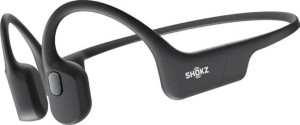
The Shokz OpenRun Air use an open-ear, bone conduction fit and come in a neckband configuration with wingtips included for a more secure hold during activity. They weigh just 26 g and carry an IP67 rating, offering protection against sweat and water immersion. Stereo sound is supported, and while the earbuds are not true wireless, the neckband design keeps the setup cable-free between the two transducers.
The Shokz OpenRun Air covers a frequency range of 20 Hz to 20000 Hz, spanning the full standard range of human hearing. It does not include active noise cancellation or passive noise isolation, meaning environmental sound remains audible during use — a characteristic inherent to its open-ear design. The transducers do not use a neodymium magnet.
The Shokz OpenRun Air is equipped with a rechargeable battery rated for 8 hours of use, with a full charge taking 1.5 hours. A battery level indicator is present to keep users informed of remaining charge. Wireless charging is not supported, so the device requires a wired connection to charge.
The Shokz OpenRun Air connects wirelessly via Bluetooth 5.1 with a maximum range of 10 m, but does not support any enhanced audio codecs — AAC, aptX, aptX HD, aptX Adaptive, aptX Low Latency, aptX Lossless, aptX Voice, and LDAC are all absent. NFC pairing and fast pairing are not available, and the device does not use a USB Type-C connector for charging or data. The connection is wireless-only, with no wired audio option.
The Shokz OpenRun Air supports fast charging and can function as a headset for calls, with a mute function available during conversations. Playback and call controls are accessible through both an in-line control panel and on-device controls, and voice prompts provide audio feedback for actions and status updates. Ambient sound mode, in/on-ear detection, and a find-device feature are not included, nor is a travel bag or a body temperature sensor.
The Shokz OpenRun Air features two microphones with noise-canceling capability, helping to reduce background noise during calls for clearer voice transmission.