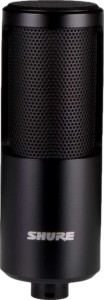
Shure SM4 specifications and in-depth review

Shure SM4

Manufacturer: Shure

The Shure SM4 is a cardioid condenser microphone built around a traditional XLR connection, making it a straightforward choice for studio setups and desktop recording rigs that rely on audio interfaces or mixing consoles. It ships with a pop filter included, which is a practical touch for vocal work right out of the box. At 463 g and standing 254.7 mm tall, the SM4 has a solid, substantial build without being unwieldy.

On the technical side, the SM4 covers a frequency range of 20 Hz to 20,000 Hz and can handle sound pressure levels up to 145 dB, giving it meaningful headroom for louder sound sources. It operates with a single cardioid polar pattern and presents a headphone output impedance of 150 Ohms. The microphone is compatible with Windows and Mac OS X systems, though it does not offer native support for iOS or Android devices, and it lacks features such as onboard muting, RGB lighting, or multi-pattern switching.

Pros
  • Covers the full audible frequency range from 20 Hz to 20,000 Hz, capturing both low-end depth and high-frequency detail
  • Handles sound pressure levels up to 145 dB, providing significant headroom for louder sound sources
  • A pop filter is included in the box, reducing the need for additional accessories for vocal recording
  • Compatible with both Windows and Mac OS X, making it usable across the two most common desktop operating systems
  • The XLR connection suits professional recording environments that use audio interfaces or mixing consoles
Cons
  • No shock mount is included, requiring a separate purchase for vibration isolation
  • Lacks a mute button, meaning audio control must be managed at the interface or software level
  • Not compatible with Android or iOS devices, ruling out mobile recording workflows
  • Offers only a single cardioid polar pattern with no option to switch to omni, bidirectional, or hyper-cardioid modes
  • No headphone jack is present on the microphone itself, so direct zero-latency monitoring is not possible through the unit
  • At 463 g, the microphone has a notable weight that may require a sturdy stand or arm for stable positioning
Who is this for?

The Shure SM4 is well suited to desktop recording environments where a traditional XLR-based signal chain is already in place, such as home studios or broadcast setups using an audio interface or mixing console. Its full 20 Hz to 20,000 Hz frequency response and 145 dB SPL handling make it a practical choice for recording vocals or instruments that benefit from wide dynamic range capture. Users on Windows or Mac OS X systems who want a straightforward, no-frills microphone without onboard controls or software dependencies will find the SM4 a natural fit.

Who is this NOT for?

The SM4 is not a suitable choice for users looking to record directly with a smartphone or tablet, as it offers no compatibility with Android or iOS devices and has no built-in mobile connection option. Those who need flexible pickup options will also find it limiting, since the microphone is fixed to a single cardioid pattern with no ability to switch to omni or bidirectional modes — making it unsuitable for multi-directional or room recording scenarios. Additionally, users who require onboard monitoring or direct headphone output will need to look elsewhere, as the SM4 includes no headphone jack for zero-latency playback.

Sound quality:

Connection XLR
lowest mic frequency 20 Hz
sound pressure level 145dB
highest mic frequency 20000 Hz

The Shure SM4 connects via XLR, positioning it squarely within traditional wired recording setups. It covers a frequency range of 20 Hz to 20,000 Hz, spanning the full breadth of human hearing from the lowest audible bass to the highest treble detail. Complementing this, the microphone supports a maximum sound pressure level of 145 dB, providing substantial headroom when capturing louder sound sources without distortion.

Features:

number of polar patterns 1
has cardioid pattern
has a mute function
has omni pattern
Is compatible with Android
Is compatible with iOS
Is compatible with Windows
Is compatible with Mac OS X
has hyper-cardioid pattern
has flat DSP mode
has bidirectional pattern

The Shure SM4 offers a single cardioid polar pattern, with no support for omni, hyper-cardioid, or bidirectional pickup modes. There is no onboard mute function, nor does it include a flat DSP mode. In terms of platform compatibility, the microphone works with Windows and Mac OS X, but it does not support Android or iOS devices.

Headphone output:

has a socket for a 3.5 mm audio jack
impedance 150 Ohms
Has a connector for a 6.35 mm audio jack

The Shure SM4 headphone output carries an impedance of 150 Ohms, and the microphone does not include either a 3.5 mm or a 6.35 mm headphone jack, meaning direct headphone monitoring is not available through the device itself.

Design:

shock mount included
pop filter included
control panel placed on a device
Has LED sound level indicator
has RGB lighting
has an integrated touchpad
volume 2404.368 cm³
weight 463 g
height 254.7 mm
thickness 80 mm
width 118 mm

The Shure SM4 measures 254.7 mm in height, 118 mm in width, and 80 mm in thickness, with a total volume of 2404.368 cm³ and a weight of 463 g. A pop filter is included in the package, though no shock mount is bundled with the microphone. The design is straightforward and utilitarian — there is no onboard control panel, no LED sound level indicator, no RGB lighting, and no integrated touchpad.

Final Verdict

The Shure SM4 is a focused, no-frills XLR microphone built for users who already operate within a traditional wired recording setup. Its full-range frequency response paired with 145 dB SPL handling gives it genuine technical credibility for vocal and instrument recording in controlled environments, and the inclusion of a pop filter adds immediate practical value. That said, it is deliberately limited in scope — no mobile compatibility, no pattern switching, no onboard monitoring — which means it serves a specific kind of user rather than a broad one. For anyone working within a desktop studio running Windows or Mac OS X with an established audio interface, the SM4 presents a capable and straightforward option; those needing more flexibility in connectivity or pickup behavior will need to look at a different class of microphone entirely.