Skytech Aqua (R7 7800X3D / RX 9060 XT / 32GB RAM / 1TB SSD) specifications and in-depth review

Skytech Aqua (R7 7800X3D / RX 9060 XT / 32GB RAM / 1TB SSD)

Manufacturer: Skytech

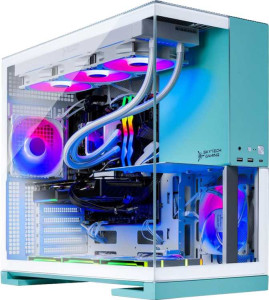
The Skytech Aqua is a desktop gaming PC built around the AMD Ryzen 7 7800X3D processor and the RX 9060 XT graphics card. It ships with 32GB of DDR5 memory running at 6000 MHz and a 1TB NVMe SSD, housed in an ATX form factor chassis measuring 480 mm × 440 mm × 242 mm. The system supports Wi-Fi and Bluetooth, and includes a range of USB ports alongside a single RJ45 port for wired networking. A one-year warranty is included.

On the graphics side, the RX 9060 XT is based on the RDNA 4.0 architecture built on a 4 nm process node, featuring 2048 shading units, 128 TMUs, and 64 ROPs. It carries 16GB of GDDR6 memory across a 128-bit bus with an effective memory speed of 20000 MHz and a maximum bandwidth of 320 GB/s. The card delivers 25.6 TFLOPS of floating-point performance, supports ray tracing, DirectX 12 Ultimate, FSR4, and AMD SAM, and can drive up to three displays simultaneously via three DisplayPort outputs and one HDMI 2.1 port. The Ryzen 7 7800X3D runs eight cores across 16 threads at a base clock of 4.2 GHz with a turbo of 5 GHz, backed by 96 MB of L3 cache, and scores 34295 in PassMark multi-thread testing.

Pros
  • The RX 9060 XT carries 16GB of GDDR6 VRAM, which is a generous amount for a 128-bit bus card and benefits memory-intensive workloads and higher-resolution textures
  • The Ryzen 7 7800X3D features a massive 96MB L3 cache, which is particularly beneficial for gaming workloads that are sensitive to memory latency
  • 32GB of DDR5 RAM running at 6000 MHz provides ample headroom for multitasking and memory-hungry applications
  • The system supports up to four simultaneous display outputs — three DisplayPort and one HDMI 2.1 — making it suitable for multi-monitor setups
  • FSR4 and AMD SAM support on the GPU side work together to help improve frame output in compatible titles
  • The 1TB NVMe SSD delivers fast storage access, and the AM5 platform supports up to 128GB of memory, leaving room for future upgrades
Cons
  • The GPU uses a 128-bit memory bus, which is relatively narrow and may limit memory bandwidth in sustained workloads despite the high effective memory speed
  • There are no USB-C ports accessible externally, and no USB 4 or Thunderbolt connectivity of any kind
  • DLSS is not supported, which rules out that upscaling option for users who prefer it
  • The maximum supported RAM speed is listed as 5200 MHz, which sits below the installed kit's 6000 MHz speed, suggesting the rated speed may require XMP or EXPO to be enabled
  • The warranty period covers only one year, which is shorter than what some competing desktop systems offer in the same category
Who is this for?

This system is well-suited to users who want a capable gaming desktop that can handle demanding titles at high resolutions, given the RX 9060 XT's 16GB of VRAM, RDNA 4.0 architecture, FSR4 support, and the Ryzen 7 7800X3D's large 96MB L3 cache, which is particularly advantageous in game scenarios sensitive to cache latency. The 32GB of DDR5 RAM at 6000 MHz and 1TB NVMe SSD also make it a reasonable fit for users who mix gaming with content creation or heavy multitasking. Those looking to run a multi-monitor setup will find the four available display outputs — three DisplayPort and one HDMI 2.1 — practical for productivity or immersive gaming configurations.

Who is this NOT for?

Users who require high-bandwidth GPU memory performance for tasks such as large-scale 3D rendering or AI workloads may find the 128-bit memory bus a limiting factor despite the card's 16GB VRAM. The absence of USB 4 and Thunderbolt ports makes this system a poor fit for professionals who rely on high-speed external device connectivity, such as those working with fast external storage arrays or specialized peripherals. Additionally, users with a strong preference for DLSS-based upscaling will find no support for it here, as that technology is not available on this platform.

General info:

SSD storage capacity 1000GB
form factor ATX
Is an NVMe SSD
volume 51110.4 cm³
thickness 480 mm
height 440 mm
width 242 mm

The Skytech Aqua uses an ATX form factor chassis with dimensions of 480 mm (thickness) × 440 mm (height) × 242 mm (width), giving it a total volume of 51110.4 cm³. Storage is handled by a 1TB NVMe SSD, providing fast data access through the NVMe interface.

Graphics card:

VRAM 16GB
floating-point performance 25.6 TFLOPS
effective memory speed 20000 MHz
GPU clock speed 1700 MHz
GPU memory speed 2518 MHz
GPU turbo 3130 MHz
GDDR version GDDR6
DirectX version DirectX 12 Ultimate
PCI Express (PCIe) version 5
supports ray tracing
texture rate 400.6 GTexels/s
pixel rate 200.3 GPixel/s
maximum memory bandwidth 320 GB/s
memory bus width 128-bit
supports DLSS
supported displays 3
semiconductor size 4 nm
texture mapping units (TMUs) 128
shading units 2048
render output units (ROPs) 64
OpenGL version 4.6
OpenCL version 2.2
has LHR
Supports multi-display technology
Has Double Precision Floating Point (DPFP)
Supports 3D
has RGB lighting
number of transistors 29700 million

The graphics card is equipped with 16GB of GDDR6 VRAM across a 128-bit memory bus, with an effective memory speed of 20000 MHz, a raw memory speed of 2518 MHz, and a maximum bandwidth of 320 GB/s. It delivers 25.6 TFLOPS of floating-point performance, a texture rate of 400.6 GTexels/s, and a pixel rate of 200.3 GPixel/s, backed by 2048 shading units, 128 TMUs, and 64 ROPs built on a 4 nm process node housing 29700 million transistors. The base GPU clock runs at 1700 MHz and boosts up to 3130 MHz via turbo. The card supports DirectX 12 Ultimate, OpenGL 4.6, OpenCL 2.2, ray tracing, double precision floating point, stereoscopic 3D, and multi-display output for up to three screens simultaneously, and connects via PCIe 5. It does not support DLSS, LHR, or RGB lighting.

CPU:

CPU speed 8 x 4.2 GHz
Has integrated graphics
Has an unlocked multiplier
L1 cache 512 KB
L2 cache 8 MB
L3 cache 96 MB
turbo clock speed 5GHz
CPU threads 16 threads
uses multithreading
clock multiplier 42
L2 core 1 MB/core
L3 core 12 MB/core
Supports 64-bit
CPU temperature 89 °C

The CPU runs 8 cores at a base speed of 4.2 GHz per core and boosts up to 5 GHz via turbo, with a clock multiplier of 42. It supports multithreading for a total of 16 threads and is 64-bit compatible, though it does not have an unlocked multiplier. Cache memory is organized across three levels — 512 KB of L1, 8 MB of L2 (1 MB per core), and 96 MB of L3 (12 MB per core). The processor includes integrated graphics and has a maximum operating temperature of 89 °C.

Benchmarks:

Geekbench 6 result (multi) 15100
Geekbench 6 result (single) 2725
PassMark result 34295
PassMark result (single) 3759
PassMark result (overclocked) 35590

In Geekbench 6, the system scores 2725 in the single-core test and 15100 in the multi-core test. PassMark results show a single-core score of 3759, a multi-thread score of 34295, and an overclocked result of 35590.

Memory:

RAM 32GB
RAM speed 6000 MHz
DDR memory version 5

The system comes with 32GB of DDR5 RAM running at a speed of 6000 MHz.

Connectivity:

supports Wi-Fi
USB 2.0 ports 2
USB 3.2 Gen 2 ports (USB-A) 1
USB 3.2 Gen 1 ports (USB-A) 2
USB 3.2 Gen 2 ports (USB-C) 0
USB 4 40Gbps ports 0
USB 4 20Gbps ports 0
USB 3.2 Gen 2x2 ports 0
USB 3.2 Gen 1 ports (USB-C) 1
RJ45 ports 1
Thunderbolt 4 ports 0
Thunderbolt 3 ports 0
DisplayPort outputs 3
HDMI version HDMI 2.1
HDMI ports 1
Has Bluetooth
DVI outputs 0
Has S/PDIF Out port
has a socket for a 3.5 mm audio jack
has a VGA connector

The system supports Wi-Fi and Bluetooth for wireless connectivity, along with a single RJ45 port for wired networking. USB ports include two USB 2.0, two USB 3.2 Gen 1 (USB-A), one USB 3.2 Gen 2 (USB-A), and one USB 3.2 Gen 1 (USB-C); there are no USB 3.2 Gen 2 USB-C, USB 4, or Thunderbolt ports of any kind. Display output is handled by three DisplayPort connectors and one HDMI 2.1 port, with no DVI or VGA outputs present. Audio connectivity includes a 3.5 mm headset jack and an S/PDIF out port.

Miscellaneous:

has an HDMI output
has FSR4
AMD SAM / Intel Resizable BAR AMD SAM
GPU architecture RDNA 4.0
USB-C ports 0
Has air-water cooling
Thermal Design Power (TDP) 160W
mini DisplayPort outputs 0
Supports ECC memory
has XeSS (XMX)
chipset X670, B650, X870, B840, B850
Type Desktop
CPU socket AM5
Has NX bit
GPU execution units 2
maximum memory amount 128GB
memory channels 2
instruction sets SSE 4.2, SSE 4.1, AVX, AES, FMA3, F16C, MMX
RAM speed (max) 5200 MHz
warranty period 1 years

The GPU is based on the RDNA 4.0 architecture with 2 execution units, supports FSR4, HDMI output, and AMD SAM (Smart Access Memory), but does not include XeSS (XMX) or mini DisplayPort outputs. The desktop-class CPU uses an AM5 socket with a TDP of 160W, supports the NX bit, ECC memory, and dual memory channels, with a maximum supported RAM speed of 5200 MHz and a memory ceiling of 128GB. Compatible chipsets include X670, B650, X870, B840, and B850. The processor supports instruction sets covering SSE 4.1, SSE 4.2, AVX, AES, FMA3, F16C, and MMX. There are no USB-C ports, no air or water cooling solution included, and the system carries a one-year warranty.
Final Verdict

The Skytech Aqua (R7 7800X3D / RX 9060 XT) is a well-rounded gaming desktop that brings together a cache-heavy processor and a modern RDNA 4.0 GPU in an ATX package suited to both dedicated gaming and light creative work. Its 96MB L3 cache paired with 32GB of DDR5 RAM gives it a meaningful edge in latency-sensitive workloads, while the RX 9060 XT's 16GB of VRAM and FSR4 support extend its usefulness across a range of titles and display configurations. Connectivity limitations — particularly the narrow 128-bit memory bus and the absence of USB 4 or Thunderbolt — mean it is best matched to users whose workflows stay within its defined boundaries. For those it does suit, it delivers a coherent and capable gaming platform backed by a modern AM5 foundation with room to expand memory down the line.