General info:
| SSD storage capacity |
2000GB |
| form factor |
ATX |
| Is an NVMe SSD |
✓ |
| volume |
41306.415 cm³ |
| thickness |
421 mm |
| height |
465 mm |
| width |
211 mm |
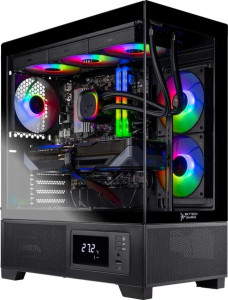
The Skytech Azure 3 Plus is built around a full ATX form factor and houses a 2TB NVMe SSD for fast storage access. The chassis measures 465 mm in height, 211 mm in width, and 421 mm in depth, resulting in a total volume of 41,306.415 cm³, making it a standard-sized full tower suitable for desktop placement.
Graphics card:
| VRAM |
16GB |
| floating-point performance |
48.7 TFLOPS |
| effective memory speed |
20000 MHz |
| GPU clock speed |
1660 MHz |
| GPU memory speed |
2518 MHz |
| GPU turbo |
2200 MHz |
| GDDR version |
GDDR6 |
| DirectX version |
DirectX 12 Ultimate |
| PCI Express (PCIe) version |
5 |
| supports ray tracing |
✓ |
| texture rate |
760.3 GTexels/s |
| pixel rate |
380.2 GPixel/s |
| maximum memory bandwidth |
640 GB/s |
| memory bus width |
256-bit |
| supported displays |
4 |
| semiconductor size |
4 nm |
| texture mapping units (TMUs) |
256 |
| shading units |
4096 |
| render output units (ROPs) |
128 |
| OpenGL version |
4.6 |
| OpenCL version |
2.2 |
| has LHR |
✕ |
| Supports multi-display technology |
✓ |
| Has Double Precision Floating Point (DPFP) |
✓ |
| Supports 3D |
✓ |
| has RGB lighting |
✕ |
| number of transistors |
8315 million |
The graphics card features 16GB of GDDR6 VRAM across a 256-bit memory bus, delivering a maximum memory bandwidth of 640 GB/s with an effective memory speed of 20,000 MHz and a raw memory speed of 2,518 MHz. Built on a 4 nm semiconductor process with 8,315 million transistors, it operates at a base clock of 1,660 MHz and boosts up to 2,200 MHz, producing 48.7 TFLOPS of floating-point performance alongside a texture rate of 760.3 GTexels/s and a pixel rate of 380.2 GPixel/s. The card includes 4,096 shading units, 256 texture mapping units, and 128 render output units, and connects via PCIe 5.0. It supports DirectX 12 Ultimate, OpenGL 4.6, OpenCL 2.2, ray tracing, double precision floating point, stereoscopic 3D, and multi-display output across up to four screens simultaneously. The card does not include RGB lighting and does not carry an LHR designation.
CPU:
| CPU speed |
8 x 4.7 GHz |
| Has integrated graphics |
✓ |
| Has an unlocked multiplier |
✓ |
| L1 cache |
640 KB |
| L2 cache |
8 MB |
| L3 cache |
96 MB |
| turbo clock speed |
5.2GHz |
| CPU threads |
16 threads |
| uses multithreading |
✓ |
| clock multiplier |
47 |
| L2 core |
1 MB/core |
| L3 core |
12 MB/core |
| Supports 64-bit |
✓ |
| CPU temperature |
95 °C |
The CPU runs eight cores at 4.7 GHz with a turbo clock speed of 5.2 GHz and a clock multiplier of 47, supported by 16 threads through multithreading. It carries a 96 MB L3 cache (12 MB per core), an 8 MB L2 cache (1 MB per core), and 640 KB of L1 cache, providing a deep cache hierarchy for data-intensive tasks. The processor features an unlocked multiplier, integrated graphics, 64-bit support, and has a maximum operating temperature of 95 °C.
Benchmarks:
| Geekbench 6 result (multi) |
18411 |
| Geekbench 6 result (single) |
3341 |
| PassMark (G3D) result |
26869 |
| PassMark result |
40005 |
| PassMark result (single) |
4430 |
| PassMark result (overclocked) |
41293 |
| Cinebench R20 (single) result |
820 |
| Cinebench R20 (multi) result |
9072 |
In CPU benchmarks, the system scores 18,411 in Geekbench 6 multi-core and 3,341 in the single-core test, while Cinebench R20 results come in at 9,072 for multi-core and 820 for single-core. On the PassMark side, the overall result reaches 40,005, with a single-core score of 4,430 and an overclocked result of 41,293. The GPU registers a PassMark G3D score of 26,869, rounding out a broad set of benchmark data across both processor and graphics performance.
Memory:
| RAM |
32GB |
| RAM speed |
6000 MHz |
| DDR memory version |
5 |
The system is equipped with 32GB of DDR5 RAM running at 6,000 MHz, providing a fast and modern memory configuration suited to demanding desktop workloads and gaming applications.
Connectivity:
| supports Wi-Fi |
✓ |
| USB 2.0 ports |
3 |
| USB 3.2 Gen 2 ports (USB-A) |
1 |
| USB 3.2 Gen 1 ports (USB-A) |
3 |
| USB 3.2 Gen 2 ports (USB-C) |
1 |
| USB 4 40Gbps ports |
0 |
| USB 4 20Gbps ports |
0 |
| USB 3.2 Gen 2x2 ports |
0 |
| USB 3.2 Gen 1 ports (USB-C) |
0 |
| RJ45 ports |
1 |
| Thunderbolt 4 ports |
0 |
| Thunderbolt 3 ports |
0 |
| DisplayPort outputs |
3 |
| HDMI version |
HDMI 2.1 |
| HDMI ports |
1 |
| Has Bluetooth |
✓ |
| Bluetooth version |
5.2 |
| DVI outputs |
0 |
| Has S/PDIF Out port |
✓ |
| has a socket for a 3.5 mm audio jack |
✓ |
| has a VGA connector |
✕ |
The system supports Wi-Fi and Bluetooth 5.2 for wireless connectivity, alongside a single RJ45 port for wired Ethernet. USB ports include three USB 2.0, three USB 3.2 Gen 1 Type-A, one USB 3.2 Gen 2 Type-A, and one USB 3.2 Gen 2 Type-C; there are no USB 4, USB 3.2 Gen 2x2, Thunderbolt 3, or Thunderbolt 4 ports present. Display output is handled through three DisplayPort outputs and one HDMI 2.1 port, with no DVI or VGA connectors available. Audio connectivity includes a 3.5 mm headset jack and an S/PDIF Out port.
Miscellaneous:
| has an HDMI output |
✓ |
| Type |
Desktop |
| CPU socket |
AM5 |
| chipset |
X670, B650, X870 |
| Uses big.LITTLE technology |
✕ |
| instruction sets |
MMX, F16C, FMA3, AES, AVX, AVX2, SSE 4.1, SSE 4.2 |
| Has NX bit |
✓ |
| Supports ECC memory |
✓ |
| memory channels |
2 |
| RAM speed (max) |
5600 MHz |
| maximum memory amount |
192GB |
| Thermal Design Power (TDP) |
120W |
| AMD SAM / Intel Resizable BAR |
AMD SAM |
| GPU architecture |
RDNA 4.0 |
| has FSR4 |
✓ |
| USB-C ports |
0 |
| Has air-water cooling |
✕ |
| mini DisplayPort outputs |
0 |
| has XeSS (XMX) |
✕ |
| warranty period |
1 years |
The desktop CPU uses an AM5 socket and is compatible with X670, B650, and X870 chipsets, with a thermal design power of 120W. It supports dual-channel memory up to 192GB, is rated for a maximum RAM speed of 5,600 MHz, and is compatible with ECC memory. The processor includes NX bit support and covers a broad set of instruction sets — MMX, F16C, FMA3, AES, AVX, AVX2, SSE 4.1, and SSE 4.2 — but does not use big.LITTLE technology. The GPU is based on the RDNA 4.0 architecture and supports AMD SAM (Resizable BAR) and FSR4, while XeSS is not supported. The system includes an HDMI output, has no mini DisplayPort outputs, no USB-C ports, and does not include air-water cooling. A one-year warranty is provided.