Skytech Azure 3 Plus (R7 9800X3D / RTX 5080 / 32GB RAM / 1TB SSD) specifications and in-depth review

Skytech Azure 3 Plus (R7 9800X3D / RTX 5080 / 32GB RAM / 1TB SSD)

Manufacturer: Skytech

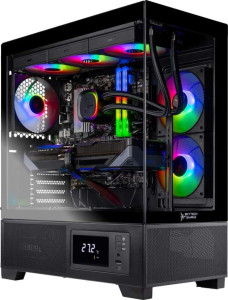
The Skytech Azure 3 Plus (R7 9800X3D / RTX 5080 / 32GB RAM / 1TB SSD) is an ATX-form-factor desktop gaming PC built around AMD and NVIDIA hardware. It ships with a Ryzen 7 9800X3D processor and an RTX 5080 graphics card, complemented by 32GB of DDR5 memory running at 6000 MHz and a 1TB NVMe SSD. The system measures 465 mm tall, 211 mm wide, and 421 mm deep, with a total volume of roughly 41,306 cm³.

The RTX 5080 GPU delivers 56.34 TFLOPS of floating-point performance alongside 16GB of GDDR7 VRAM on a 256-bit bus, offering up to 960 GB/s of memory bandwidth and an effective memory speed of 30,000 MHz. It supports DirectX 12 Ultimate, ray tracing, DLSS, and up to four simultaneous displays via three DisplayPort outputs and one HDMI 2.1 port. The R7 9800X3D CPU runs eight cores at a base clock of 4.7 GHz with a turbo of 5.2 GHz across 16 threads, backed by 96MB of L3 cache and a 360W TDP rating. Connectivity includes Wi-Fi, Bluetooth 5.2, a single RJ45 port, and a mix of USB 2.0, USB 3.2 Gen 1, and USB 3.2 Gen 2 ports, with a one-year warranty included.

Pros
  • The RTX 5080 GPU delivers 56.34 TFLOPS of floating-point performance with 16GB of GDDR7 VRAM on a 256-bit bus, providing substantial graphics throughput for demanding gaming workloads
  • The 8-core CPU runs at up to 5.2 GHz with 96MB of L3 cache spread across 16 threads, supported by a Cinebench R20 multi-core score of 9,072 and a PassMark result of 40,005
  • 32GB of DDR5 RAM running at 6000 MHz offers high memory bandwidth for gaming and multitasking scenarios
  • The system supports up to four simultaneous displays via three DisplayPort outputs and one HDMI 2.1 port, making multi-monitor setups straightforward
  • Connectivity is well-rounded, including Wi-Fi, Bluetooth 5.2, a wired RJ45 port, S/PDIF audio out, a 3.5 mm headset jack, and a range of USB ports across multiple generations
  • The 1TB NVMe SSD provides fast storage access within an ATX chassis that supports ECC memory and up to 192GB of RAM for future expandability
Cons
  • The CPU has a 360W TDP, which places significant demands on the system's power delivery and thermal management
  • The warranty period covers only one year, which is relatively short for a desktop system of this size and specification
  • There are no USB 4 ports, no Thunderbolt 3 or 4 ports, and no USB 3.2 Gen 2x2 connectivity, limiting high-speed peripheral options
  • Maximum supported RAM speed is listed as 5600 MHz, while the installed kit runs at 6000 MHz, indicating the CPU officially operates the memory above its rated specification
  • The system does not include air or water cooling, meaning the cooling solution is unspecified in the provided data
Who is this for?

This system is well-suited to users who regularly run demanding games and GPU-intensive applications, given the RTX 5080's 56.34 TFLOPS of floating-point performance, 16GB of GDDR7 VRAM, and support for ray tracing and DLSS. The eight-core CPU with a 5.2 GHz turbo, 96MB of L3 cache, and a PassMark multi-core score of 40,005 also makes it a capable machine for content creation and rendering workloads. Users who need a multi-monitor workspace will find the combination of three DisplayPort outputs and one HDMI 2.1 port useful, and the ATX form factor with support for up to 192GB of ECC RAM leaves meaningful room for future hardware expansion.

Who is this NOT for?

Users looking for a compact or space-efficient desktop will find the ATX chassis — measuring 465 mm tall, 211 mm wide, and 421 mm deep — too large for tight or minimalist setups. The 360W CPU TDP demands a robust power and cooling solution, making this a poor fit for anyone prioritising low energy consumption or quiet operation in a thermally constrained environment. Those who rely on high-speed peripheral connections such as Thunderbolt 3 or 4, USB 4, or USB 3.2 Gen 2x2 will find those interfaces absent, and the single-year warranty may be a concern for users who expect longer manufacturer coverage on a large desktop investment.

General info:

SSD storage capacity 1000GB
form factor ATX
Is an NVMe SSD
volume 41306.415 cm³
thickness 421 mm
height 465 mm
width 211 mm

The Skytech Azure 3 Plus uses an ATX form factor and houses a 1TB NVMe SSD for fast system and game storage. The chassis measures 465 mm in height, 211 mm in width, and 421 mm in depth, giving it a total volume of roughly 41,306 cm³.

Graphics card:

VRAM 16GB
floating-point performance 56.34 TFLOPS
effective memory speed 30000 MHz
GPU clock speed 2300 MHz
GPU memory speed 1875 MHz
GPU turbo 2620 MHz
GDDR version GDDR7
DirectX version DirectX 12 Ultimate
PCI Express (PCIe) version 5
supports ray tracing
texture rate 880 GTexels/s
pixel rate 293.4 GPixel/s
maximum memory bandwidth 960 GB/s
memory bus width 256-bit
supports DLSS
supported displays 4
semiconductor size 5 nm
texture mapping units (TMUs) 336
shading units 10752
render output units (ROPs) 112
OpenGL version 4.6
OpenCL version 3
has LHR
Supports multi-display technology
Has Double Precision Floating Point (DPFP)
Supports 3D
has RGB lighting
number of transistors 45600 million

The graphics card is built on a 5 nm process and packs 10,752 shading units, 336 texture mapping units, and 112 render output units, backed by 16GB of GDDR7 VRAM on a 256-bit bus with a maximum bandwidth of 960 GB/s and an effective memory speed of 30,000 MHz. The GPU runs at a base clock of 2,300 MHz and boosts up to 2,620 MHz, delivering 56.34 TFLOPS of floating-point performance alongside a texture rate of 880 GTexels/s and a pixel rate of 293.4 GPixel/s. It connects via PCIe 5 and supports DirectX 12 Ultimate, OpenGL 4.6, OpenCL 3, ray tracing, DLSS, double precision floating point, stereoscopic 3D, and multi-display output across up to four screens. The card does not include LHR or RGB lighting, and its 45,600 million transistors underpin the full feature set described above.

CPU:

CPU speed 8 x 4.7 GHz
Has integrated graphics
Has an unlocked multiplier
L1 cache 640 KB
L2 cache 8 MB
L3 cache 96 MB
turbo clock speed 5.2GHz
CPU threads 16 threads
uses multithreading
clock multiplier 47
L2 core 1 MB/core
L3 core 12 MB/core
Supports 64-bit
CPU temperature 95 °C

The CPU runs eight cores at 4.7 GHz with a turbo clock of 5.2 GHz and a clock multiplier of 47, spreading its workload across 16 threads with multithreading enabled. Cache is organized as 640 KB of L1, 8 MB of L2 (1 MB per core), and 96 MB of L3 (12 MB per core), giving the processor a substantial amount of fast on-chip memory. It supports 64-bit computing, includes integrated graphics, and features an unlocked multiplier for frequency adjustments. The maximum rated CPU temperature is 95 °C.

Benchmarks:

Geekbench 6 result (multi) 18411
Geekbench 6 result (single) 3341
PassMark result 40005
PassMark result (single) 4430
PassMark result (overclocked) 41293
Cinebench R20 (single) result 820
Cinebench R20 (multi) result 9072

In Geekbench 6, the CPU scores 3,341 in the single-core test and 18,411 in the multi-core test. PassMark results come in at 4,430 for the single-core run, 40,005 in the standard multi-core test, and 41,293 when overclocked. Cinebench R20 records a single-core score of 820 and a multi-core result of 9,072.

Memory:

RAM 32GB
RAM speed 6000 MHz
DDR memory version 5

The system is equipped with 32GB of DDR5 RAM running at a speed of 6000 MHz, providing a solid foundation for handling memory-intensive workloads and gaming sessions.

Connectivity:

supports Wi-Fi
USB 2.0 ports 3
USB 3.2 Gen 2 ports (USB-A) 1
USB 3.2 Gen 1 ports (USB-A) 3
USB 3.2 Gen 2 ports (USB-C) 1
USB 4 40Gbps ports 0
USB 4 20Gbps ports 0
USB 3.2 Gen 2x2 ports 0
USB 3.2 Gen 1 ports (USB-C) 0
RJ45 ports 1
Thunderbolt 4 ports 0
Thunderbolt 3 ports 0
DisplayPort outputs 3
HDMI version HDMI 2.1
HDMI ports 1
Has Bluetooth
Bluetooth version 5.2
DVI outputs 0
Has S/PDIF Out port
has a socket for a 3.5 mm audio jack
has a VGA connector

Connectivity options include Wi-Fi, Bluetooth 5.2, and a single RJ45 port for wired networking. The USB layout consists of three USB 2.0 ports, three USB 3.2 Gen 1 Type-A ports, one USB 3.2 Gen 2 Type-A port, and one USB 3.2 Gen 2 Type-C port; there are no USB 4, USB 3.2 Gen 2x2, or Thunderbolt 3 or 4 ports. Display output is handled by three DisplayPort outputs and one HDMI 2.1 port, with no DVI or VGA connectors present. Audio connectivity covers a 3.5 mm headset jack and an S/PDIF out port.

Miscellaneous:

has an HDMI output
AMD SAM / Intel Resizable BAR Intel Resizable BAR
GPU architecture Blackwell
USB-C ports 0
Has air-water cooling
Thermal Design Power (TDP) 360W
mini DisplayPort outputs 0
Supports ECC memory
has XeSS (XMX)
Type Desktop
CPU socket AM5
chipset X670, B650, X870
Uses big.LITTLE technology
instruction sets MMX, F16C, FMA3, AES, AVX, AVX2, SSE 4.1, SSE 4.2
Has NX bit
memory channels 2
RAM speed (max) 5600 MHz
maximum memory amount 192GB
warranty period 1 years

The desktop CPU uses an AM5 socket and is compatible with X670, B650, and X870 chipsets, carrying a 360W TDP and supporting instruction sets including MMX, F16C, FMA3, AES, AVX, AVX2, SSE 4.1, and SSE 4.2, along with the NX bit for hardware-level security. It does not use big.LITTLE technology and operates across two memory channels, with a maximum supported RAM speed of 5600 MHz and a ceiling of 192GB total memory; ECC memory is supported. The GPU is based on the Blackwell architecture and includes an HDMI output and Intel Resizable BAR support, but does not feature XeSS, mini DisplayPort outputs, or USB-C ports. The system does not include air or water cooling and comes with a one-year warranty.
Final Verdict

The Skytech Azure 3 Plus (R7 9800X3D / RTX 5080 / 32GB RAM / 1TB SSD) is a full-sized desktop that brings together a high-core-count processor and a current-generation GPU to cover both gaming and content creation scenarios within a single ATX build. Its RTX 5080 GPU with 16GB of GDDR7 VRAM and 56.34 TFLOPS of floating-point performance is the clear centerpiece, complemented by the R7 9800X3D's strong multi-threaded throughput and a generous 96MB L3 cache. The system's size, 360W TDP, and absence of high-speed ports like Thunderbolt or USB 4 mean it is best suited to a dedicated workstation environment rather than a flexible or portable setup. For users whose workflow or gaming habits can make full use of what this configuration offers, the Skytech Azure 3 Plus represents a cohesive, well-specified desktop build.