Skytech Azure 3 (R7 9700X / RTX 5060 / 32GB RAM / 1TB SSD) specifications and in-depth review

Skytech Azure 3 (R7 9700X / RTX 5060 / 32GB RAM / 1TB SSD)

Manufacturer: Skytech

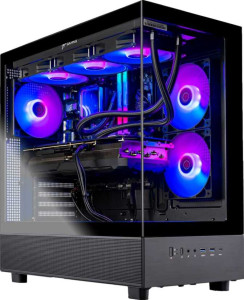
The Skytech Azure 3 is a desktop gaming PC built around the AMD Ryzen 7 9700X processor and paired with an NVIDIA RTX 5060 graphics card. Housed in an ATX form factor chassis measuring 452 mm tall and 231 mm wide, it comes configured with 32GB of DDR5 RAM running at 5600 MHz and a 1TB NVMe SSD for storage. The system supports Wi-Fi and Bluetooth 5.2, and includes a varied USB port selection alongside HDMI 2.1 and three DisplayPort outputs.

The RTX 5060 GPU is based on the Blackwell architecture, featuring 3840 shading units, 120 texture mapping units, and 8GB of GDDR7 VRAM on a 128-bit memory bus with a maximum bandwidth of 448 GB/s. Its floating-point performance is rated at 19.2 TFLOPS, with support for ray tracing, DLSS, and DirectX 12 Ultimate. The Ryzen 7 9700X CPU offers 8 cores and 16 threads with a base clock of 3.8 GHz and a turbo reaching 5.5 GHz, backed by 32MB of L3 cache and a 145W TDP, with benchmark results including a PassMark score of 37163 and a Geekbench 6 multi-core score of 17000.

Pros
  • The RTX 5060 GPU delivers 19.2 TFLOPS of floating-point performance with support for ray tracing and DLSS, enabling demanding rendering workloads
  • 32GB of DDR5 RAM running at 5600 MHz provides substantial headroom for multitasking and memory-intensive applications
  • The 8-core CPU reaches a turbo clock speed of 5.5 GHz with an unlocked multiplier, allowing for manual overclocking
  • GDDR7 VRAM with a maximum memory bandwidth of 448 GB/s ensures fast texture and frame data throughput for the GPU
  • The system supports up to four simultaneous display outputs, with three DisplayPort outputs and one HDMI 2.1 port available
  • Wi-Fi and Bluetooth 5.2 are both included, removing the need for additional wireless adapters
Cons
  • The GPU uses a 128-bit memory bus, which limits maximum memory bandwidth compared to wider bus configurations at this VRAM capacity
  • The system does not include air-water cooling, which may restrict sustained thermal performance under prolonged heavy loads
  • Only 8GB of VRAM is available on the GPU, which may prove limiting for certain high-resolution textures or memory-heavy workloads
  • No USB 4 or Thunderbolt ports are present, restricting high-speed peripheral and external device connectivity options
  • The warranty period covers only one year, offering a relatively short coverage window for a desktop system
Who is this for?

This system is well-suited to users who engage in gaming at high resolutions or with ray tracing enabled, given the RTX 5060's Blackwell architecture, DLSS support, and 19.2 TFLOPS of compute throughput. The 8-core Ryzen 7 9700X with a 5.5 GHz turbo clock and 32GB of DDR5 RAM also makes it a capable workstation for content creation tasks such as video editing, 3D rendering, and simulation workloads that benefit from strong multi-threaded CPU performance. Users who need a multi-monitor setup will find the four-display output capability — three DisplayPort and one HDMI 2.1 — particularly practical for productivity-focused or immersive gaming environments.

Who is this NOT for?

Users who require extensive high-speed peripheral connectivity will find this system limiting, as it lacks USB 4 and Thunderbolt ports, ruling out fast external storage arrays or high-bandwidth docking solutions that depend on those interfaces. The 8GB GDDR7 VRAM on a 128-bit memory bus may prove insufficient for workflows involving large texture assets, high-resolution generative tasks, or memory-intensive professional GPU applications where significantly more VRAM is typically required. Additionally, users looking for a system with liquid or advanced air-water cooling for extreme overclocking scenarios will need to consider aftermarket solutions, as no such cooling is included by default.

General info:

SSD storage capacity 1000GB
form factor ATX
Is an NVMe SSD
volume 45628.044 cm³
thickness 437 mm
height 452 mm
width 231 mm

The Skytech Azure 3 uses an ATX form factor chassis with dimensions of 452 mm in height, 231 mm in width, and a thickness of 437 mm, resulting in a total volume of approximately 45628 cm³. Storage is handled by a 1TB NVMe SSD, offering fast read and write access through the NVMe interface.

Graphics card:

VRAM 8GB
floating-point performance 19.2 TFLOPS
effective memory speed 28000 MHz
GPU clock speed 2280 MHz
GPU memory speed 1750 MHz
GPU turbo 2500 MHz
GDDR version GDDR7
DirectX version DirectX 12 Ultimate
PCI Express (PCIe) version 5
supports ray tracing
texture rate 300 GTexels/s
pixel rate 120 GPixel/s
maximum memory bandwidth 448 GB/s
memory bus width 128-bit
supports DLSS
supported displays 4
semiconductor size 5 nm
texture mapping units (TMUs) 120
shading units 3840
render output units (ROPs) 48
OpenGL version 4.6
OpenCL version 3
has LHR
Supports multi-display technology
Has Double Precision Floating Point (DPFP)
Supports 3D
has RGB lighting
number of transistors 21900 million

The graphics card in this system is equipped with 8GB of GDDR7 VRAM on a 128-bit memory bus, delivering a maximum memory bandwidth of 448 GB/s and an effective memory speed of 28000 MHz. The GPU runs at a base clock of 2280 MHz with a turbo frequency of 2500 MHz, and its floating-point performance is rated at 19.2 TFLOPS, backed by 3840 shading units, 120 texture mapping units, and 48 render output units across a 5 nm die containing 21900 million transistors. It supports ray tracing, DLSS, DirectX 12 Ultimate, OpenGL 4.6, OpenCL 3, stereoscopic 3D, double precision floating point, and multi-display output across up to 4 screens, while connecting via PCIe 5. The texture rate stands at 300 GTexels/s and the pixel rate at 120 GPixel/s. The card does not include LHR or RGB lighting.

CPU:

CPU speed 8 x 3.8 GHz
Has integrated graphics
Has an unlocked multiplier
L1 cache 512 KB
L2 cache 8 MB
L3 cache 32 MB
turbo clock speed 5.5GHz
CPU threads 16 threads
uses multithreading
clock multiplier 38
L2 core 1 MB/core
L3 core 4 MB/core
Supports 64-bit
CPU temperature 95 °C

The processor runs 8 cores at a base speed of 3.8 GHz per core, with a turbo clock speed reaching 5.5 GHz, and supports 16 threads through multithreading. It carries a clock multiplier of 38, an unlocked multiplier for manual adjustment, and a maximum operating temperature of 95 °C. Cache memory is arranged across three levels: 512 KB of L1, 8 MB of L2 at 1 MB per core, and 32 MB of L3 cache at 4 MB per core. The CPU supports 64-bit processing and includes integrated graphics, while also being fully compatible with a range of instruction sets and memory configurations as part of its desktop platform design.

Benchmarks:

Geekbench 6 result (multi) 17000
Geekbench 6 result (single) 3353
PassMark result 37163
PassMark result (single) 4654
PassMark result (overclocked) 38543
Cinebench R20 (single) result 866
Cinebench R20 (multi) result 8890

In Geekbench 6, the CPU scores 3353 in the single-core test and 17000 in the multi-core test. PassMark results come in at 37163 overall and 4654 for the single-core measurement, with an overclocked PassMark score of 38543. Cinebench R20 rounds out the benchmark data with a single-core result of 866 and a multi-core score of 8890.

Memory:

RAM 32GB
RAM speed 5600 MHz
DDR memory version 5

The system is fitted with 32GB of DDR5 RAM running at a speed of 5600 MHz, providing a solid foundation for handling memory-intensive workloads and multitasking within the DDR5 memory standard.

Connectivity:

supports Wi-Fi
USB 2.0 ports 3
USB 3.2 Gen 2 ports (USB-A) 1
USB 3.2 Gen 1 ports (USB-A) 3
USB 3.2 Gen 2 ports (USB-C) 1
USB 4 40Gbps ports 0
USB 4 20Gbps ports 0
USB 3.2 Gen 2x2 ports 0
USB 3.2 Gen 1 ports (USB-C) 0
RJ45 ports 1
Thunderbolt 4 ports 0
Thunderbolt 3 ports 0
DisplayPort outputs 3
HDMI version HDMI 2.1
HDMI ports 1
Has Bluetooth
Bluetooth version 5.2
DVI outputs 0
Has S/PDIF Out port
has a socket for a 3.5 mm audio jack
has a VGA connector

The system supports Wi-Fi and Bluetooth 5.2 for wireless connectivity, alongside a single RJ45 port for wired networking. USB ports include three USB 2.0, three USB 3.2 Gen 1 ports (USB-A), one USB 3.2 Gen 2 port (USB-A), and one USB 3.2 Gen 2 port (USB-C); there are no USB 4, USB 3.2 Gen 2x2, Thunderbolt 3, or Thunderbolt 4 ports present. Display output is handled through three DisplayPort outputs and one HDMI 2.1 port, with no DVI or VGA connectors included. Audio connectivity is covered by a 3.5 mm headset jack and an S/PDIF Out port.

Miscellaneous:

has an HDMI output
AMD SAM / Intel Resizable BAR Intel Resizable BAR
GPU architecture Blackwell
USB-C ports 0
Has air-water cooling
Thermal Design Power (TDP) 145W
mini DisplayPort outputs 0
Supports ECC memory
Type Desktop
CPU socket AM5
chipset X670, B650, X870, B840, B850
Uses big.LITTLE technology
instruction sets MMX, F16C, FMA3, AES, AVX, AVX2, SSE 4.1, SSE 4.2
GPU execution units 2
memory channels 2
RAM speed (max) 5600 MHz
maximum memory amount 192GB
Has NX bit
warranty period 1 years

The desktop CPU sits in an AM5 socket with a thermal design power of 145W and is compatible with X670, B650, X870, B840, and B850 chipsets. It supports a range of instruction sets including MMX, F16C, FMA3, AES, AVX, AVX2, SSE 4.1, and SSE 4.2, along with NX bit support, dual memory channels, and a maximum memory capacity of 192GB at up to 5600 MHz; ECC memory is also supported. The GPU is based on the Blackwell architecture with 2 execution units, and the system uses Intel Resizable BAR for optimized GPU memory access. An HDMI output is present, while mini DisplayPort outputs and USB-C ports are absent, and the system does not use air-water cooling or big.LITTLE technology. The product comes with a 1-year warranty.
Final Verdict

The Skytech Azure 3 configured with the Ryzen 7 9700X and RTX 5060 presents a well-rounded desktop gaming PC that covers the core needs of most modern gamers and creative users. Its Blackwell-architecture GPU with DLSS and ray tracing support, combined with a fast 8-core processor and 32GB of DDR5 RAM, gives it genuine capability across both gaming and content-focused workloads. While the 8GB VRAM and absence of USB 4 connectivity place some practical limits on heavier professional applications and high-speed peripheral use, these are relatively predictable trade-offs for a system at this configuration level. Overall, the Azure 3 in this specification stands as a competent ATX gaming desktop that delivers on its core promise for users seeking smooth gameplay, multi-display support, and solid CPU throughput in a single package.