Skytech Nebula (i5-14400F / RTX 5060 / 16GB RAM / 1TB SSD) specifications and in-depth review

Skytech Nebula (i5-14400F / RTX 5060 / 16GB RAM / 1TB SSD)

Manufacturer: Skytech

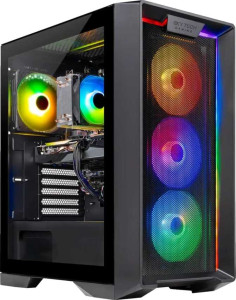
The Skytech Nebula (i5-14400F / RTX 5060 / 16GB RAM / 1TB SSD) is a mid-range desktop gaming PC built around Intel's 10-core Core i5-14400F processor and NVIDIA's RTX 5060 graphics card. Housed in an ATX form factor chassis measuring 490 mm tall and 220 mm wide, the system ships with 16GB of DDR5 memory running at 6000 MHz alongside a 1TB NVMe SSD for storage. Wi-Fi and Bluetooth are included, and the system carries a one-year warranty.

The RTX 5060 GPU is based on NVIDIA's Blackwell architecture, built on a 5 nm process with 3840 shading units and 21.9 billion transistors. It delivers 19.2 TFLOPS of floating-point performance and a maximum memory bandwidth of 448 GB/s through a 128-bit GDDR7 interface with an effective memory speed of 28000 MHz. The card supports ray tracing, DLSS, DirectX 12 Ultimate, and up to four simultaneous displays via three DisplayPort outputs and one HDMI 2.1 port. On the processor side, the i5-14400F operates across 16 threads with a turbo clock speed of 4.7 GHz and a TDP of 145W, paired with 9.5 MB of L2 cache and 20 MB of L3 cache on the LGA 1700 socket.

Pros
  • The RTX 5060 GPU delivers 19.2 TFLOPS of floating-point performance and supports ray tracing, DLSS, and DirectX 12 Ultimate, covering a broad range of modern rendering workloads
  • DDR5 RAM running at 6000 MHz provides notably fast memory throughput for a desktop system in this category
  • The 1TB NVMe SSD ensures quick system boot times and fast application loading compared to traditional storage interfaces
  • With four display outputs — three DisplayPort and one HDMI 2.1 — the system can drive up to four monitors simultaneously
  • Wi-Fi and Bluetooth are both built in, removing the need for additional adapters to achieve wireless connectivity
  • The GPU's GDDR7 memory delivers a maximum bandwidth of 448 GB/s, keeping the graphics pipeline well-fed across demanding rendering tasks
Cons
  • The memory bus width is limited to 128 bits, which constrains total memory bandwidth headroom as VRAM demands increase
  • There are no USB-C ports of any kind, which limits compatibility with modern peripherals and accessories that rely on that connector type
  • The CPU's maximum supported RAM speed is listed at 4800 MHz, while the installed kit runs at 6000 MHz, indicating the CPU officially operates the memory above its rated specification
  • Air or water cooling is not included, so thermal management under sustained load depends entirely on whatever cooling solution is pre-fitted
  • The system carries only a one-year warranty period
  • With 16GB of RAM installed and a DDR5 platform that supports up to 192GB, the current memory configuration leaves significant headroom unused, which may require an upgrade for memory-intensive workloads
Who is this for?

This system is well-suited to users who want a capable desktop for modern gaming at 1080p and 1440p resolutions, where the RTX 5060's 19.2 TFLOPS, ray tracing support, and DLSS compatibility can be put to practical use. The 6000 MHz DDR5 memory and NVMe SSD make it a reasonable fit for users who also engage in content creation or streaming alongside gaming, where fast storage and responsive memory throughput reduce friction in day-to-day workflows. Those looking to run a multi-monitor setup of up to four displays will find the connectivity options on the GPU sufficient, and built-in Wi-Fi and Bluetooth add flexibility for users who cannot rely on a wired network connection.

Who is this NOT for?

Users with demanding professional workloads that rely on large memory pools — such as high-resolution video editing or 3D rendering — will find the 16GB of installed RAM and the 8GB of VRAM limiting as scene complexity and asset sizes grow. The complete absence of USB-C ports makes this a poor match for users whose peripheral ecosystem depends on that connector, including those using modern external drives, displays, or docking stations. Similarly, users seeking a system for competitive 4K gaming may find the 128-bit memory bus and 8GB VRAM capacity insufficient to sustain high frame rates at that resolution with demanding titles and settings.

General info:

SSD storage capacity 1000GB
form factor ATX
Is an NVMe SSD
volume 44737 cm³
thickness 415 mm
height 490 mm
width 220 mm

The Skytech Nebula ships in an ATX form factor chassis measuring 490 mm tall, 220 mm wide, and 415 mm deep, with a total volume of 44737 cm³. Storage is handled by a 1TB NVMe SSD, offering fast read and write access through the NVMe interface.

Graphics card:

VRAM 8GB
floating-point performance 19.2 TFLOPS
effective memory speed 28000 MHz
GPU clock speed 2280 MHz
GPU memory speed 1750 MHz
GPU turbo 2500 MHz
GDDR version GDDR7
DirectX version DirectX 12 Ultimate
PCI Express (PCIe) version 5
supports ray tracing
texture rate 300 GTexels/s
pixel rate 120 GPixel/s
maximum memory bandwidth 448 GB/s
memory bus width 128-bit
supports DLSS
supported displays 4
semiconductor size 5 nm
texture mapping units (TMUs) 120
shading units 3840
render output units (ROPs) 48
OpenGL version 4.6
OpenCL version 3
has LHR
Supports multi-display technology
Has Double Precision Floating Point (DPFP)
Supports 3D
has RGB lighting
number of transistors 21900 million

The graphics card features 8GB of GDDR7 VRAM on a 128-bit memory bus, delivering a maximum memory bandwidth of 448 GB/s and an effective memory speed of 28000 MHz. Its 3840 shading units, 120 texture mapping units, and 48 render output units combine to produce a texture rate of 300 GTexels/s and a pixel rate of 120 GPixel/s, while overall floating-point performance reaches 19.2 TFLOPS. The GPU runs at a base clock of 2280 MHz with a turbo frequency of 2500 MHz, and is manufactured on a 5 nm process with 21.9 billion transistors. It connects via PCIe 5 and supports DirectX 12 Ultimate, OpenGL 4.6, OpenCL 3, ray tracing, DLSS, double precision floating point, stereoscopic 3D, and multi-display output across up to four screens. The card does not include LHR or RGB lighting.

CPU:

CPU speed 6 x 2.5 & 4 x 1.8 GHz
Has integrated graphics
Has an unlocked multiplier
L2 cache 9.5 MB
L3 cache 20 MB
turbo clock speed 4.7GHz
CPU threads 16 threads
uses multithreading
Turbo Boost version 2
clock multiplier 25
Supports 64-bit
CPU temperature 100 °C

The processor operates across 16 threads with multithreading enabled, running six cores at 2.5 GHz and four cores at 1.8 GHz, with a turbo clock speed of 4.7 GHz via Turbo Boost version 2 and a clock multiplier of 25. It is backed by 9.5 MB of L2 cache and 20 MB of L3 cache, and supports 64-bit processing with a maximum rated temperature of 100 °C. The CPU does not include integrated graphics and does not have an unlocked multiplier.

Benchmarks:

Geekbench 6 result (multi) 11491
Geekbench 6 result (single) 2337
PassMark result 25773
PassMark result (single) 3709
PassMark result (overclocked) 27389

In Geekbench 6, the processor scores 11491 in the multi-core test and 2337 in the single-core test. PassMark results place it at 25773 in the standard multi-threaded run and 3709 in the single-threaded test, with the overclocked PassMark score reaching 27389.

Memory:

RAM 16GB
RAM speed 6000 MHz
DDR memory version 5

The system comes equipped with 16GB of DDR5 RAM running at a speed of 6000 MHz, providing fast memory throughput for the platform.

Connectivity:

supports Wi-Fi
USB 2.0 ports 4
USB 3.2 Gen 2 ports (USB-A) 1
USB 3.2 Gen 1 ports (USB-A) 2
USB 3.2 Gen 2 ports (USB-C) 0
USB 4 40Gbps ports 0
USB 4 20Gbps ports 0
USB 3.2 Gen 2x2 ports 0
USB 3.2 Gen 1 ports (USB-C) 0
RJ45 ports 1
Thunderbolt 4 ports 0
Thunderbolt 3 ports 0
DisplayPort outputs 3
HDMI version HDMI 2.1
HDMI ports 1
Has Bluetooth
DVI outputs 0
Has S/PDIF Out port
has a socket for a 3.5 mm audio jack
has a VGA connector

The system supports Wi-Fi and Bluetooth for wireless connectivity, alongside a single RJ45 port for wired networking. USB ports include four USB 2.0, two USB 3.2 Gen 1 (USB-A), and one USB 3.2 Gen 2 (USB-A) connection; there are no USB-C ports of any type, and neither Thunderbolt 3 nor Thunderbolt 4 are available. Display output is handled by three DisplayPort connectors and one HDMI 2.1 port, with no DVI or VGA outputs present. Audio connectivity includes both a 3.5 mm headset jack and an S/PDIF output, rounding out the available I/O options.

Miscellaneous:

has an HDMI output
AMD SAM / Intel Resizable BAR Intel Resizable BAR
GPU architecture Blackwell
USB-C ports 0
Has air-water cooling
Thermal Design Power (TDP) 145W
mini DisplayPort outputs 0
Supports ECC memory
Type Desktop
CPU socket LGA 1700
chipset B760, H770, Z790, H610, H670, B660, Z690
instruction sets MMX, F16C, FMA3, AES, AVX, AVX2, SSE 4.1, SSE 4.2
Has NX bit
memory channels 2
RAM speed (max) 4800 MHz
maximum memory amount 192GB
Uses big.LITTLE technology
warranty period 1 years

The desktop CPU sits in an LGA 1700 socket with a TDP of 145W and employs big.LITTLE technology across its cores, supporting instruction sets including MMX, F16C, FMA3, AES, AVX, AVX2, SSE 4.1, and SSE 4.2, along with an NX bit for hardware-level security. Memory support extends to a maximum of 192GB across two channels, with ECC memory compatibility and a maximum rated RAM speed of 4800 MHz. The GPU is based on the Blackwell architecture and the system includes HDMI output and Intel Resizable BAR support, while mini DisplayPort outputs and USB-C ports are absent, and air-water cooling is not included. Compatible chipsets span B760, H770, Z790, H610, H670, B660, and Z690, and the system is covered by a one-year warranty.
Final Verdict

The Skytech Nebula (i5-14400F / RTX 5060 / 16GB RAM / 1TB SSD) is a focused desktop gaming system that covers the essentials for mainstream gaming and light creative work without overreaching. Its most compelling attribute is the RTX 5060 GPU built on NVIDIA's Blackwell architecture, bringing ray tracing, DLSS, and DirectX 12 Ultimate support alongside a fast GDDR7 memory interface — a technically current foundation for 1080p and 1440p workloads. The DDR5 platform and NVMe storage ensure the rest of the system keeps pace with the GPU in everyday use, though the 16GB RAM ceiling and the absence of USB-C connectivity are real practical constraints for users whose needs extend beyond gaming. For a user whose primary goal is a no-frills, ready-to-run gaming desktop with modern GPU features, the Nebula delivers a coherent and well-specified package; those with broader or more demanding workflows would benefit from evaluating whether these hardware boundaries align with their workload before committing.