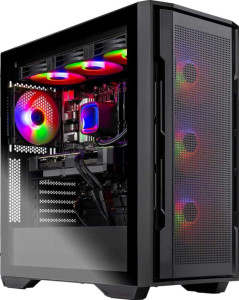
The Skytech Rampage ships with a 1TB NVMe SSD for fast system and game load times, housed in an ATX form factor chassis. The tower measures 493 mm in height, 231 mm in width, and 475 mm in depth, giving it a total volume of approximately 54,094 cm³ — a footprint typical of a standard full-sized desktop build.
The graphics card offers 12GB of GDDR7 VRAM on a 192-bit memory bus, with an effective memory speed of 28,000 MHz and a maximum bandwidth of 672 GB/s. It runs at a base clock of 2330 MHz, boosting up to 2510 MHz, and delivers 30.84 TFLOPS of floating-point performance through 6144 shading units, 192 TMUs, and 80 ROPs — translating to a texture rate of 481.9 GTexels/s and a pixel rate of 200.8 GPixel/s. Built on a 5 nm process with 31,100 million transistors, it connects via PCIe 5.0 and supports DirectX 12 Ultimate, ray tracing, DLSS, OpenGL 4.6, OpenCL 3, stereoscopic 3D, multi-display output across up to four screens, and Double Precision Floating Point. LHR is not present, and the card does not include RGB lighting.
The processor runs a hybrid configuration of 6 cores at 2.5 GHz and 4 cores at 1.8 GHz, supporting 16 threads via multithreading and reaching a turbo clock speed of 4.7 GHz through Turbo Boost version 2. It carries 9.5 MB of L2 cache and 20 MB of L3 cache, operates with a clock multiplier of 25, and has a maximum rated temperature of 100 °C. The CPU supports 64-bit processing but does not include integrated graphics, and its multiplier is locked, meaning overclocking via multiplier adjustment is not available.
In Geekbench 6, the processor scores 2337 in the single-core test and 11,491 in the multi-core test. PassMark results place it at 25,773 in the standard multi-threaded run and 3,709 in the single-threaded test, with the overclocked PassMark score reaching 27,389.
The system is equipped with 16GB of DDR5 RAM running at 5200 MHz, providing a modern memory configuration suited to the demands of current applications and games.
The system supports Wi-Fi and Bluetooth for wireless connectivity, alongside a single RJ45 port for wired Ethernet. USB ports include two USB 2.0, two USB 3.2 Gen 1 Type-A, and one USB 3.2 Gen 1 Type-C; there are no USB 3.2 Gen 2, USB 4, or Thunderbolt ports of any kind. Video output is handled by three DisplayPort outputs and one HDMI 2.1 port, with no DVI or VGA connectors present. Audio connectivity covers both a 3.5 mm headset jack and an S/PDIF output, rounding out a fairly complete set of I/O options for a standard desktop build.
The desktop CPU sits in an LGA 1700 socket and is compatible with a range of chipsets including B760, H770, Z790, H610, H670, B660, and Z690. It employs big.LITTLE technology across its cores, supports a dual-channel memory configuration with a maximum capacity of 192GB and a rated maximum RAM speed of 4800 MHz, and is compatible with ECC memory. The processor supports a broad set of instruction sets — MMX, F16C, FMA3, AES, AVX, AVX2, SSE 4.1, and SSE 4.2 — and includes NX bit support, while XeSS is not available. The GPU is based on the Blackwell architecture and benefits from Intel Resizable BAR support; it includes an HDMI output but no mini DisplayPort outputs and no USB-C ports. The CPU carries a thermal design power rating of 250W, does not use air-water cooling, and the system is covered by a one-year warranty.