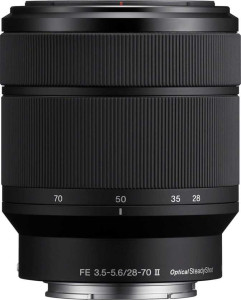
Sony FE 28-70mm f/3.5-5.6 OSS II specifications and in-depth review

Sony FE 28-70mm f/3.5-5.6 OSS II

Manufacturer: Sony

The Sony FE 28-70mm f/3.5-5.6 OSS II is a standard zoom lens designed for Sony E-mount cameras, covering a versatile focal range from 28mm to 70mm. It features built-in optical image stabilization, which is integrated directly into the lens body, and ships with a lens hood included. The metal mount construction adds a level of physical durability, though the lens does not carry a weather-sealed rating.

Optically, the lens offers a maximum angle of view of 75° at its wide end, narrowing to 34° at the telephoto end, with a maximum magnification of 0.19x and 2.5x optical zoom. The aperture ranges from f/3.5 at the widest focal length to f/5.6 at 70mm, with a minimum aperture of f/22 and f/36 respectively. Its 7-blade rounded aperture diaphragm contributes to smooth out-of-focus rendering, while the silent autofocus motor built into the lens enables quiet and responsive focusing, with a minimum focus distance of 0.3 m. The filter thread measures 55 mm, and the lens weighs 293 g.

Pros
  • Built-in optical image stabilization helps reduce blur during handheld use
  • Silent autofocus motor enables quiet operation suitable for video or discreet shooting
  • Rounded 7-blade aperture diaphragm produces smoother background blur
  • Includes a lens hood in the box, ready to use without additional accessories
  • Metal mount provides a more durable connection to the camera body
  • Compact and relatively light at 293 g for a zoom lens covering this focal range
Cons
  • Variable maximum aperture means less light is available when zooming toward 70 mm
  • No weather sealing, leaving the lens vulnerable to moisture and dust
  • Maximum magnification of 0.19x limits close-up shooting capability
  • Minimum aperture reaches f/36 at the telephoto end, which may introduce diffraction at very narrow settings
Who is this for?

This lens is a good fit for photographers who frequently shoot in a variety of everyday situations, from street and travel photography to casual portraits, where a single versatile zoom covers most needs. The built-in optical image stabilization makes it particularly practical for handheld shooting in lower-light conditions or at slower shutter speeds. The silent autofocus motor also makes it a reasonable choice for video work or quiet environments where audible focusing would be disruptive. Its relatively light 293 g build suits users who prioritize a compact, carry-everywhere setup without committing to a heavier lens.

Who is this NOT for?

Users who regularly shoot in challenging outdoor conditions will find the lack of weather sealing a significant limitation, as the lens offers no protection against moisture or dust. The variable aperture ranging from f/3.5 to f/5.6 makes it less suited for photographers who need consistent light intake across the zoom range, particularly in low-light situations at the telephoto end. Additionally, those interested in close-up or macro-style photography will be constrained by the 0.19x maximum magnification, which is not sufficient for detailed near-subject work.

General info:

lens type Zoom, Telephoto, Standard
lens mount Sony E
release date February 2026
is weather-sealed (splashproof)
Has a metal mount
weight 293 g
Includes lens hood
filter size 55 mm

The Sony FE 28-70mm f/3.5-5.6 OSS II is a zoom lens covering standard and telephoto focal lengths, designed for the Sony E mount. It weighs 293 g and accepts filters with a 55 mm diameter. The lens features a metal mount for solid construction and comes with a lens hood included in the box. It is worth noting that this lens is not weather-sealed, meaning it does not offer splashproof protection.

Optics:

maximum focal length 70 mm
minimum focal length 28 mm
has built-in optical image stabilization
maximum angle of view 75°
minimum angle of view 34°
magnification 0.19x
optical zoom 2.5x

The lens covers a focal range of 28 mm to 70 mm, delivering a maximum angle of view of 75° at the wide end and 34° at the telephoto end. It provides 2.5x optical zoom and a maximum magnification of 0.19x. A notable optical feature is the built-in optical image stabilization, which is integrated directly into the lens to help reduce camera shake during handheld shooting.

Aperture:

wide aperture (main camera) 3.5f
widest aperture at maximum focal length 5.6f
aperture blades 7
Has rounded aperture blades
smallest aperture at maximum focal length 36f
smallest aperture at minimum focal length 22f

This lens has a variable maximum aperture, opening to f/3.5 at the minimum focal length and f/5.6 at the maximum focal length. On the other end of the range, the smallest available aperture is f/22 at the wide end and f/36 at the telephoto end. The diaphragm is constructed with 7 rounded aperture blades, which helps produce a smoother, more circular out-of-focus effect in the background.

Focus:

Has focus motor
has a silent focus motor built into the lens
minimum focus distance 0.3 m

The lens includes a built-in focus motor that operates silently, making it well-suited for situations where quiet autofocus operation is important. The minimum focus distance is 0.3 m, indicating how close the lens can be to a subject while still achieving focus.

Benchmarks:

Final Verdict

The Sony FE 28-70mm f/3.5-5.6 OSS II is a competent everyday zoom lens that covers a practical focal range for a wide variety of shooting scenarios. Its most defining characteristic is the built-in optical image stabilization paired with a silent autofocus motor, which together make it a reliable choice for handheld photography and video work. The metal mount and included lens hood add a degree of practical readiness out of the box, while the 293 g weight keeps the overall setup manageable. That said, the variable aperture and absence of weather sealing do place certain limits on its versatility in demanding conditions. Overall, the Sony FE 28-70mm f/3.5-5.6 OSS II is best positioned as a capable, lightweight walk-around lens for Sony E-mount users who prioritize convenience and stabilization over outright optical speed or environmental durability.