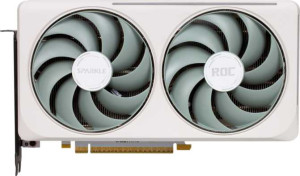
Sparkle Arc B580 ROC Luna OC Edition specifications and in-depth review

Sparkle Arc B580 ROC Luna OC Edition

Manufacturer: Sparkle

The Sparkle Arc B580 ROC Luna OC Edition is a discrete graphics card based on Intel's Xe2-HPG architecture, manufactured on a 5 nm process node. With 2560 shading units and a boost clock reaching 2800 MHz, it targets solid rasterization throughput across its supported workloads. The card includes RGB lighting and supports up to four simultaneous displays, making it a flexible option for multi-monitor configurations.

On the memory side, the card carries 12 GB of GDDR6 VRAM across a 192-bit bus, delivering an effective memory speed of 19000 MHz and a peak bandwidth of 456 GB/s. It supports DirectX 12 Ultimate, OpenGL 4.6, and OpenCL 3, along with hardware ray tracing and Intel's XeSS upscaling via XMX units. Connectivity is handled through one HDMI 2.1 port and three DisplayPort outputs. The card draws 190W TDP and connects via PCIe 4.0, with ECC memory support also present.

Pros
  • Supports up to four simultaneous displays through three DisplayPort outputs and one HDMI 2.1 port, offering flexible multi-monitor setups
  • 12 GB of GDDR6 VRAM across a 192-bit bus with 456 GB/s of peak bandwidth suits memory-intensive workloads well
  • Hardware ray tracing and XeSS upscaling via XMX units are both supported, expanding rendering capabilities
  • ECC memory support adds a degree of data integrity useful for compute-oriented tasks
  • Fabricated on a 5 nm process with 19,600 million transistors, reflecting a dense and modern silicon design
  • RGB lighting is included for users who prioritize visual customization of their build
Cons
  • DLSS is not supported, limiting upscaling options to XeSS only
  • No USB-C, DVI, or mini DisplayPort outputs, which may not suit users with older or specialized display hardware
  • Air-water cooling is not supported, so thermal management relies entirely on the air cooling solution
  • A 190W TDP places meaningful demands on system power delivery and case airflow
Who is this for?

This card is well matched to users who want hardware ray tracing and XeSS-based upscaling in their rendering pipeline, making it a reasonable fit for gamers and content creators working with modern APIs like DirectX 12 Ultimate and OpenCL 3. The 12 GB of GDDR6 VRAM with 456 GB/s of bandwidth gives it enough headroom for higher-resolution textures and moderately demanding compute workloads, while ECC memory support makes it relevant for users who need added data reliability in GPU-accelerated tasks. Those running multi-monitor setups of up to four displays will also find the port configuration practical, particularly with three DisplayPort outputs and an HDMI 2.1 connection available.

Who is this NOT for?

Users who rely specifically on DLSS for upscaling will find this card incompatible with that workflow, as it is not supported. The absence of USB-C, DVI, and mini DisplayPort outputs makes it a poor fit for anyone with legacy or specialized display hardware that depends on those connection types. Additionally, the 190W TDP combined with air-only cooling means users working in thermally constrained environments, small form factor builds, or systems with limited airflow may struggle to maintain stable operating conditions under sustained load.

Performance:

GPU clock speed 2670 MHz
GPU turbo 2800 MHz
pixel rate 224 GPixel/s
floating-point performance 14.34 TFLOPS
texture rate 448 GTexels/s
GPU memory speed 2375 MHz
shading units 2560
texture mapping units (TMUs) 160
render output units (ROPs) 80
Has Double Precision Floating Point (DPFP)

The Performance section of this card is defined by a base GPU clock of 2670 MHz that boosts up to 2800 MHz, backed by 2560 shading units, 160 texture mapping units, and 80 render output units. These combine to deliver a texture rate of 448 GTexels/s, a pixel rate of 224 GPixel/s, and 14.34 TFLOPS of floating-point performance. GPU memory operates at 2375 MHz, and the card includes support for Double Precision Floating Point (DPFP), broadening its suitability for compute-oriented tasks alongside standard graphics workloads.

Memory:

effective memory speed 19000 MHz
maximum memory bandwidth 456 GB/s
VRAM 12GB
GDDR version GDDR6
memory bus width 192-bit
Supports ECC memory

This card is equipped with 12 GB of GDDR6 VRAM running at an effective speed of 19000 MHz across a 192-bit memory bus, resulting in a peak bandwidth of 456 GB/s. These figures reflect a memory configuration suited to handling demanding texture workloads and larger data sets. ECC memory support is also present, adding a layer of data integrity for workloads where memory reliability is a concern.

Features:

DirectX version DirectX 12 Ultimate
OpenGL version 4.6
OpenCL version 3
Supports multi-display technology
supports ray tracing
Supports 3D
supports DLSS
has XeSS (XMX)
has LHR
has RGB lighting
supported displays 4

The card supports DirectX 12 Ultimate, OpenGL 4.6, and OpenCL 3, covering a broad range of graphics and compute APIs. Hardware ray tracing and stereoscopic 3D are both supported, while XeSS upscaling via XMX units is present; DLSS, however, is not supported. Multi-display technology is included with support for up to four simultaneous outputs, and the card does not feature LHR. RGB lighting is also built in, rounding out the feature set on the physical side.

Ports:

has an HDMI output
HDMI ports 1
HDMI version HDMI 2.1
DisplayPort outputs 3
USB-C ports 0
DVI outputs 0
mini DisplayPort outputs 0

The card's output configuration consists of three DisplayPort outputs and one HDMI 2.1 port, providing four physical display connections in total. There are no DVI, mini DisplayPort, or USB-C outputs present on this model, keeping the port layout straightforward and focused on the two most current display interface standards.

General info:

GPU architecture Xe2-HPG
Thermal Design Power (TDP) 190W
PCI Express (PCIe) version 4
semiconductor size 5 nm
number of transistors 19600 million
Has air-water cooling
width 230 mm
height 128 mm

Built on the Xe2-HPG architecture and fabricated using a 5 nm process, the GPU integrates 19,600 million transistors and connects to the system via PCIe 4.0. It carries a thermal design power of 190W and relies solely on air cooling, as liquid or hybrid air-water cooling is not supported. The card measures 230 mm in width and 128 mm in height, giving a clear sense of its physical footprint.

Final Verdict

The Sparkle Arc B580 ROC Luna OC Edition is a capable graphics card built around Intel's Xe2-HPG architecture, bringing together a modern 5 nm silicon design, 12 GB of GDDR6 VRAM with 456 GB/s of bandwidth, and a solid feature set that includes hardware ray tracing, XeSS upscaling, and support for up to four simultaneous displays. Its compatibility with DirectX 12 Ultimate and OpenCL 3, alongside ECC memory support, gives it utility beyond pure gaming. That said, the lack of DLSS support and the constraints of a 190W air-cooled configuration are factors worth weighing carefully depending on the intended environment. For users whose workflow aligns with what this card actually offers, it presents a well-specified option within its category — but those with specific upscaling, connectivity, or thermal requirements should verify compatibility before committing.