Thunderobot Gravity 16 Max G5 16" specifications and in-depth review

Thunderobot Gravity 16 Max G5 16"

Manufacturer: Thunderobot

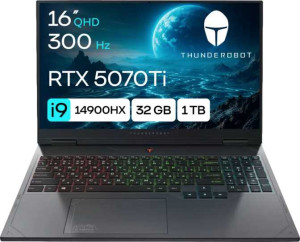
The Thunderobot Gravity 16 Max G5 16″ is a gaming laptop built around a 16-inch IPS panel running at 2560 x 1600 resolution with a 300Hz refresh rate, making it a display-focused machine for users who prioritize both clarity and motion fluidity. It weighs 2580 grams and measures 358 x 266 x 24 mm, placing it in the mid-range of portable gaming form factors. The backlit keyboard and stereo speakers are present, while features like a touch screen, fingerprint scanner, and optical disc drive are absent from this configuration.

Under the hood, the Thunderobot Gravity 16 Max G5 16″ is equipped with 32GB of DDR5 memory running at 5600 MHz, expandable up to 192GB, paired with a 1024GB NVMe SSD for storage. The discrete GPU is based on the Blackwell architecture and carries 12GB of GDDR7 VRAM across a 192-bit memory bus, delivering 17.04 TFLOPS of floating-point performance and a maximum memory bandwidth of 608.6 GB/s. Connectivity includes one HDMI 2.1 output, one mini DisplayPort, three USB-A 3.2 Gen 1 ports, one USB-C 3.2 Gen 1 port, Wi-Fi 6, Bluetooth 5.3, and a single RJ45 Ethernet port. The system supports DirectX 12 Ultimate, OpenCL 3, and ray tracing, and Intel Resizable BAR is enabled.

Pros
  • The 16-inch IPS display runs at 2560x1600 resolution with a 300Hz refresh rate, offering both sharp visuals and very smooth motion for gaming use
  • The GPU delivers 17.04 TFLOPS of floating-point performance with 12GB of GDDR7 VRAM across a 192-bit bus, backed by a maximum memory bandwidth of 608.6 GB/s
  • 32GB of DDR5 RAM running at 5600 MHz can be expanded up to 192GB, providing significant headroom for memory-intensive workloads
  • Storage is handled by a 1024GB NVMe PCIe 5 SSD, offering fast read and write access for large game libraries and files
  • Ray tracing and DLSS are both supported, enabling hardware-accelerated visual effects in compatible titles
  • The display supports up to four simultaneous outputs, and the port layout includes HDMI 2.1, a mini DisplayPort, and an RJ45 Ethernet jack for flexible external connectivity
Cons
  • No USB 3.2 Gen 2 ports are present, and the single USB-C port is limited to Gen 1 speeds, restricting high-speed peripheral and external storage throughput
  • There are no Thunderbolt 3 or Thunderbolt 4 ports, which limits connectivity options for high-bandwidth docking stations and external GPUs
  • The display lacks an anti-reflection coating, which may reduce visibility in brightly lit environments
  • No fingerprint scanner or 3D facial recognition is included, leaving the device without hardware-based biometric authentication
  • The warranty period covers only one year
  • The chassis is neither weather-sealed nor built to a rugged standard, offering no protection against moisture or physical stress
Who is this for?

This laptop is well-matched for users who spend significant time on demanding gaming workloads, given its Blackwell-architecture GPU with 12GB of GDDR7 VRAM, 17.04 TFLOPS of floating-point performance, and support for both ray tracing and DLSS. The 2560x1600 IPS display running at 300Hz makes it a strong fit for fast-paced titles where high frame rates and image clarity matter simultaneously. Content creators and technical users who need generous memory headroom will also find value here, as the 32GB DDR5 configuration is expandable up to 192GB, and the 1024GB PCIe 5 NVMe SSD handles large file operations efficiently. The multi-display support for up to four screens further suits users who rely on an extended desktop workspace for productivity or streaming setups.

Who is this NOT for?

Users looking for a highly portable machine will find the 2580g weight and 24mm thickness limiting for frequent travel or on-the-go use. Those who require high-speed USB connectivity for external storage drives or advanced docking stations will be constrained by the absence of Thunderbolt ports and the lack of USB 3.2 Gen 2 on both the USB-A and USB-C ports. The display's lack of an anti-reflection coating makes this laptop a poor fit for anyone who regularly works in bright or outdoor environments. Additionally, users who depend on biometric login — through fingerprint scanning or facial recognition — will need to rely on alternative authentication methods, as neither is available on this configuration.

Design:

Type Gaming
weight 2580 g
Uses a fanless design
Has a backlit keyboard
warranty period 1 years
volume 2285.472 cm³
width 358 mm
height 266 mm
thickness 24 mm
is weather-sealed (splashproof)
has a rugged build

The Thunderobot Gravity 16 Max G5 is a gaming laptop with a physical footprint of 358 x 266 mm and a thickness of 24 mm, resulting in a total volume of 2285.472 cm³. It weighs 2580 g and relies on an active cooling solution, as it does not use a fanless design. The chassis includes a backlit keyboard but is neither weather-sealed nor built to a rugged standard. The warranty period covers one year from purchase.

Display:

screen size 16"
resolution 2560 x 1600 px
pixel density 188 ppi
Display type LCD, LED-backlit, IPS
has a touch screen
refresh rate 300Hz
has anti-reflection coating
supported displays 4

The laptop features a 16″ IPS LCD panel with LED backlighting and a resolution of 2560 x 1600 px, yielding a pixel density of 188 ppi. The display runs at a 300Hz refresh rate, which is well-suited for fast-paced content, and supports up to four simultaneous displays. Touch input and anti-reflection coating are not included in this configuration.

Performance:

RAM 32GB
RAM speed 5600 MHz
Uses flash storage
internal storage 1024GB
CPU speed 8 x 2.2 & 16 x 1.6 GHz
CPU threads 32 threads
VRAM 12GB
floating-point performance 17.04 TFLOPS
GDDR version GDDR7
texture rate 266.2 GTexels/s
pixel rate 115.8 GPixel/s
Is an NVMe SSD
DirectX version DirectX 12 Ultimate
GPU clock speed 847 MHz
uses multithreading
maximum memory amount 192GB
DDR memory version 5
turbo clock speed 5.8GHz
GPU turbo 1447 MHz
PCI Express (PCIe) version 5
semiconductor size 4 nm
has XeSS (XMX)
Supports 64-bit

This laptop is powered by a CPU with 32 threads, a base configuration of 8 cores at 2.2 GHz and 16 cores at 1.6 GHz, a turbo clock speed of 5.8 GHz, and a 4 nm semiconductor process, with multithreading and 64-bit support both enabled. System memory stands at 32GB of DDR5 RAM running at 5600 MHz, expandable up to 192GB. Storage is handled by a 1024GB NVMe SSD using PCIe 5. On the graphics side, the GPU carries 12GB of GDDR7 VRAM, operates at a base clock of 847 MHz with a turbo of 1447 MHz, and delivers 17.04 TFLOPS of floating-point performance alongside a texture rate of 266.2 GTexels/s and a pixel rate of 115.8 GPixel/s. DirectX 12 Ultimate is supported, while XeSS (XMX) is not available on this configuration.

Benchmarks:

Geekbench 6 result (multi) 15655
Geekbench 6 result (single) 2680
PassMark (G3D) result 23749
PassMark result 45332
PassMark result (single) 4245

In Geekbench 6, the system scores 15,655 in the multi-core test and 2,680 in the single-core test. PassMark results show an overall score of 45,332 with a single-thread score of 4,245, while the GPU-focused PassMark G3D benchmark returns a result of 23,749.

Connectivity:

USB 3.2 Gen 2 ports (USB-C) 0
USB 3.2 Gen 2 ports (USB-A) 0
USB 4 20Gbps ports 0
USB 4 40Gbps ports 0
Thunderbolt 4 ports 0
USB 3.2 Gen 1 ports (USB-C) 1
USB 3.2 Gen 1 ports (USB-A) 3
Thunderbolt 3 ports 0
has an HDMI output
Has USB Type-C
supports Wi-Fi
Wi-Fi version Wi-Fi 6 (802.11ax), Wi-Fi 5 (802.11ac), Wi-Fi 4 (802.11n)
has an external memory slot
Bluetooth version 5.3
RJ45 ports 1
HDMI ports 1
HDMI version HDMI 2.1
DisplayPort outputs 0
USB 2.0 ports 0
has AirPlay
mini DisplayPort outputs 1
has a VGA connector

Wired connectivity includes three USB-A 3.2 Gen 1 ports, one USB-C 3.2 Gen 1 port, one RJ45 Ethernet port, one HDMI 2.1 output, and one mini DisplayPort; there are no USB 2.0, Thunderbolt, USB 4, or standard DisplayPort outputs, and no VGA connector or external memory slot. Wireless connectivity is handled by Wi-Fi 6 (802.11ax) with backward compatibility for Wi-Fi 5 and Wi-Fi 4, alongside Bluetooth 5.3. AirPlay is supported on this configuration.

Battery:

Has sleep-and-charge USB ports
Has a MagSafe power adapter

The laptop includes sleep-and-charge USB ports, allowing connected devices to be charged even when the system is powered off or in sleep mode. A MagSafe power adapter is not part of this configuration.

Features:

has stereo speakers
has a socket for a 3.5 mm audio jack
megapixels (front camera) 2MP
supports ray tracing
supports DLSS
has Dolby Atmos
Stylus included
Has a fingerprint scanner
number of microphones 1
Uses 3D facial recognition
has voice commands
has a front camera
Has S/PDIF Out port
has a gyroscope
has GPS
has an accelerometer
has a compass
Has an optical disc drive

The laptop is equipped with stereo speakers, a 3.5 mm headset jack, and a single microphone, though Dolby Atmos and S/PDIF output are not present. A 2MP front camera is included, while fingerprint scanning, 3D facial recognition, and voice commands are absent. On the graphics side, the system supports both ray tracing and DLSS. Motion and location sensors — including a gyroscope, accelerometer, compass, and GPS — are not part of this build, and there is no optical disc drive or stylus included.

Miscellaneous:

clock multiplier 22
number of transistors 31100 million
AMD SAM / Intel Resizable BAR Intel Resizable BAR
GPU architecture Blackwell
has LHR
Thermal Design Power (TDP) 60W
Supports 3D
Supports multi-display technology
OpenCL version 3
OpenGL version 4.6
Supports ECC memory
memory bus width 192-bit
effective memory speed 25400 MHz
maximum memory bandwidth 608.6 GB/s
render output units (ROPs) 80
texture mapping units (TMUs) 184
shading units 5888
Has Double Precision Floating Point (DPFP)
GPU memory speed 1750 MHz
GPU name UHD Graphics 770
Type Laptop
instruction sets MMX, F16C, FMA3, AES, AVX2, AVX, SSE 4.1, SSE 4.2
L3 cache 36 MB
Has an unlocked multiplier
Has NX bit
CPU temperature 100 °C
GPU execution units 32
Has integrated graphics
memory channels 2
RAM speed (max) 5600 MHz
Uses big.LITTLE technology

The CPU is a laptop-class processor with a clock multiplier of 22, a maximum operating temperature of 100 °C, a TDP of 60W, and a 36 MB L3 cache; it uses big.LITTLE technology, supports the NX bit and Double Precision Floating Point, carries 31,100 million transistors, and exposes instruction sets including MMX, F16C, FMA3, AES, AVX, AVX2, SSE 4.1, and SSE 4.2, though the multiplier is not unlocked. Integrated graphics are present in the form of the UHD Graphics 770 with 32 execution units, while the discrete GPU is based on the Blackwell architecture and features 5,888 shading units, 184 TMUs, 80 ROPs, a 192-bit memory bus, a GPU memory speed of 1750 MHz, an effective memory speed of 25,400 MHz, and a maximum memory bandwidth of 608.6 GB/s. The system operates across two memory channels with a maximum RAM speed of 5600 MHz, supports ECC memory, and has Intel Resizable BAR enabled; LHR is not present. API support covers OpenCL 3 and OpenGL 4.6, and the configuration includes stereoscopic 3D and multi-display support.
Final Verdict

The Thunderobot Gravity 16 Max G5 16″ is a gaming-focused laptop that brings together a capable set of specifications for users who prioritize raw graphical output and display quality. Its Blackwell-architecture GPU, paired with the 2560x1600 IPS panel running at 300Hz, forms a coherent foundation for high-fidelity gaming and content-heavy workflows, while the expandable DDR5 memory and fast PCIe 5 NVMe storage add practical versatility. The connectivity options and the absence of Thunderbolt ports or biometric security features reflect some design trade-offs that narrow its appeal for professional or highly mobile users. Overall, the Gravity 16 Max G5 16″ is a well-specified machine for desktop-replacement gaming use, best suited to users who keep it stationary and prioritize display performance and GPU capability above portability and peripheral flexibility.

Popular Comparisons

Thunderobot Gravity 16 Max G5 16"
VS
MSI Raider 18 HX A14V (2024) 18"