Thunderobot MIX NUC specifications and in-depth review

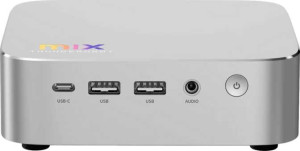
Thunderobot MIX NUC

Manufacturer: Thunderobot

The Thunderobot MIX NUC is a compact Micro-ATX mini PC built around an 8-core processor with a base clock of 3.8 GHz per core and a turbo frequency reaching 4.9 GHz. It ships with 32GB of DDR5 memory and a 1TB NVMe SSD, providing a reasonable foundation for everyday computing and light workloads within a small-footprint chassis.

On the graphics side, the system relies on an integrated Radeon 780M GPU, manufactured on a 4nm process, with 768 shading units, 48 texture mapping units, and support for up to four simultaneous displays via its HDMI 2.1 and DisplayPort outputs. Connectivity options include Wi-Fi 6, Bluetooth 5.3, two USB 3.2 Gen 2 Type-A ports, four USB 3.2 Gen 1 Type-A ports, one USB 3.2 Gen 2 Type-C port, and a single RJ45 Ethernet jack, while the CPU carries a 45W TDP and a maximum operating temperature of 100°C.

Pros
  • Supports Wi-Fi 6 alongside Bluetooth 5.3, covering both fast wireless networking and modern peripheral connectivity
  • The seven available USB ports span multiple standards, including two USB 3.2 Gen 2 Type-A and one USB 3.2 Gen 2 Type-C, offering a practical range of wired connections
  • Can drive up to four displays simultaneously through HDMI 2.1 and DisplayPort outputs
  • 32GB of DDR5 RAM with a maximum supported capacity of 256GB provides meaningful headroom for memory-intensive workloads
  • The 1TB NVMe SSD delivers considerably faster storage access than traditional SATA-based drives
  • Comes with a 2-year warranty
Cons
  • No USB 4 or Thunderbolt ports limits high-bandwidth peripheral and external storage options
  • The multiplier is locked, removing any possibility of CPU overclocking
  • ECC memory is not supported, which may matter in reliability-sensitive workloads
  • No external memory card slot restricts expandable storage options
  • S/PDIF audio output is absent, limiting options for connecting certain digital audio equipment
Who is this for?

This mini PC is a solid fit for users who need a compact desktop capable of handling everyday productivity, light creative work, and multi-display setups, given its 8-core CPU with 16 threads, 32GB of DDR5 RAM, and support for up to four simultaneous displays. The inclusion of Wi-Fi 6, Bluetooth 5.3, and a generous spread of USB ports also makes it well-suited for home office or small workspace environments where cable management and wireless flexibility are priorities. Users who need fast local storage access will also benefit from the 1TB NVMe SSD.

Who is this NOT for?

This system is not well-suited for users with demanding graphics workloads such as high-end gaming, 3D rendering, or GPU-accelerated content creation, as it relies entirely on integrated graphics rather than a dedicated GPU. The locked CPU multiplier makes it a poor choice for anyone interested in overclocking or performance tuning. Additionally, the absence of Thunderbolt or USB 4 ports means users who depend on high-bandwidth external devices — such as fast external NVMe enclosures or professional audio/video peripherals — may find the connectivity options limiting.

General info:

SSD storage capacity 1000GB
form factor Micro-ATX
Is an NVMe SSD

The Thunderobot MIX NUC uses a Micro-ATX form factor, placing it in the compact end of the desktop spectrum. Storage is handled by a 1000GB NVMe SSD, which uses the faster NVMe interface rather than a traditional SATA connection, offering quicker data access and transfer speeds within that space-conscious chassis.

CPU:

Thermal Design Power (TDP) 45W
CPU speed 8 x 3.8 GHz
turbo clock speed 4.9GHz
CPU threads 16 threads
Has integrated graphics
uses multithreading
L3 cache 16 MB
L2 cache 8 MB
L2 core 1 MB/core
L3 core 2 MB/core
clock multiplier 38
Has an unlocked multiplier
Supports 64-bit
CPU temperature 100 °C

The processor runs 8 cores at a base frequency of 3.8 GHz, with a turbo clock speed reaching 4.9 GHz, and supports multithreading for a total of 16 threads. Cache memory consists of 8 MB of L2 (1 MB per core) and 16 MB of L3 (2 MB per core), while the chip carries a 45W TDP and a maximum operating temperature of 100°C. The CPU includes integrated graphics, is 64-bit compatible, and uses a clock multiplier of 38, though the multiplier is locked and cannot be adjusted for overclocking.

Graphics card:

GPU clock speed 800 MHz
GPU turbo 2600 MHz
PCI Express (PCIe) version 4
texture mapping units (TMUs) 48
shading units 768
render output units (ROPs) 32
DirectX version DirectX 12
OpenGL version 4.6
OpenCL version 2.1
semiconductor size 4 nm
supported displays 4

The integrated GPU operates at a base clock of 800 MHz, climbing to a turbo frequency of 2600 MHz, and is built on a 4nm semiconductor process. It features 768 shading units, 48 texture mapping units, and 32 render output units, with PCIe 4 connectivity. API support covers DirectX 12, OpenGL 4.6, and OpenCL 2.1, and the GPU is capable of driving up to four displays simultaneously.

Memory:

RAM 32GB
DDR memory version 5

The system comes equipped with 32GB of DDR5 RAM, making use of the DDR5 memory standard for its onboard memory configuration.

Connectivity:

Wi-Fi version Wi-Fi 6 (802.11ax), Wi-Fi 5 (802.11ac), Wi-Fi 4 (802.11n)
supports Wi-Fi
Has Bluetooth
Bluetooth version 5.3
USB 2.0 ports 0
USB 3.2 Gen 2 ports (USB-A) 2
USB 3.2 Gen 1 ports (USB-A) 4
USB 3.2 Gen 2 ports (USB-C) 1
USB 4 40Gbps ports 0
USB 4 20Gbps ports 0
USB 3.2 Gen 2x2 ports 0
USB 3.2 Gen 1 ports (USB-C) 0
Thunderbolt 4 ports 0
Thunderbolt 3 ports 0
DisplayPort outputs 1
HDMI version HDMI 2.1
HDMI ports 1
RJ45 ports 1
has a socket for a 3.5 mm audio jack
has a VGA connector
Has S/PDIF Out port

Wireless connectivity covers Wi-Fi 6 (802.11ax) alongside backward-compatible Wi-Fi 5 and Wi-Fi 4 support, complemented by Bluetooth 5.3. On the wired side, there is one RJ45 Ethernet port for a stable network connection. The USB layout includes two USB 3.2 Gen 2 Type-A ports, four USB 3.2 Gen 1 Type-A ports, and one USB 3.2 Gen 2 Type-C port; there are no USB 4, Thunderbolt 3, or Thunderbolt 4 ports. Display output is handled through one HDMI 2.1 port and one DisplayPort, while VGA and S/PDIF outputs are absent. A 3.5mm headset jack is also present on the chassis.

Benchmarks:

PassMark result 28797
PassMark result (single) 3556

In PassMark testing, the processor achieves a multi-core score of 28,797, with a single-core result of 3,556, reflecting its threaded and per-core processing throughput respectively.

Miscellaneous:

maximum memory amount 256GB
has an external memory slot
Type Laptop, Desktop
Uses big.LITTLE technology
instruction sets MMX, F16C, FMA3, AES, AVX, AVX2, SSE 4.1, SSE 4.2
Has NX bit
GPU name Radeon 780M
Supports ECC memory
memory channels 2
RAM speed (max) 7500 MHz
warranty period 2 years
Uses flash storage

The system is built around a Radeon 780M GPU and a CPU rated for both laptop and desktop use, with memory support extending up to 256GB of RAM across two channels at a maximum speed of 7500 MHz; ECC memory is not supported, and there is no external memory slot. The processor does not use big.LITTLE technology and includes the NX bit for hardware-level memory protection, while supported instruction sets cover MMX, F16C, FMA3, AES, AVX, AVX2, SSE 4.1, and SSE 4.2. Flash storage is not used, and the product comes with a 2-year warranty.
Final Verdict

The Thunderobot MIX NUC presents a well-rounded mini PC option for users seeking a compact desktop with capable everyday performance. Its 8-core processor, 32GB of DDR5 RAM with a maximum expandable capacity of 256GB, and 1TB NVMe SSD form a practical foundation for productivity and light multi-tasking, while Wi-Fi 6, Bluetooth 5.3, and multi-display support add meaningful day-to-day versatility. That said, its reliance on integrated graphics and the absence of Thunderbolt connectivity place clear boundaries on what it can realistically handle. For users whose workloads fall within those boundaries — home office use, multi-monitor setups, and general computing — the MIX NUC delivers a coherent and functional package in a compact Micro-ATX form factor.