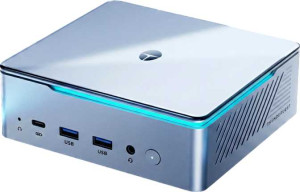
The Thunderobot Mix Pro II adopts a Micro-ATX form factor, keeping its physical footprint compact while still accommodating the components within. Storage is handled by a 1000GB NVMe SSD, which uses the NVMe interface for faster data transfer compared to older SATA-based drives.
The processor runs a hybrid configuration of 6 cores at 2.9 GHz and 8 cores at 2.7 GHz, delivering 16 threads in total and boosting up to 5.4 GHz under turbo conditions. It operates within a 45W TDP envelope and is rated to a maximum temperature of 110 °C, with a clock multiplier of 29 that is locked rather than unlocked. The CPU includes integrated graphics and supports 64-bit processing, backed by 24 MB of L3 cache to help sustain throughput across workloads. Notably, the processor does not use multithreading in the traditional sense, meaning each core maps to a single thread.
The integrated graphics solution features 1024 shading units, 64 texture mapping units, and 32 render output units, with a base clock of 300 MHz that scales up to a turbo frequency of 2350 MHz. It is fabricated on a 3 nm semiconductor process and connects via PCIe 5, supporting up to four displays simultaneously. On the API side, the GPU is compatible with DirectX 12 Ultimate, OpenGL 4.6, and OpenCL 3, covering a broad range of graphics and compute workloads.
The system is equipped with 64GB of DDR5 RAM, providing a substantial amount of working memory for handling demanding multitasking and memory-intensive workloads. The use of DDR5 as the memory standard reflects the platform's more recent architecture, bringing higher bandwidth characteristics inherent to that generation of memory technology.
Wireless connectivity covers Wi-Fi 6E (802.11ax) alongside backward-compatible Wi-Fi 6, Wi-Fi 5, and Wi-Fi 4 standards, paired with Bluetooth 5.3 for peripheral and device pairing. On the wired side, two RJ45 ports provide dual Ethernet connectivity, while the USB layout includes two USB 3.2 Gen 2 Type-A ports, one USB 3.2 Gen 2 Type-C port, one USB 3.2 Gen 1 Type-C port, and a USB 4 40Gbps port — with no USB 2.0, USB 3.2 Gen 1 Type-A, USB 3.2 Gen 2x2, or USB 4 20Gbps ports present. A single Thunderbolt 4 port is included, while there is no Thunderbolt 3. Display output is handled through one HDMI 2.1 port and one DisplayPort, and a 3.5 mm audio jack is available for headset use. The unit does not include a VGA connector or an S/PDIF output.
In PassMark testing, the processor achieves a multi-threaded score of 34,431 and a single-threaded score of 4,475, with the overclocked PassMark result coming in at 34,411 — nearly identical to the standard result. Geekbench 6 testing records a multi-core score of 14,803 alongside a single-core score of 2,611, giving a more granular view of per-core and aggregate CPU throughput across different benchmarking methodologies.
The platform uses a laptop-class processor mounted in a BGA 2049 socket, paired with an Arc 140T GPU that carries 128 execution units. Memory support extends to a maximum of 128GB across two channels, with a peak RAM speed of 8400 MHz, though ECC memory is not supported and there is no external memory slot. The CPU employs big.LITTLE technology for its hybrid core arrangement and includes NX bit support for hardware-level execution protection. It is compatible with a range of instruction sets including AVX2, AES, FMA3, F16C, MMX, AVX, SSE 4.1, and SSE 4.2.