ViewSonic VX2479A-HD-Pro 24" specifications and in-depth review

ViewSonic VX2479A-HD-Pro 24"

Manufacturer: ViewSonic

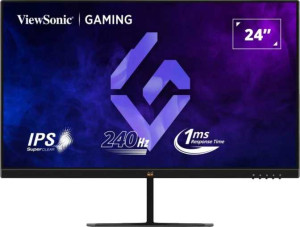
The ViewSonic VX2479A-HD-Pro 24″ is a gaming monitor built around a 23.8-inch IPS panel that delivers a 240Hz refresh rate, making it a straightforward option for users who prioritize smooth motion in fast-paced content. The display carries a matte, anti-glare coating and supports both AMD FreeSync and Nvidia G-Sync Compatible adaptive synchronization technologies. With a 1ms response time and wide 178-degree viewing angles both horizontally and vertically, the screen maintains consistent image clarity across a broad range of positions.

Running at a native resolution of 1920 x 1080 pixels at 92 ppi, the panel renders 16.7 million colors at 8-bit depth with a contrast ratio of 1000:1 and a typical brightness of 250 nits. The sRGB coverage is rated at 102%, and color calibration is supported. Connectivity options include two HDMI 1.4 ports, one DisplayPort 1.4 output, and a 3.5mm audio jack. The monitor supports VESA mounting and tilt adjustment, weighs 3200g, and draws 26W during operation with a 0.5W standby consumption.

Pros
  • The 240Hz refresh rate combined with a 1ms response time makes the display well-suited for fast-paced content where motion clarity matters
  • Support for both AMD FreeSync and Nvidia G-Sync Compatible adaptive sync gives flexibility across different GPU setups
  • The IPS panel offers 178-degree viewing angles both horizontally and vertically, keeping image consistency across a wide range of viewing positions
  • A 102% sRGB coverage with color calibration support provides reasonably accurate color reproduction for a gaming-oriented display
  • The matte, anti-glare coating reduces reflections in typical room lighting conditions
  • VESA mount support allows the monitor to be used with third-party arms or wall mounts
Cons
  • The HDMI ports are version 1.4, which may limit bandwidth for higher refresh rate configurations over that connection
  • There are no USB ports of any kind, including no USB Type-C, reducing peripheral connectivity options directly at the monitor
  • The stand lacks swivel adjustment and does not support portrait mode, restricting ergonomic flexibility
  • The EU energy label is rated F, indicating relatively lower energy efficiency
  • At 250 nits typical brightness, the display may struggle in very bright ambient environments
  • The absence of built-in speakers means a separate audio solution is always required
Who is this for?

This monitor is a solid fit for PC gamers who prioritize smooth, fast gameplay, as the 240Hz refresh rate and 1ms response time are well-matched to titles where motion clarity and input responsiveness matter. The support for both AMD FreeSync and Nvidia G-Sync Compatible adaptive sync makes it a practical choice for users with either GPU brand. The wide 178-degree viewing angles and 102% sRGB coverage with color calibration support also make it reasonable for users who do casual content consumption or light creative work alongside gaming. Those who prefer a matte, non-reflective screen surface in moderately lit rooms will find the anti-glare coating useful in everyday setups.

Who is this NOT for?

Users looking for a monitor to support color-critical professional work such as photo editing or print production may find the 8-bit panel, 250-nit brightness, and 1000:1 contrast ratio insufficient for that level of accuracy and dynamic range. The lack of USB ports and USB Type-C makes it a poor match for those who need a hub-style monitor to connect peripherals directly. The 1920 x 1080 resolution at 23.8 inches may not satisfy users who require sharper text and finer detail for tasks like dense document work or high-resolution media viewing. Additionally, the stand's limited ergonomic range — no swivel, no portrait mode — makes it less suitable for users with specific multi-orientation or accessibility needs.

Display:

Display type LED-backlit, LCD, IPS
response time 1 ms
screen size 23.8"
resolution 1920 x 1080 px
pixel density 92 ppi
Adaptive synchronization AMD FreeSync, Nvidia G-Sync Compatible
has anti-glare coating
refresh rate 240Hz
maximum horizontal viewing angle 178º
maximum vertical viewing angle 178º
has a matte panel
has a glossy panel
has a touch screen

The ViewSonic VX2479A-HD-Pro 24″ features a 23.8-inch LED-backlit LCD IPS panel with a native resolution of 1920 x 1080 pixels and a pixel density of 92 ppi. Its 240Hz refresh rate is paired with a 1ms response time, and the display supports both AMD FreeSync and Nvidia G-Sync Compatible adaptive synchronization to help reduce screen tearing. The panel has a matte, anti-glare coating and is not glossy, with 178-degree viewing angles in both the horizontal and vertical directions. The screen does not support touch input.

General info:

Type Gaming
release date March 2025
EU energy label F
supports total tilt
Has a swivel stand
Supports VESA mount
height 323 mm
width 541 mm
thickness 43 mm
weight 3200 g
supports portrait mode
maximum operating temperature 40 °C
lowest potential operating temperature 0 °C
volume 7513.949 cm³

This is a gaming monitor with an EU energy label of F, measuring 541 mm wide, 323 mm tall, and 43 mm thick, with a total volume of 7513.949 cm³ and a weight of 3200 g. The stand supports tilt adjustment but does not include swivel functionality, and the monitor does not support portrait mode. VESA mounting is supported for alternative mounting setups. Operating temperatures range from 0 °C at the low end to a maximum of 40 °C, defining the conditions under which the monitor is rated to function.

Colors:

brightness (typical) 250 nits
supports color calibration
display colors 16.7 million
bit depth 8-bit
contrast ratio 1000:1
sRGB coverage 102%

The display renders 16.7 million colors at an 8-bit depth, with a 102% sRGB coverage that slightly exceeds the standard color space. Typical brightness is rated at 250 nits, and the contrast ratio stands at 1000:1. Color calibration is supported, allowing for adjustments to color output accuracy.

Connectivity:

HDMI ports 2
supports Thunderbolt
DisplayPort outputs 1
DisplayPort version DisplayPort 1.4
has a socket for a 3.5 mm audio jack
has a DVI connector
USB ports 0
Has USB Type-C
HDMI version HDMI 1.4
supports Ethernet
supports Wi-Fi
has AirPlay
mini DisplayPort outputs 0
has a VGA connector

The monitor provides video input through two HDMI 1.4 ports and one DisplayPort 1.4 output, with no mini DisplayPort, DVI, or VGA connectors available. A 3.5mm audio jack is included for headset or audio output use. There are no USB ports on the monitor, and it does not support USB Type-C or Thunderbolt connectivity. Wireless and network options are absent, as the monitor lacks Wi-Fi, Ethernet, and AirPlay support.

Power:

operating power consumption 26W
standby power consumption 0.5W

The monitor draws 26W during normal operation and drops to 0.5W in standby mode.

Features:

has PiP
has stereo speakers
has built-in smart TV
has a remote control
supports Dolby Digital
supports Dolby Digital Plus
has DTS Surround
has an ambient light sensor
has a front camera

The monitor does not include stereo speakers or any audio format support such as Dolby Digital, Dolby Digital Plus, or DTS Surround. There is no Picture-in-Picture functionality, remote control, ambient light sensor, or front camera. Built-in smart TV capability is also absent.

Final Verdict

The ViewSonic VX2479A-HD-Pro 24″ is a gaming-focused monitor whose specifications align clearly with its intended purpose. Its 240Hz refresh rate paired with 1ms response time and dual adaptive sync support position it well for users who want responsive, tear-free gameplay across both major GPU platforms. The IPS panel with wide viewing angles and 102% sRGB coverage adds a degree of versatility beyond pure gaming use. That said, the 1080p resolution, limited ergonomic stand, absent USB connectivity, and modest brightness define a product with a focused rather than broad appeal. For a dedicated gaming display in a typical desktop setup, the VX2479A-HD-Pro delivers on its core promises — but users with needs extending into professional color work, extensive peripheral connectivity, or sharper pixel density will find its specification set limiting.