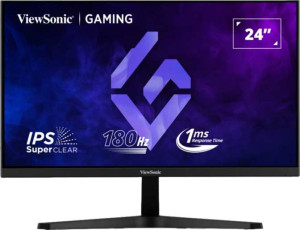
The Display section of the ViewSonic VX24G1-HD is built around a 23.8-inch LED-backlit IPS LCD panel running at a native resolution of 1920 x 1080 pixels and a pixel density of 92 ppi. With a 180Hz refresh rate and a 1ms response time, it is clearly oriented toward gaming use. The panel supports Nvidia G-Sync Compatible adaptive synchronization to reduce screen tearing, and offers wide viewing angles of 178 degrees both horizontally and vertically. Its matte, anti-glare coating minimizes reflections without a glossy finish, and the display does not feature touch input.
This gaming monitor measures 542 mm wide, 322 mm tall, and 45 mm thick, with a total weight of 2700 g. It supports tilt adjustment and is compatible with VESA mounting, offering some flexibility in how it can be positioned or installed. The stand does not include swivel functionality, and the monitor cannot be rotated into portrait mode. Its volume comes in at 7853.58 cm³, and it is rated to operate within a temperature range of 0 °C to 40 °C.
The monitor renders up to 16.7 million colors at an 8-bit depth, backed by a 111% sRGB coverage that extends slightly beyond the standard gamut. Its contrast ratio stands at 1000:1, and the display supports color calibration, allowing for adjustments to better suit specific use cases or preferences.
For video input, the monitor provides two HDMI 2.0 ports and one DisplayPort 1.4 output, covering the most common connection types in use today. A 3.5mm headset jack is also included for audio passthrough. The monitor does not offer USB ports of any kind, including USB Type-C, nor does it include DVI, VGA, or mini DisplayPort connectors. Wireless connectivity options such as Wi-Fi, Ethernet, AirPlay, and Thunderbolt are likewise absent.
The monitor draws 23W during normal operation and drops to a minimal 0.5W in standby mode, reflecting a modest and energy-conscious power profile.
This monitor does not include built-in stereo speakers, a front camera, or an ambient light sensor, keeping its feature set focused on display output rather than peripheral functions. It lacks PiP support, a remote control, and smart TV functionality, and does not support any audio formats such as Dolby Digital, Dolby Digital Plus, or DTS Surround.