ViewSonic XG275D-4K 27" specifications and in-depth review

ViewSonic XG275D-4K 27"

Manufacturer: ViewSonic

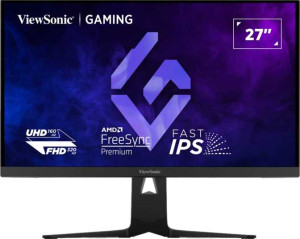
The ViewSonic XG275D-4K 27-inch is a gaming monitor built around a 4K IPS panel that targets users who want both sharp detail and fluid motion in a single display. Its 160Hz refresh rate paired with a 0.5ms response time positions it toward competitive and enthusiast gaming use, while the inclusion of AMD FreeSync Premium and Nvidia G-Sync Compatible support broadens its compatibility across GPU brands. The matte, anti-glare surface helps manage reflections in varied lighting conditions.

On the color side, the panel covers 99% of the sRGB color space with a 10-bit bit depth capable of displaying 1.07 billion colors, alongside a typical brightness of 300 nits and a 1000:1 contrast ratio. Connectivity includes two HDMI 2.1 ports, one DisplayPort output, a USB Type-C port, and a 3.5mm audio jack, with built-in stereo speakers rated at 2x2W. The stand supports tilt, swivel, height adjustment, and portrait rotation, and the monitor is also VESA mount compatible, weighing in at 6.3kg with overall dimensions of 614x365x66mm.

Pros
  • The IPS panel delivers wide 178-degree viewing angles both horizontally and vertically, ensuring consistent image quality from off-center positions
  • Adaptive sync support covers both AMD FreeSync Premium and Nvidia G-Sync Compatible, making it usable across a broad range of graphics card setups
  • The stand supports tilt, swivel, height adjustment, and portrait mode rotation, offering meaningful ergonomic flexibility
  • Two HDMI 2.1 ports alongside a DisplayPort output and a USB Type-C connection provide a solid variety of modern video input options
  • A 10-bit panel with 99% sRGB coverage and support for color calibration makes color output adjustable and consistent
  • Standby power consumption is just 0.5W, indicating efficient idle power use
Cons
  • Built-in speakers are limited to 2x2W with no support for Dolby Digital, Dolby Digital Plus, or DTS Surround, restricting audio quality
  • There is no Ethernet or Wi-Fi connectivity, so the monitor cannot be networked independently
  • Picture-in-Picture mode is not supported, limiting multitasking display options
  • Only one additional USB port is available, which may be insufficient for users needing a hub-like setup
  • No ambient light sensor is present, so brightness cannot adjust automatically to room lighting conditions
Who is this for?

This monitor suits users who want a 4K gaming experience with smooth motion, thanks to its 160Hz refresh rate, 0.5ms response time, and support for both AMD FreeSync Premium and Nvidia G-Sync Compatible adaptive sync. The wide 178-degree viewing angles, 99% sRGB coverage, and color calibration support also make it a reasonable fit for content creators or designers who need accurate color reproduction in a single versatile display. The flexible stand with tilt, swivel, and portrait mode rotation, combined with VESA mount compatibility, means it adapts well to varied desk setups and ergonomic preferences.

Who is this NOT for?

Users who depend on extensive USB connectivity for peripherals will find the single USB port limiting, as the monitor offers minimal hub functionality. Those who require immersive audio from built-in speakers will be underserved, given the modest 2x2W output and absence of Dolby Digital or DTS Surround support. The monitor also lacks Picture-in-Picture, an ambient light sensor, and any wireless connectivity, making it a poor match for users who prioritize multitasking display modes or need the display to adapt automatically to changing room lighting conditions.

Display:

Display type LED-backlit, LCD, IPS
response time 0.5 ms
screen size 26.9"
resolution 3840 x 2160 px
pixel density 163 ppi
Adaptive synchronization AMD FreeSync Premium, Nvidia G-Sync Compatible
has anti-glare coating
refresh rate 160Hz
maximum horizontal viewing angle 178º
maximum vertical viewing angle 178º
has a matte panel
has a glossy panel
has a touch screen

The ViewSonic XG275D-4K features a 26.9-inch LED-backlit IPS LCD panel with a 3840x2160 resolution and a pixel density of 163 ppi, delivering a detailed image across the screen. It runs at a 160Hz refresh rate with a 0.5ms response time, and supports both AMD FreeSync Premium and Nvidia G-Sync Compatible adaptive synchronization to help reduce screen tearing. Viewing angles reach 178 degrees horizontally and vertically, while the matte, anti-glare surface reduces reflections without a glossy finish. The display does not support touch input.

General info:

Type Gaming
supports total tilt
Has a swivel stand
Supports VESA mount
height 365 mm
width 614 mm
thickness 66 mm
weight 6300 g
supports portrait mode
maximum operating temperature 40 °C
lowest potential operating temperature 0 °C
volume 14791.26 cm³

This is a gaming-category monitor with a physical footprint of 614mm wide, 365mm tall, and 66mm thick, weighing 6,300g. The stand supports tilt, swivel, and portrait mode rotation, offering a reasonable degree of ergonomic flexibility, and the display is also compatible with VESA mounting for wall or arm installations. Operating temperatures range from 0°C to 40°C, and the unit has a total volume of 14,791.26 cm³.

Colors:

brightness (typical) 300 nits
supports color calibration
display colors 1070 million
bit depth 10-bit
contrast ratio 1000:1
sRGB coverage 99%

The display offers a typical brightness of 300 nits and a contrast ratio of 1000:1, with a 10-bit bit depth enabling a total of 1,070 million colors. It covers 99% of the sRGB color space and supports color calibration, which allows for manual adjustment of color output accuracy. These figures collectively describe the panel's color rendering capabilities as specified.

Connectivity:

HDMI ports 2
supports Thunderbolt
DisplayPort outputs 1
has a socket for a 3.5 mm audio jack
has a DVI connector
USB ports 1
Has USB Type-C
HDMI version HDMI 2.1
supports Ethernet
supports Wi-Fi
has AirPlay
mini DisplayPort outputs 0
has a VGA connector

The monitor provides two HDMI 2.1 ports alongside one DisplayPort output and a USB Type-C port, covering the most common modern video input options, while a single additional USB port is also available. A 3.5mm audio jack is included for headset or speaker connectivity. There is no DVI, VGA, mini DisplayPort, or Thunderbolt support, and the monitor does not include Ethernet, Wi-Fi, or AirPlay, making it a wired-only display in terms of both video and network connectivity.

Power:

operating power consumption 46W
standby power consumption 0.5W

During normal operation, the monitor draws 46W of power, while in standby mode consumption drops significantly to just 0.5W.

Features:

has PiP
has stereo speakers
has built-in smart TV
audio output power 2 x 2W
has a remote control
supports Dolby Digital
supports Dolby Digital Plus
has DTS Surround
has an ambient light sensor
has a front camera

The monitor includes built-in stereo speakers with a combined audio output of 2x2W, providing basic audio without the need for external speakers. It does not support Dolby Digital, Dolby Digital Plus, or DTS Surround sound formats, and there is no remote control included. Additional features such as Picture-in-Picture, an ambient light sensor, a front camera, and built-in smart TV functionality are all absent from this model.
Final Verdict

The ViewSonic XG275D-4K 27-inch brings together a 4K IPS panel, a 160Hz refresh rate, and broad adaptive sync compatibility into a single gaming-oriented display that also holds enough color accuracy credentials to serve light creative work. Its ergonomic stand, VESA compatibility, and a solid spread of modern video inputs — including two HDMI 2.1 ports and USB Type-C — add practical day-to-day flexibility. Where it falls short is in peripheral connectivity and audio, areas where its spec sheet is noticeably thin. Still, for users whose primary need is a high-resolution, high-refresh-rate gaming display with reliable color output, the XG275D-4K delivers a well-rounded specification set that covers the essentials without significant compromise in its core use case.