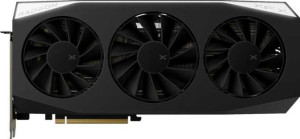
XFX Mercury Radeon RX 9060 XT OC Gaming Edition 16GB specifications and in-depth review

XFX Mercury Radeon RX 9060 XT OC Gaming Edition 16GB

Manufacturer: XFX

The XFX Mercury Radeon RX 9060 XT OC Gaming Edition is a graphics card built on AMD's RDNA 4.0 architecture, manufactured on a 4 nm process node with 29.7 billion transistors. It ships with 16GB of GDDR6 video memory across a 128-bit bus, delivering an effective memory speed of 20000 MHz and a maximum bandwidth of 322.3 GB/s. RGB lighting is included, and the card carries a three-year warranty.

At its core, the GPU houses 2048 shading units, 128 texture mapping units, and 64 render output units, producing a texture rate of 425 GTexels/s and a pixel fill rate of 212.5 GPixel/s. The base clock runs at 1900 MHz with a boost frequency reaching 3320 MHz, yielding 27.2 TFLOPS of single-precision floating-point performance. The card supports DirectX 12 Ultimate, OpenGL 4.6, ray tracing, AMD FSR4, and AMD SAM, with a TDP of 160W and a PCIe 5 interface. Display output consists of one HDMI 2.1b port and two DisplayPort connectors, supporting up to three simultaneous displays.

Pros
  • 16GB of GDDR6 VRAM provides a generous frame buffer for demanding workloads and high-resolution textures
  • The 3320 MHz boost clock and 27.2 TFLOPS of compute output indicate strong processing headroom for graphics-intensive tasks
  • Ray tracing support is included, enabling more realistic lighting and shadow rendering
  • AMD FSR4 upscaling is supported, allowing for improved frame rendering efficiency without relying on external upscaling ecosystems
  • ECC memory support adds a layer of data integrity useful for compute and content creation workloads
  • RGB lighting is built in, offering visual customization options for system builds where aesthetics matter
Cons
  • The 128-bit memory bus is relatively narrow for a card carrying 16GB of VRAM, which may limit sustained memory throughput in certain scenarios
  • DLSS and XeSS (XMX) are not supported, limiting upscaling options to AMD FSR4 only
  • With only one HDMI port and no USB-C or mini DisplayPort outputs, connectivity flexibility is limited for multi-monitor setups beyond three displays
  • Water cooling is not supported, leaving thermal management entirely dependent on the air-cooling solution
  • A 160W TDP requires adequate case airflow and power delivery planning, particularly in compact system builds
Who is this for?

This card is well-suited to users working with high-resolution gaming and content creation, where the 16GB GDDR6 VRAM and 27.2 TFLOPS of compute performance provide meaningful headroom for texture-heavy scenes and complex rendering pipelines. The inclusion of ray tracing and AMD FSR4 makes it a practical fit for those who want enhanced visual fidelity with upscaling support built in. ECC memory support also makes it appealing for compute and prosumer workloads where data integrity is a consideration, while the three-display output capability suits users running multi-monitor setups for productivity or immersive gaming environments.

Who is this NOT for?

Users requiring the broadest possible upscaling ecosystem may find this card limiting, as DLSS and XeSS are not supported, leaving FSR4 as the only upscaling option. The 128-bit memory bus, while paired with a high effective memory speed, may not satisfy those pushing very high bandwidth workloads such as large-scale AI inference or professional visualization tasks that benefit from wider bus configurations. Additionally, users building in small form-factor cases should be mindful of the 320 mm card length and the reliance on air cooling alone, making it less ideal for compact or thermally constrained builds.

Performance:

GPU clock speed 1900 MHz
GPU turbo 3320 MHz
pixel rate 212.5 GPixel/s
floating-point performance 27.2 TFLOPS
texture rate 425 GTexels/s
GPU memory speed 2518 MHz
shading units 2048
texture mapping units (TMUs) 128
render output units (ROPs) 64
Has Double Precision Floating Point (DPFP)

The GPU operates at a base clock of 1900 MHz, climbing to a boost frequency of 3320 MHz, and delivers 27.2 TFLOPS of floating-point performance alongside a texture rate of 425 GTexels/s and a pixel fill rate of 212.5 GPixel/s. Underpinning these figures are 2048 shading units, 128 texture mapping units, and 64 render output units, while the GPU memory itself runs at 2518 MHz. The card also supports Double Precision Floating Point (DPFP), broadening its suitability for compute-oriented workloads.

Memory:

effective memory speed 20000 MHz
maximum memory bandwidth 322.3 GB/s
VRAM 16GB
GDDR version GDDR6
memory bus width 128-bit
Supports ECC memory

The card is equipped with 16GB of GDDR6 VRAM running at an effective speed of 20000 MHz across a 128-bit memory bus, yielding a maximum memory bandwidth of 322.3 GB/s. ECC memory support is also present, adding a layer of data integrity for workloads where memory accuracy is a concern.

Features:

DirectX version DirectX 12 Ultimate
OpenGL version 4.6
OpenCL version 2.2
Supports multi-display technology
supports ray tracing
Supports 3D
supports DLSS
has FSR4
has XeSS (XMX)
AMD SAM / Intel Resizable BAR AMD SAM
has LHR
has RGB lighting
supported displays 3

The card supports DirectX 12 Ultimate, OpenGL 4.6, and OpenCL 2.2, covering a broad range of graphics and compute workloads. Ray tracing and stereoscopic 3D are both supported, and AMD FSR4 is available for upscaling, while DLSS and XeSS (XMX) are not supported. AMD SAM (Smart Access Memory) is included to help optimize data throughput between the CPU and GPU. Multi-display technology is supported with a maximum of three simultaneous displays, and the card features RGB lighting. LHR (Lite Hash Rate) limitations are not present on this model.

Ports:

has an HDMI output
HDMI ports 1
HDMI version HDMI 2.1b
DisplayPort outputs 2
USB-C ports 0
DVI outputs 0
mini DisplayPort outputs 0

The card's output configuration consists of one HDMI 2.1b port and two DisplayPort outputs, providing a total of three display connections. There are no USB-C, DVI, or mini DisplayPort outputs present on this model.

General info:

GPU architecture RDNA 4.0
Thermal Design Power (TDP) 160W
PCI Express (PCIe) version 5
semiconductor size 4 nm
number of transistors 29700 million
warranty period 3 years
Has air-water cooling
width 320 mm
height 127 mm

Built on the RDNA 4.0 architecture and fabricated using a 4 nm process, the GPU integrates 29,700 million transistors and connects via a PCIe 5 interface. It carries a Thermal Design Power of 160W and measures 320 mm in width and 127 mm in height, with cooling handled entirely by air rather than a water-cooling solution. The card comes backed by a 3-year warranty.

Final Verdict

The XFX Mercury Radeon RX 9060 XT OC Gaming Edition brings together a well-rounded specification set centered on its 16GB GDDR6 VRAM and RDNA 4.0 architecture, making it a capable option for users who prioritize generous memory capacity, ray tracing support, and AMD FSR4 upscaling in a single package. Its 27.2 TFLOPS of compute output, ECC memory support, and three-display connectivity give it practical breadth across both gaming and light prosumer scenarios. Those operating within AMD-centric ecosystems and needing a card with solid thermal headroom through air cooling will find it a coherent fit, though users with strict bandwidth demands or a preference for broader upscaling compatibility should weigh the 128-bit bus and absence of DLSS and XeSS accordingly. On balance, it is a focused, well-specified graphics card that delivers meaningfully within its intended use profile.