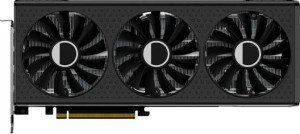
XFX Speedster QICK 309 Radeon RX 7600 XT specifications and in-depth review

XFX Speedster QICK 309 Radeon RX 7600 XT

Manufacturer: XFX

The XFX Speedster QICK 309 Radeon RX 7600 XT is a mid-range graphics card from XFX based on AMD's RDNA 3.0 architecture, manufactured using a 6 nm process with 13,300 million transistors. It operates at a base clock of 2029 MHz and reaches a turbo clock of 2810 MHz, delivering 23.02 TFLOPS of floating-point performance alongside a texture rate of 359.7 GTexels/s. The card carries a TDP of 190W and measures 302 mm in length and 114 mm in height.

On the memory side, the card is equipped with 16GB of GDDR6 VRAM across a 128-bit bus, running at an effective speed of 18000 MHz and offering up to 288 GB/s of bandwidth, with ECC memory support included. Feature support covers DirectX 12 Ultimate, OpenGL 4.6, OpenCL 2.2, ray tracing, AMD SAM, and stereoscopic 3D, while DLSS and XeSS are not supported. Connectivity is handled through one HDMI 2.1 port and three DisplayPort outputs, enabling up to four simultaneous displays over PCIe 4.0.

Pros
  • Generous 16GB of GDDR6 VRAM on a card in this segment provides ample headroom for memory-intensive workloads and high-resolution textures
  • ECC memory support adds a layer of data reliability useful for compute and content creation tasks
  • Ray tracing support is included, enabling hardware-accelerated lighting effects in compatible titles and applications
  • Supports up to four displays simultaneously through a practical mix of one HDMI 2.1 and three DisplayPort outputs
  • AMD SAM support allows compatible systems to access the full VRAM pool, potentially improving frame delivery
  • Double Precision Floating Point (DPFP) support broadens the card's suitability for compute-oriented use cases beyond gaming
Cons
  • 128-bit memory bus width is relatively narrow, which limits the scalability of memory bandwidth despite the high effective clock speed
  • Neither DLSS nor XeSS upscaling technologies are supported, leaving users without AI-based resolution scaling options
  • A 190W TDP places a moderate power demand on the system, requiring an adequately rated PSU and sufficient case airflow
  • No USB-C output is available, which may limit compatibility with certain modern monitors or display adapters
  • No RGB lighting is present for users building systems where visual aesthetics are a consideration
Who is this for?

This card is well-suited for users who work across content creation and compute-intensive tasks, where the generous 16GB of GDDR6 VRAM and Double Precision Floating Point support provide meaningful headroom for handling large datasets, textures, and parallel workloads. The inclusion of ECC memory makes it a reasonable fit for those who require data integrity in professional or semi-professional workflows. It also appeals to users running multi-monitor setups, as the four-display output capability — combining HDMI 2.1 and three DisplayPort connections — covers a wide range of productivity and creative configurations. AMD SAM support further benefits users on compatible platforms looking to extract consistent frame delivery in graphically demanding scenarios.

Who is this NOT for?

Users who rely heavily on AI-based upscaling technologies such as DLSS or XeSS will find this card lacking, as neither is supported, which narrows options for resolution scaling in compatible titles and applications. The 128-bit memory bus, while paired with fast GDDR6 memory, may feel restrictive for workloads that demand sustained high-bandwidth throughput at scale. Additionally, the 190W TDP means this card is not a good match for compact or low-power builds where thermal headroom and power delivery are tightly constrained, and users prioritizing a visually cohesive system aesthetic will note the absence of RGB lighting.

Performance:

GPU clock speed 2029 MHz
GPU turbo 2810 MHz
pixel rate 179.8 GPixel/s
floating-point performance 23.02 TFLOPS
texture rate 359.7 GTexels/s
GPU memory speed 2250 MHz
shading units 2048
texture mapping units (TMUs) 128
render output units (ROPs) 64
Has Double Precision Floating Point (DPFP)

The XFX Speedster QICK 309 Radeon RX 7600 XT runs at a base GPU clock of 2029 MHz, boosting up to 2810 MHz in turbo mode, and delivers 23.02 TFLOPS of floating-point performance alongside a texture rate of 359.7 GTexels/s and a pixel rate of 179.8 GPixel/s. Its 2048 shading units are complemented by 128 texture mapping units and 64 render output units, while the GPU memory operates at 2250 MHz. The card also supports Double Precision Floating Point (DPFP), rounding out a solid set of compute-oriented capabilities.

Memory:

effective memory speed 18000 MHz
maximum memory bandwidth 288 GB/s
VRAM 16GB
GDDR version GDDR6
memory bus width 128-bit
Supports ECC memory

The card comes equipped with 16GB of GDDR6 VRAM running at an effective speed of 18000 MHz over a 128-bit memory bus, providing a maximum memory bandwidth of 288 GB/s. ECC memory support is also included, adding a layer of data integrity for workloads that benefit from error correction.

Features:

DirectX version DirectX 12 Ultimate
OpenGL version 4.6
OpenCL version 2.2
Supports multi-display technology
supports ray tracing
Supports 3D
supports DLSS
has XeSS (XMX)
AMD SAM / Intel Resizable BAR AMD SAM
has LHR
has RGB lighting
supported displays 4

The card supports DirectX 12 Ultimate, OpenGL 4.6, and OpenCL 2.2, covering a broad range of graphics and compute APIs. Ray tracing and stereoscopic 3D are both supported, while multi-display technology allows connection of up to four screens simultaneously. AMD SAM (Smart Access Memory) is present to help optimize data throughput between the GPU and compatible systems. On the other hand, DLSS and XeSS (XMX) are not supported, and the card lacks both LHR and RGB lighting.

Ports:

has an HDMI output
HDMI ports 1
HDMI version HDMI 2.1
DisplayPort outputs 3
USB-C ports 0
DVI outputs 0
mini DisplayPort outputs 0

The card's output configuration consists of one HDMI 2.1 port and three DisplayPort outputs, offering a total of four display connections. There are no USB-C, DVI, or mini DisplayPort outputs present on this model.

General info:

GPU architecture RDNA 3.0
Thermal Design Power (TDP) 190W
PCI Express (PCIe) version 4
semiconductor size 6 nm
number of transistors 13300 million
Has air-water cooling
width 302 mm
height 114 mm

Built on AMD's RDNA 3.0 architecture and fabricated using a 6 nm process, this card integrates 13,300 million transistors and connects via PCIe 4.0. It carries a Thermal Design Power of 190W and measures 302 mm in width and 114 mm in height, making physical fitment a consideration in smaller builds. Cooling is handled without an air-water hybrid solution, as that option is not present on this model.

Final Verdict

The XFX Speedster QICK 309 Radeon RX 7600 XT presents a well-rounded specification sheet anchored by its 16GB of GDDR6 VRAM and RDNA 3.0 architecture, making it a credible option for users who prioritize memory capacity and compute capability alongside gaming. ECC support, Double Precision Floating Point, AMD SAM, and a four-display output configuration add genuine utility for creative and productivity-focused users. Where it falls short — namely the absence of AI upscaling support and the constraints of a 128-bit bus — limits its appeal for those seeking the broadest feature set. On balance, this card is best directed at users who can leverage its memory and compute strengths and are working within compatible platform ecosystems, making it a purposeful rather than universal choice within the graphics card category.