Design:
| Uses a fanless design |
✕ |
| Has a backlit keyboard |
✕ |
| is weather-sealed (splashproof) |
✕ |
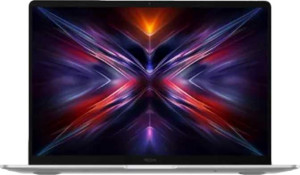
The Redmibook 14 (2025) does not adopt a fanless design, meaning it relies on active cooling to manage heat during operation. It also lacks a backlit keyboard, which may be a consideration for those who frequently work in low-light environments. Additionally, the laptop does not carry any weather-sealing or splashproof certification, so it offers no rated protection against moisture exposure.
Display:
| screen size |
14" |
| has a touch screen |
✕ |
| has anti-reflection coating |
✕ |
| supported displays |
4 |
The Redmibook 14 (2025) features a 14-inch screen that does not support touch input, so interaction is limited to the keyboard and trackpad. The display also lacks an anti-reflection coating, which means glare may be noticeable in brightly lit settings. On the multi-display front, the integrated graphics support up to four simultaneous external displays, offering reasonable flexibility for users who work across multiple screens.
Performance:
| RAM |
32GB |
| Uses flash storage |
✓ |
| internal storage |
1024GB |
| CPU speed |
4 x 2.7 & 8 x 2 GHz |
| CPU threads |
16 threads |
| Is an NVMe SSD |
✓ |
| DirectX version |
DirectX 12 Ultimate |
| uses multithreading |
✓ |
| maximum memory amount |
96GB |
| DDR memory version |
5 |
| turbo clock speed |
4.9GHz |
| GPU turbo |
1500 MHz |
| PCI Express (PCIe) version |
5 |
| semiconductor size |
10 nm |
| Supports 64-bit |
✓ |
The Redmibook 14 (2025) comes equipped with 32GB of DDR5 RAM, expandable up to 96GB, paired with a 1TB NVMe SSD that uses flash storage for fast data access. The processor runs across 16 threads with multithreading enabled, operating at a split configuration of four cores at 2.7 GHz and eight cores at 2 GHz, with a turbo ceiling of 4.9 GHz. Built on a 10nm process and supporting 64-bit computing, the chip connects via PCIe 5 for high-bandwidth storage throughput. On the graphics side, the integrated GPU reaches a turbo frequency of 1500 MHz and is compatible with DirectX 12 Ultimate, rounding out a performance profile suited to a range of everyday and moderately demanding computing tasks.
Benchmarks:
| PassMark result |
21268 |
| PassMark result (single) |
3120 |
In PassMark testing, the Redmibook 14 (2025) achieves a multi-threaded score of 21,268, reflecting the processor's ability to handle parallel workloads across its full thread count. The single-core result of 3,120 gives an indication of per-core performance, which is relevant for tasks that rely heavily on single-threaded execution rather than spreading work across multiple cores.
Connectivity:
| supports Wi-Fi |
✓ |
| has AirPlay |
✓ |
| has a VGA connector |
✕ |
The Redmibook 14 (2025) includes Wi-Fi support for wireless network connectivity and is compatible with AirPlay, allowing wireless streaming to supported displays and audio devices. It does not feature a VGA connector, so users requiring a legacy video output connection would need to use an alternative interface.
Battery:
| Battery life |
13.8 hours |
| Has sleep-and-charge USB ports |
✓ |
| Has a MagSafe power adapter |
✕ |
The Redmibook 14 (2025) is rated for 13.8 hours of battery life, making it a reasonable option for extended use away from a power source. It includes sleep-and-charge USB ports, which allow connected devices to be charged even when the laptop is powered off or in sleep mode. The machine does not use a MagSafe power adapter, so charging relies on a standard connector instead.
Features:
| has stereo speakers |
✓ |
| has a socket for a 3.5 mm audio jack |
✓ |
| supports ray tracing |
✕ |
| supports DLSS |
✕ |
| has Dolby Atmos |
✕ |
| Stylus included |
✕ |
| Has a fingerprint scanner |
✕ |
| number of microphones |
1 |
| Uses 3D facial recognition |
✕ |
| has voice commands |
✕ |
| has a front camera |
✓ |
| Has S/PDIF Out port |
✕ |
| has a gyroscope |
✕ |
| has GPS |
✕ |
| has an accelerometer |
✕ |
| has a compass |
✕ |
| Has an optical disc drive |
✕ |
The Redmibook 14 (2025) includes stereo speakers, a 3.5mm headset jack, and a single built-in microphone for audio input, while a front-facing camera is present for video calls. It does not support Dolby Atmos, and there is no S/PDIF output port for digital audio. On the security side, the laptop lacks both a fingerprint scanner and 3D facial recognition, and voice commands are not supported. Graphics-related features such as ray tracing and DLSS are absent, and no stylus is included. The device also omits motion and location sensors — there is no gyroscope, accelerometer, compass, or GPS — and it does not have an optical disc drive.
Miscellaneous:
| clock multiplier |
27 |
| Type |
Laptop |
| instruction sets |
MMX, F16C, FMA3, AES, AVX, AVX2, SSE 4.1, SSE 4.2 |
| Has an unlocked multiplier |
✕ |
| L3 cache |
18 MB |
| Has NX bit |
✓ |
| CPU temperature |
100 °C |
| OpenCL version |
3 |
| OpenGL version |
4.6 |
| GPU execution units |
80 |
| Has integrated graphics |
✓ |
| Supports ECC memory |
✕ |
| memory channels |
2 |
| RAM speed (max) |
6400 MHz |
| Thermal Design Power (TDP) |
45W |
| Uses big.LITTLE technology |
✓ |
The laptop-class processor carries a clock multiplier of 27 and a 45W TDP, with a maximum rated temperature of 100°C; the multiplier is locked, so clock speed adjustment is not available. It employs big.LITTLE technology to distribute workloads across its core types and supports a broad set of instruction sets including MMX, F16C, FMA3, AES, AVX, AVX2, SSE 4.1, and SSE 4.2, alongside NX bit support for hardware-level memory protection. The chip features an 18MB L3 cache and operates across two memory channels, with RAM speeds reaching up to 6400 MHz; ECC memory is not supported. Integrated graphics are present, backed by 80 execution units, and the GPU is compatible with OpenCL 3 and OpenGL 4.6.