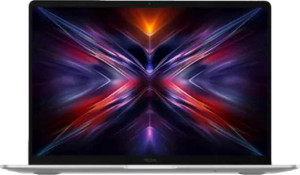
Design:
| Uses a fanless design |
✕ |
| Has a backlit keyboard |
✕ |
| is weather-sealed (splashproof) |
✕ |
The Xiaomi Redmibook 14 (2025) does not adopt a fanless design, meaning it relies on active cooling to manage heat during operation. It also lacks a backlit keyboard, which may be a consideration for users who frequently work in low-light environments. Additionally, the laptop is not weather-sealed or splashproof, so it offers no rated protection against moisture or water exposure.
Display:
| screen size |
14" |
| has a touch screen |
✕ |
| has anti-reflection coating |
✕ |
| supported displays |
4 |
The Xiaomi Redmibook 14 (2025) features a 14-inch screen and supports up to 4 external displays simultaneously, making it a capable option for multi-monitor setups. The panel does not include a touchscreen, so interaction is limited to traditional input methods. It also lacks an anti-reflection coating, which may affect visibility in brightly lit or high-glare environments.
Performance:
| RAM |
16GB |
| Uses flash storage |
✓ |
| internal storage |
1024GB |
| CPU speed |
4 x 2.7 & 8 x 2 GHz |
| CPU threads |
16 threads |
| Is an NVMe SSD |
✓ |
| DirectX version |
DirectX 12 Ultimate |
| uses multithreading |
✓ |
| maximum memory amount |
96GB |
| DDR memory version |
5 |
| turbo clock speed |
4.9GHz |
| GPU turbo |
1500 MHz |
| PCI Express (PCIe) version |
5 |
| semiconductor size |
10 nm |
| Supports 64-bit |
✓ |
The Redmibook 14 (2025) is equipped with 16GB of DDR5 RAM, expandable up to 96GB, paired with a 1024GB NVMe SSD that uses flash storage for fast read and write speeds. The processor runs across 16 threads with multithreading support, combining four cores at 2.7GHz and eight cores at 2.0GHz, with a turbo clock speed reaching 4.9GHz — all built on a 10nm semiconductor process. The platform supports PCIe 5 and is fully 64-bit compatible, while the integrated GPU boosts up to 1500MHz and supports DirectX 12 Ultimate, rounding out a performance profile suited for both everyday tasks and moderately demanding workloads.
Benchmarks:
| PassMark result |
21268 |
| PassMark result (single) |
3120 |
In benchmark testing, the Redmibook 14 (2025) achieves a PassMark multi-core score of 21,268, reflecting solid multi-threaded processing capability. Its single-core PassMark result of 3,120 indicates how the processor performs on tasks that rely on one thread at a time, which is relevant for many common desktop applications and workflows.
Connectivity:
| supports Wi-Fi |
✓ |
| has AirPlay |
✓ |
| has a VGA connector |
✕ |
The Redmibook 14 (2025) includes Wi-Fi support for wireless network connectivity and features AirPlay, enabling wireless streaming and screen mirroring with compatible devices. It does not have a VGA connector, so users requiring a legacy display connection would need an appropriate adapter.
Battery:
| Battery life |
13.8 hours |
| Has sleep-and-charge USB ports |
✓ |
| Has a MagSafe power adapter |
✕ |
The Redmibook 14 (2025) is rated for 13.8 hours of battery life, offering a reasonable amount of unplugged use for day-to-day tasks. It includes sleep-and-charge USB ports, allowing connected devices to be charged even when the laptop is in sleep mode. The laptop does not use a MagSafe power adapter, so charging relies on a standard connector instead.
Features:
| has stereo speakers |
✓ |
| has a socket for a 3.5 mm audio jack |
✓ |
| supports ray tracing |
✕ |
| supports DLSS |
✕ |
| has Dolby Atmos |
✕ |
| Stylus included |
✕ |
| Has a fingerprint scanner |
✕ |
| number of microphones |
1 |
| Uses 3D facial recognition |
✕ |
| has voice commands |
✕ |
| has a front camera |
✓ |
| Has S/PDIF Out port |
✕ |
| has a gyroscope |
✕ |
| has GPS |
✕ |
| has an accelerometer |
✕ |
| has a compass |
✕ |
| Has an optical disc drive |
✕ |
The Redmibook 14 (2025) includes stereo speakers, a 3.5mm headphone jack, and a single built-in microphone, covering the basics for audio input and output. A front camera is present for video calls, though the laptop does not offer a fingerprint scanner, 3D facial recognition, or voice command support for biometric or hands-free access. On the graphics and audio enhancement side, it does not support ray tracing, DLSS, or Dolby Atmos, and there is no S/PDIF output port. The device also omits motion and location sensors — there is no gyroscope, accelerometer, compass, or GPS — and it comes without a stylus or an optical disc drive.
Miscellaneous:
| clock multiplier |
27 |
| Type |
Laptop |
| instruction sets |
MMX, F16C, FMA3, AES, AVX, AVX2, SSE 4.1, SSE 4.2 |
| Has an unlocked multiplier |
✕ |
| L3 cache |
18 MB |
| Has NX bit |
✓ |
| CPU temperature |
100 °C |
| OpenCL version |
3 |
| OpenGL version |
4.6 |
| GPU execution units |
80 |
| Has integrated graphics |
✓ |
| Supports ECC memory |
✕ |
| memory channels |
2 |
| RAM speed (max) |
6400 MHz |
| Thermal Design Power (TDP) |
45W |
| Uses big.LITTLE technology |
✓ |
The laptop CPU carries a clock multiplier of 27 and a TDP of 45W, with a maximum operating temperature of 100°C, and employs big.LITTLE technology to balance performance and efficiency cores within a single chip. The multiplier is locked, so there is no option for manual overclocking. It supports a broad range of instruction sets including MMX, AES, AVX, AVX2, FMA3, F16C, SSE 4.1, and SSE 4.2, and includes NX bit support for hardware-level security. The integrated GPU offers 80 execution units with OpenCL 3 and OpenGL 4.6 support, while the memory subsystem runs across two channels at up to 6400MHz, though ECC memory is not supported. The processor also features an 18MB L3 cache, and the platform does not support ECC memory.