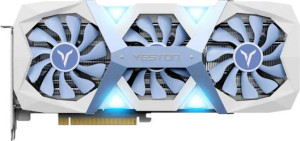
Yeston Game Ace GeForce RTX 5060 Ti 8GB specifications and in-depth review

Yeston Game Ace GeForce RTX 5060 Ti 8GB

Manufacturer: Yeston

The Yeston Game Ace GeForce RTX 5060 Ti 8GB is a mid-range graphics card based on NVIDIA's Blackwell architecture, manufactured on a 5nm process with 21.9 billion transistors. It operates at a base clock of 2407 MHz, boosting up to 2662 MHz, and ships with 8GB of GDDR7 VRAM across a 128-bit memory bus. The card measures 311mm in length and 147mm in height, includes RGB lighting, and carries a thermal design power rating of 180W.

On the technical side, the card delivers 24.53 TFLOPS of floating-point performance alongside a texture rate of 383.3 GTexels/s and a pixel rate of 127.8 GPixels/s, backed by 4608 shading units, 144 TMUs, and 48 ROPs. Memory bandwidth reaches 448 GB/s at an effective speed of 28000 MHz, with ECC support included. The card connects via PCIe 5.0 and supports up to four displays through one HDMI 2.1b port and three DisplayPort outputs. Feature support spans DirectX 12 Ultimate, OpenGL 4.6, OpenCL 3.0, ray tracing, DLSS, Intel Resizable BAR, and stereoscopic 3D.

Pros
  • Supports ray tracing and DLSS, enabling more advanced rendering techniques without relying on brute-force rasterization alone
  • GDDR7 memory delivers an effective speed of 28000 MHz and 448 GB/s of bandwidth, which is notably high for an 8GB configuration
  • PCIe 5.0 interface ensures the card is compatible with current-generation motherboard platforms without bandwidth bottlenecks
  • Four simultaneous display outputs — one HDMI 2.1b and three DisplayPort — offer flexible multi-monitor setups
  • ECC memory support adds a degree of data integrity protection useful for compute-adjacent tasks
  • Intel Resizable BAR support allows the CPU to access the full VRAM pool at once, which can improve frame delivery in supported scenarios
Cons
  • The 128-bit memory bus width is relatively narrow for a card with this level of compute throughput, which may limit scalability in memory-intensive workloads
  • Only 8GB of VRAM may prove restrictive in scenarios where large textures or high-resolution assets are loaded simultaneously
  • No USB-C output is available, limiting compatibility with displays or devices that rely solely on that connector
  • Air cooling is the only thermal solution; there is no support for water cooling, which may concern users in thermally constrained builds
  • No DVI output means older monitors using that interface cannot be connected directly
Who is this for?

This card is well matched to users who want to run ray tracing and DLSS in modern titles, as both features are fully supported and can help maintain visual quality without placing the entire burden on raw rasterization throughput. The 448 GB/s of memory bandwidth delivered by GDDR7 makes it a reasonable fit for content creators handling moderately sized assets or GPU-accelerated compute tasks that benefit from fast data throughput. Users looking to drive a multi-monitor setup of up to four displays will also find the output configuration practical, with a mix of HDMI 2.1b and three DisplayPort connections covering most common display configurations.

Who is this NOT for?

Users working with memory-intensive workloads such as large-scale 3D rendering, high-resolution texture editing, or AI model inference will likely find the 8GB VRAM ceiling restrictive, particularly as asset sizes continue to grow. The 128-bit memory bus, while partially offset by GDDR7 speeds, may still bottleneck scenarios that demand sustained high-bandwidth access across large datasets. Additionally, those building in compact or thermally constrained cases should note that the card measures 311mm in length and relies entirely on air cooling, making it a poor fit for small form factor builds where space and airflow are limited.

Performance:

GPU clock speed 2407 MHz
GPU turbo 2662 MHz
pixel rate 127.8 GPixel/s
floating-point performance 24.53 TFLOPS
texture rate 383.3 GTexels/s
GPU memory speed 1750 MHz
shading units 4608
texture mapping units (TMUs) 144
render output units (ROPs) 48
Has Double Precision Floating Point (DPFP)

The Performance section of this card centers on a base GPU clock of 2407 MHz that boosts up to 2662 MHz, driving a floating-point throughput of 24.53 TFLOPS. Rasterization is handled by 4608 shading units paired with 144 texture mapping units and 48 render output units, producing a texture rate of 383.3 GTexels/s and a pixel rate of 127.8 GPixel/s. GPU memory operates at 1750 MHz, and the card includes support for Double Precision Floating Point (DPFP), extending its utility to workloads that require higher numerical precision.

Memory:

effective memory speed 28000 MHz
maximum memory bandwidth 448 GB/s
VRAM 8GB
GDDR version GDDR7
memory bus width 128-bit
Supports ECC memory

This card is equipped with 8GB of GDDR7 VRAM running at an effective speed of 28000 MHz across a 128-bit memory bus, yielding a maximum memory bandwidth of 448 GB/s. ECC memory support is included, adding a layer of data integrity protection for workloads where memory accuracy is a priority.

Features:

DirectX version DirectX 12 Ultimate
OpenGL version 4.6
OpenCL version 3
Supports multi-display technology
supports ray tracing
Supports 3D
supports DLSS
has XeSS (XMX)
AMD SAM / Intel Resizable BAR Intel Resizable BAR
has LHR
has RGB lighting
supported displays 4

The card supports DirectX 12 Ultimate, OpenGL 4.6, and OpenCL 3, covering a broad range of graphics and compute workloads. Ray tracing and DLSS are both supported, while XeSS (XMX) is not included. On the display side, up to four monitors can be connected simultaneously with multi-display technology enabled. Intel Resizable BAR is supported, though Lite Hash Rate (LHR) limiting is not present. Additional features include stereoscopic 3D support and RGB lighting on the card itself.

Ports:

has an HDMI output
HDMI ports 1
HDMI version HDMI 2.1b
DisplayPort outputs 3
USB-C ports 0
DVI outputs 0
mini DisplayPort outputs 0

The card's output configuration consists of one HDMI 2.1b port and three DisplayPort outputs, bringing the total to four available display connections. There are no USB-C, DVI, or mini DisplayPort outputs on this model.

General info:

GPU architecture Blackwell
Thermal Design Power (TDP) 180W
PCI Express (PCIe) version 5
semiconductor size 5 nm
number of transistors 21900 million
Has air-water cooling
width 311 mm
height 147 mm

This card is built on the Blackwell architecture, fabricated using a 5nm process and integrating 21,900 million transistors. It connects via PCIe 5.0 and carries a thermal design power rating of 180W, with cooling handled solely by air — there is no integrated water cooling. Physically, the card measures 311mm in width and 147mm in height.

Final Verdict

The Yeston Game Ace GeForce RTX 5060 Ti 8GB is a card that balances modern feature support with some practical constraints. Built on the Blackwell architecture and backed by GDDR7 memory delivering 448 GB/s of bandwidth, it handles ray tracing, DLSS, and multi-display output with a level of technical capability that suits mainstream gaming and light compute tasks well. That said, the 8GB VRAM ceiling and 128-bit bus width are real considerations for users whose workloads push memory demands higher. For those whose use cases align with its strengths — modern rendering features, broad API support, and flexible display connectivity — the RTX 5060 Ti 8GB represents a technically coherent option within its segment, provided the physical footprint and air-only cooling suit the intended build environment.

Popular Comparisons

Yeston Game Ace GeForce RTX 5060 Ti 8GB
VS
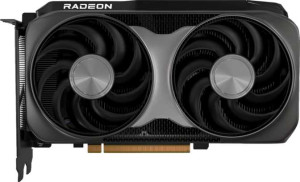
AMD Radeon RX 9060 XT 16GB
Yeston Game Ace GeForce RTX 5060 Ti 8GB
VS
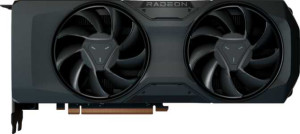
AMD Radeon RX 7800 XT