Yeston Sakura GeForce RTX 4070 Ti specifications and in-depth review

Yeston Sakura GeForce RTX 4070 Ti

Manufacturer: Yeston

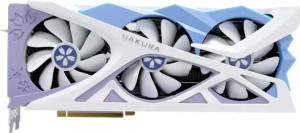
The Yeston Sakura GeForce RTX 4070 Ti is a graphics card based on NVIDIA's Ada Lovelace architecture, manufactured on a 5 nm process and housing 35,800 million transistors. It comes with 12GB of GDDR6X VRAM on a 192-bit memory bus, a thermal design power of 285W, and RGB lighting built into its design. At 342 mm wide and 153 mm tall, it occupies a sizeable physical footprint.

The card operates at a base clock of 2310 MHz and boosts up to 2610 MHz, delivering 40.09 TFLOPS of floating-point performance alongside a texture rate of 626.4 GTexels/s and a pixel rate of 208.8 GPixels/s. Its 7,680 shading units are supported by 240 texture mapping units and 80 render output units, with memory running at an effective speed of 21,000 MHz for a peak bandwidth of 504.2 GB/s. The feature set includes DirectX 12 Ultimate, OpenGL 4.6, OpenCL 3, ray tracing, DLSS, stereoscopic 3D, ECC memory, Double Precision Floating Point, and Intel Resizable BAR, while three DisplayPort and one HDMI 2.1 output allow for up to four simultaneous displays.

Pros
  • Ray tracing and DLSS are both hardware-supported, enabling advanced rendering and upscaling in compatible applications
  • ECC memory support adds data reliability for workloads where accuracy is critical
  • Double Precision Floating Point capability extends usability to professional and scientific compute tasks beyond standard rendering
  • RGB lighting is built in, offering visual customization without additional hardware
  • Four simultaneous display outputs via three DisplayPort and one HDMI 2.1 port support multi-monitor setups
  • Intel Resizable BAR is present, improving data transfer efficiency between the CPU and GPU
Cons
  • At 342 mm wide and 153 mm tall, the card has a large physical footprint that may not fit in compact or mid-tower cases without careful planning
  • The 192-bit memory bus width results in a maximum bandwidth of 504.2 GB/s, which is narrower than cards using wider bus configurations
  • 12GB of VRAM may prove limiting for workloads that rely heavily on large memory allocations
  • Air-water hybrid cooling is not supported, restricting thermal management to standard air cooling only
  • USB-C, DVI, and mini DisplayPort outputs are absent, limiting compatibility with certain display types
Who is this for?

This card is a reasonable fit for users focused on gaming and general rendering workloads who also want built-in ray tracing and DLSS support without needing a larger, higher-TDP card. The inclusion of ECC memory and Double Precision Floating Point makes it usable in light compute and professional scenarios where data integrity matters. Users who run multi-monitor setups of up to four displays will find the output configuration sufficient, and the RGB lighting adds visual flexibility for builds where aesthetics are a consideration.

Who is this NOT for?

Users working with memory-intensive applications may find the 12GB of VRAM on a 192-bit bus a constraint, particularly for tasks involving large textures, high-resolution assets, or datasets that push memory capacity. The card's 342 mm length and 153 mm height make it a poor match for compact or mid-tower cases where physical clearance is limited, and those with smaller enclosures should verify compatibility carefully. Additionally, users who require USB-C or DVI display outputs will find no support for either, which could be a limiting factor depending on their existing monitor setup.

Performance:

GPU clock speed 2310 MHz
GPU turbo 2610 MHz
pixel rate 208.8 GPixel/s
floating-point performance 40.09 TFLOPS
texture rate 626.4 GTexels/s
GPU memory speed 1313 MHz
shading units 7680
texture mapping units (TMUs) 240
render output units (ROPs) 80
Has Double Precision Floating Point (DPFP)

The GPU runs at a base clock of 2310 MHz and boosts to 2610 MHz, generating 40.09 TFLOPS of floating-point throughput alongside a texture rate of 626.4 GTexels/s and a pixel rate of 208.8 GPixels/s. Backing these figures are 7,680 shading units, 240 texture mapping units, and 80 render output units, with the GPU memory clocked at 1313 MHz. Double Precision Floating Point is supported, extending the card's reach into compute workloads that demand higher numerical precision.

Memory:

effective memory speed 21000 MHz
maximum memory bandwidth 504.2 GB/s
VRAM 12GB
GDDR version GDDR6X
memory bus width 192-bit
Supports ECC memory

The card is fitted with 12GB of GDDR6X VRAM operating at an effective speed of 21,000 MHz across a 192-bit memory bus, yielding a maximum bandwidth of 504.2 GB/s. ECC memory support is included, adding a layer of data integrity protection for compute-focused use cases.

Features:

DirectX version DirectX 12 Ultimate
OpenGL version 4.6
OpenCL version 3
Supports multi-display technology
supports ray tracing
Supports 3D
supports DLSS
has XeSS (XMX)
AMD SAM / Intel Resizable BAR Intel Resizable BAR
has LHR
has RGB lighting
supported displays 4

Software and API coverage includes DirectX 12 Ultimate, OpenGL 4.6, and OpenCL 3, while hardware-level features extend to ray tracing, DLSS, and stereoscopic 3D. Multi-display output is supported across up to four screens, and Intel Resizable BAR is available to improve data flow between the CPU and GPU. RGB lighting is present on this model, whereas XeSS and LHR are not supported.

Ports:

has an HDMI output
HDMI ports 1
HDMI version HDMI 2.1
DisplayPort outputs 3
USB-C ports 0
DVI outputs 0
mini DisplayPort outputs 0

The card offers three DisplayPort outputs alongside a single HDMI 2.1 port, covering four display connections in total. USB-C, DVI, and mini DisplayPort are not present on this model.

General info:

GPU architecture Ada Lovelace
Thermal Design Power (TDP) 285W
PCI Express (PCIe) version 4
semiconductor size 5 nm
number of transistors 35800 million
Has air-water cooling
width 342 mm
height 153 mm

The card is built on the Ada Lovelace architecture using a 5 nm manufacturing process, with 35,800 million transistors and a PCIe 4 interface. Its thermal design power is rated at 285W, and cooling is handled by a standard air solution, as air-water hybrid cooling is not supported. Physically, the card measures 342 mm in width and 153 mm in height, indicating a large form factor that requires careful case clearance planning.
Final Verdict

The Yeston Sakura GeForce RTX 4070 Ti brings together a solid feature set that covers ray tracing, DLSS, ECC memory, and Double Precision Floating Point support, giving it utility across both gaming and lighter compute workloads. Its 12GB of GDDR6X VRAM on a 192-bit bus is functional for most current use cases, though users with heavier memory demands should factor in the bandwidth ceiling. The large physical dimensions and 285W TDP mean system compatibility deserves attention before installation. For users with appropriately sized and well-equipped builds, it offers a well-rounded specification set with RGB lighting and multi-display output in a single card.