Yeyian Phoenix (i9-14900KF / 4070 Ti Super / 32GB RAM / 2TB SSD) specifications and in-depth review

Yeyian Phoenix (i9-14900KF / 4070 Ti Super / 32GB RAM / 2TB SSD)

Manufacturer: Yeyian

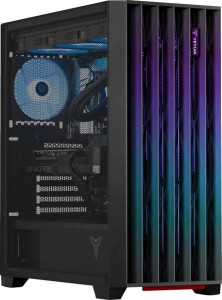
The Yeyian Phoenix (i9-14900KF / 4070 Ti Super / 32GB RAM / 2TB SSD) is a desktop gaming PC built around Intel's Core i9-14900KF processor and NVIDIA's GeForce RTX 4070 Ti Super graphics card. The system ships in an ATX form factor and comes equipped with 32GB of DDR5 RAM running at 5600 MHz, alongside a 2TB NVMe SSD for fast storage access. Connectivity options include Wi-Fi 6E, Bluetooth 5.3, and a broad selection of USB ports spanning USB 2.0, USB 3.2 Gen 1, Gen 2, and Gen 2x2 standards, plus a single RJ45 Ethernet port.

On the graphics side, the RTX 4070 Ti Super is based on NVIDIA's Ada Lovelace architecture and carries 16GB of GDDR6X memory across a 256-bit bus, with an effective memory speed of 21000 MHz and a maximum bandwidth of 89.6 GB/s. The card delivers 44.1 TFLOPS of floating-point performance and supports ray tracing, DLSS, and DirectX 12 Ultimate, with output through three DisplayPort connectors and one HDMI 2.1a port. The i9-14900KF CPU offers 32 threads via big.LITTLE architecture, a turbo clock speed of 6 GHz, and an unlocked multiplier, supported by 32MB of L2 cache and 36MB of L3 cache. The system carries a PassMark score of 58,366 and a Geekbench 6 multi-core result of 20,578, and is backed by a two-year warranty.

Pros
  • The 24-core CPU with 32 threads and a 6 GHz turbo clock handles heavily threaded workloads with headroom to spare
  • 16GB of GDDR6X VRAM on a 256-bit bus supports high-resolution textures and memory-intensive rendering tasks without running short on framebuffer capacity
  • Wi-Fi 6E support enables fast, low-latency wireless connections on the 6 GHz band alongside wired Ethernet via the RJ45 port
  • The 2TB NVMe SSD provides substantial fast storage, reducing load times for large game libraries and application data
  • Support for up to four simultaneous displays gives flexibility for multi-monitor setups
  • DDR5 RAM running at 5600 MHz across two channels provides high memory bandwidth for both the CPU and overall system throughput
Cons
  • No integrated graphics means the system cannot function for display output if the discrete GPU encounters an issue
  • Air-water cooling is not included, so adequate thermal management depends entirely on whatever cooling solution is bundled or separately installed
  • The chassis volume exceeds 94,000 cm³ with a height of 556 mm, making it a bulky unit that demands significant desk or floor space
  • USB 4 and Thunderbolt 3 or 4 ports are absent, limiting high-speed peripheral and external device options at those standards
  • The maximum supported memory of 192GB is theoretical; the system ships with only 32GB installed, leaving most of that headroom unused without further upgrades
Who is this for?

This system is well-suited to users who regularly engage in demanding gaming workloads, particularly at high resolutions where the 16GB of GDDR6X VRAM and 44.1 TFLOPS of floating-point performance provide meaningful headroom. The 24-core CPU with 32 threads and a 6 GHz turbo clock also makes it a capable machine for content creation tasks such as video editing, 3D rendering, and simulation that benefit from strong multi-threaded processing. Users who rely on a broad set of connected peripherals or multi-monitor arrangements will also find value here, given the four-display support, extensive USB port selection, Wi-Fi 6E, and Bluetooth 5.3 coverage.

Who is this NOT for?

The large ATX chassis measuring 556 mm in height and exceeding 94,000 cm³ in volume makes this system entirely impractical for anyone with limited desk or room space, or for those who need a system that can be moved or repositioned frequently. The complete absence of Thunderbolt 3 or 4 and USB 4 ports means users who depend on high-bandwidth external devices such as fast external SSDs or professional audio and video interfaces at those standards will find the connectivity options insufficient. Additionally, since there is no integrated graphics, the system is not a good fit for users who need a reliable fallback display output independent of the discrete GPU.

General info:

SSD storage capacity 2000GB
form factor ATX
Is an NVMe SSD
Uses flash storage
volume 94286.48 cm³
thickness 556 mm
height 556 mm
width 305 mm

The Yeyian Phoenix follows an ATX form factor and houses its components within a chassis measuring 556 mm in height, 305 mm in width, and 556 mm in depth, resulting in a total volume of roughly 94,286 cm³. Storage is handled by a 2TB NVMe SSD that relies on flash memory, offering fast read and write access suited to the demands of modern applications and large game libraries.

Graphics card:

VRAM 16GB
floating-point performance 44.1 TFLOPS
effective memory speed 21000 MHz
GPU clock speed 2340 MHz
GPU memory speed 1313 MHz
GPU turbo 2610 MHz
GDDR version GDDR6X
DirectX version DirectX 12 Ultimate
PCI Express (PCIe) version 5
supports ray tracing
texture rate 689 GTexels/s
pixel rate 250.6 GPixel/s
maximum memory bandwidth 89.6 GB/s
memory bus width 256-bit
supports DLSS
supported displays 4
semiconductor size 10 nm
texture mapping units (TMUs) 264
shading units 8448
render output units (ROPs) 96
OpenGL version 4.6
OpenCL version 3
has LHR
Supports multi-display technology
Has Double Precision Floating Point (DPFP)
Supports 3D
has RGB lighting
number of transistors 45900 million

The graphics card in this system is equipped with 16GB of GDDR6X VRAM across a 256-bit memory bus, delivering an effective memory speed of 21000 MHz and a maximum memory bandwidth of 89.6 GB/s. It operates at a base clock of 2340 MHz with a turbo frequency of 2610 MHz, producing 44.1 TFLOPS of floating-point performance alongside a texture rate of 689 GTexels/s and a pixel rate of 250.6 GPixel/s. The card is built on a 10 nm process node and packs 45,900 million transistors, 8448 shading units, 264 texture mapping units, and 96 render output units. It connects via PCIe 5 and supports up to four displays simultaneously through its multi-display capability. Feature support includes ray tracing, DLSS, DirectX 12 Ultimate, OpenGL 4.6, OpenCL 3, stereoscopic 3D, and Double Precision Floating Point (DPFP), while LHR and RGB lighting are not present on this card.

CPU:

CPU speed 8 x 3.2 & 16 x 2.4 GHz
Has integrated graphics
Has an unlocked multiplier
L2 cache 32 MB
L3 cache 36 MB
turbo clock speed 6GHz
CPU threads 32 threads
uses multithreading
Turbo Boost version 2
clock multiplier 32
Supports 64-bit
CPU temperature 100 °C

The processor runs across 24 cores — eight at 3.2 GHz and sixteen at 2.4 GHz — and exposes 32 threads through multithreading, with a turbo clock speed reaching up to 6 GHz via Turbo Boost version 2 and a clock multiplier of 32. Cache memory totals 32 MB of L2 and 36 MB of L3, providing ample low-latency storage for frequently accessed data. The CPU supports 64-bit operations, carries a maximum rated temperature of 100 °C, and ships with an unlocked multiplier for frequency adjustments. It does not include integrated graphics, so a discrete graphics card is required for display output.

Benchmarks:

Geekbench 6 result (multi) 20578
Geekbench 6 result (single) 3079
PassMark (G3D) result 31767
PassMark result 58366
PassMark result (single) 4684
PassMark result (overclocked) 59896

In CPU benchmarking, the system records a Geekbench 6 multi-core score of 20,578 alongside a single-core result of 3,079, reflecting both its multi-threaded throughput and per-core responsiveness. On the PassMark side, the overall score lands at 58,366 with a single-core result of 4,684, climbing to 59,896 when overclocked. Graphics performance is captured by a PassMark G3D score of 31,767, covering the rendering capability of the discrete GPU.

Memory:

RAM 32GB
RAM speed 5600 MHz
DDR memory version 5

The system is fitted with 32GB of DDR5 RAM running at 5600 MHz, providing a combination of generous capacity and high memory bandwidth to support both the processor and overall system responsiveness during demanding workloads.

Connectivity:

Wi-Fi version Wi-Fi 6E (802.11ax), Wi-Fi 6 (802.11ax), Wi-Fi 5 (802.11ac), Wi-Fi 4 (802.11n)
supports Wi-Fi
USB 2.0 ports 8
USB 3.2 Gen 2 ports (USB-A) 1
USB 3.2 Gen 1 ports (USB-A) 6
USB 3.2 Gen 2 ports (USB-C) 1
USB 4 40Gbps ports 0
USB 4 20Gbps ports 0
USB 3.2 Gen 2x2 ports 1
USB 3.2 Gen 1 ports (USB-C) 1
RJ45 ports 1
Thunderbolt 4 ports 0
Thunderbolt 3 ports 0
DisplayPort outputs 3
HDMI version HDMI 2.1a
HDMI ports 1
Has Bluetooth
Bluetooth version 5.3
DVI outputs 0
has a socket for a 3.5 mm audio jack
has a VGA connector

Wireless connectivity is handled by Wi-Fi 6E (802.11ax) with backwards compatibility down to Wi-Fi 4, complemented by Bluetooth 5.3 for short-range peripherals. Wired networking is covered by a single RJ45 port, and the USB layout includes eight USB 2.0 ports, six USB 3.2 Gen 1 Type-A ports, one USB 3.2 Gen 2 Type-A port, one USB 3.2 Gen 1 Type-C port, one USB 3.2 Gen 2 Type-C port, and one USB 3.2 Gen 2x2 Type-C port; USB 4 ports and Thunderbolt 3 or 4 are not present. Display output is provided through three DisplayPort connectors and one HDMI 2.1a port, while DVI and VGA outputs are absent. A 3.5 mm audio jack rounds out the connectivity options.

Miscellaneous:

has an HDMI output
Type Desktop
chipset B760, H770, Z790, H610, H670, B660, Z690
CPU socket LGA 1700
instruction sets MMX, SSE 4.1, SSE 4.2, AVX, AVX2, AES, F16C, FMA3
Has NX bit
Supports ECC memory
memory channels 2
maximum memory amount 192GB
Thermal Design Power (TDP) 125W
Uses big.LITTLE technology
RAM speed (max) 5600 MHz
AMD SAM / Intel Resizable BAR Intel Resizable BAR
USB-C ports 0
Has air-water cooling
mini DisplayPort outputs 0
has XeSS (XMX)
GPU architecture Ada Lovelace
warranty period 2 years

The desktop CPU sits in an LGA 1700 socket and is compatible with a range of chipsets including B760, H770, Z790, H610, H670, B660, and Z690. It carries a TDP of 125W, uses big.LITTLE technology, and supports instruction sets covering MMX, SSE 4.1, SSE 4.2, AVX, AVX2, AES, F16C, and FMA3, along with the NX bit for hardware-level security. Memory support extends to a maximum of 192GB across two channels at up to 5600 MHz, with ECC memory compatibility also confirmed. The GPU is based on the Ada Lovelace architecture and the system includes an HDMI output; mini DisplayPort outputs and XeSS (XMX) are not present. Intel Resizable BAR is supported, air-water cooling is not included, and the system comes with a two-year warranty.
Final Verdict

The Yeyian Phoenix (i9-14900KF / 4070 Ti Super / 32GB RAM / 2TB SSD) is a desktop gaming PC that brings together a high thread-count processor and a GPU carrying 16GB of GDDR6X VRAM on the Ada Lovelace architecture, forming a combination well-matched to demanding gaming sessions and multithreaded creative workloads alike. The DDR5 memory, NVMe storage, Wi-Fi 6E, and broad USB port selection reflect a system built with practical day-to-day usability in mind alongside raw processing capability. Its large ATX chassis and the absence of Thunderbolt or USB 4 connectivity do narrow its appeal for users with specific portability or high-bandwidth peripheral needs, but for those with a dedicated workspace and a focus on sustained gaming or content creation performance, the Yeyian Phoenix represents a well-specified and cohesive desktop build.