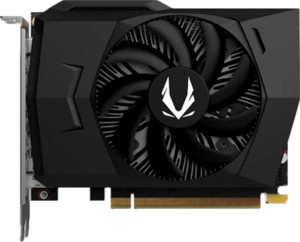
Zotac Gaming GeForce RTX 3050 Solo 6GB specifications and in-depth review

Zotac Gaming GeForce RTX 3050 Solo 6GB

Manufacturer: Zotac

The Zotac Gaming GeForce RTX 3050 Solo 6GB is a notably compact graphics card designed around NVIDIA's Ampere architecture, fabricated on an 8nm process and integrating 8700 million transistors. With a physical footprint of just 150.8×115.1 mm and a 70W TDP, it is one of the smaller form factor options available in its category, making it well-suited to builds where internal space is at a premium.

Performance is driven by 2304 shading units clocked at a base of 1042 MHz and a turbo of 1470 MHz, delivering 6.774 TFLOPS of floating-point throughput alongside a texture rate of 105.8 GTexels/s. The card pairs this with 6GB of GDDR6 VRAM running at an effective 14000 MHz across a 96-bit bus, providing up to 168 GB/s of memory bandwidth and ECC support. On the output side, it offers three DisplayPort and one HDMI 2.1 port, enabling connectivity to up to four displays simultaneously, while features such as ray tracing, DLSS, DirectX 12 Ultimate, and Intel Resizable BAR round out a modern and capable feature set.

Pros
  • At 150.8×115.1 mm, this is one of the smallest form factor cards available in its class, making it genuinely viable for mini-ITX and other space-constrained builds
  • A 70W TDP means the card can run in systems with modest power supplies and does not require supplementary PCIe power connectors in many configurations
  • Three DisplayPort outputs alongside one HDMI 2.1 port allow simultaneous connectivity to up to four displays, which is a notably flexible output configuration for this card tier
  • Hardware ray tracing and DLSS support provide access to modern rendering features without the physical bulk or power demands of larger cards
  • ECC memory support adds reliability for compute workloads where data integrity is a priority
  • Intel Resizable BAR compatibility allows the CPU to access the full GPU frame buffer, benefiting rendering throughput on supported platforms
Cons
  • The 96-bit memory bus limits available bandwidth headroom, which can constrain performance in texture-heavy or higher-resolution workloads
  • 6GB of VRAM is a tight allocation that may be insufficient for modern games or applications with large asset sets
  • With only 32 ROPs, the pixel fill rate is limited, which can affect rendering performance in complex scenes
  • No DVI output is available, which may be a drawback for users with older monitors that rely on that interface
  • The absence of RGB lighting may not suit users who want visual coordination with illuminated system components
  • Air-only cooling with no hybrid option may present thermal limitations when the card is installed in enclosures with restricted airflow
Who is this for?

The Zotac Gaming GeForce RTX 3050 Solo 6GB is particularly well-suited to users building compact or mini-ITX systems, where its 150.8×115.1 mm footprint and 70W TDP allow it to fit into tight chassis without straining the power supply. Users who need to drive multiple displays simultaneously will appreciate the four-output configuration — three DisplayPort and one HDMI 2.1 — which is notably generous for a card of this size. It also serves those who want access to ray tracing, DLSS, and DirectX 12 Ultimate for light to moderate 1080p workloads, or who need ECC memory support for reliability-sensitive compute tasks in a low-power package.

Who is this NOT for?

Users targeting 1440p or 4K gaming and rendering will find the 6GB VRAM and 96-bit memory bus become limiting factors relatively quickly, as both constrain the card's ability to handle large frame buffers and high-bandwidth workloads. Those running memory-intensive professional applications — such as real-time 3D content creation or large dataset processing — will similarly encounter the ceiling imposed by the narrow bus width and modest VRAM capacity. The card is also not a fit for users who require DVI connectivity, as that interface is entirely absent, leaving anyone reliant on older display hardware without a direct connection option.

Performance:

GPU clock speed 1042 MHz
GPU turbo 1470 MHz
pixel rate 47.04 GPixel/s
floating-point performance 6.774 TFLOPS
texture rate 105.8 GTexels/s
GPU memory speed 1750 MHz
shading units 2304
texture mapping units (TMUs) 72
render output units (ROPs) 32
Has Double Precision Floating Point (DPFP)

The GPU operates at a base clock of 1042 MHz with a turbo frequency of 1470 MHz, supported by 2304 shading units and 72 texture mapping units that together deliver a texture rate of 105.8 GTexels/s and a pixel rate of 47.04 GPixel/s. Floating-point performance stands at 6.774 TFLOPS, processed through 32 render output units. GPU memory runs at 1750 MHz, and Double Precision Floating Point (DPFP) is supported, extending the card's utility to workloads that depend on 64-bit numerical precision.

Memory:

effective memory speed 14000 MHz
maximum memory bandwidth 168 GB/s
VRAM 6GB
GDDR version GDDR6
memory bus width 96-bit
Supports ECC memory

The card is equipped with 6GB of GDDR6 VRAM running at an effective speed of 14000 MHz over a 96-bit memory bus, achieving a maximum bandwidth of 168 GB/s. The 96-bit interface keeps power consumption in check while still delivering adequate throughput for the card's intended workloads. ECC memory support is included, providing error correction for scenarios where data reliability is a requirement.

Features:

DirectX version DirectX 12 Ultimate
OpenGL version 4.6
OpenCL version 3
Supports multi-display technology
supports ray tracing
Supports 3D
supports DLSS
has XeSS (XMX)
AMD SAM / Intel Resizable BAR Intel Resizable BAR
has LHR
has RGB lighting
supported displays 4

The card supports DirectX 12 Ultimate, OpenGL 4.6, and OpenCL 3, covering the key graphics and compute APIs used in modern applications. Hardware ray tracing and DLSS are both enabled, and stereoscopic 3D output is also available. Multi-display technology supports connectivity to up to four screens simultaneously, with Intel Resizable BAR providing broader CPU access to the GPU frame buffer on compatible systems. XeSS (XMX), LHR, and RGB lighting are not present on this model.

Ports:

has an HDMI output
HDMI ports 1
HDMI version HDMI 2.1
DisplayPort outputs 3
USB-C ports 0
DVI outputs 0
mini DisplayPort outputs 0

The card's output configuration consists of three DisplayPort outputs and a single HDMI 2.1 port, giving it four total display connections without relying on DVI, USB-C, or mini DisplayPort — none of which are present on this model. The DisplayPort-heavy layout makes it a practical fit for multi-monitor setups where that interface is the preferred standard.

General info:

GPU architecture Ampere
Thermal Design Power (TDP) 70W
PCI Express (PCIe) version 4
semiconductor size 8 nm
number of transistors 8700 million
Has air-water cooling
width 150.8 mm
height 115.1 mm

Underpinned by the Ampere architecture and built on an 8nm semiconductor process, the GPU integrates 8700 million transistors and connects to the host platform via PCIe 4. Its 70W TDP places it squarely in the low-power segment, and cooling is handled entirely by air — no hybrid or liquid solution is included. At 150.8 mm wide and 115.1 mm tall, the card has one of the more compact physical profiles in its category, making it a natural candidate for space-constrained system builds.

Final Verdict

The Zotac Gaming GeForce RTX 3050 Solo 6GB carves out a clear and coherent identity as one of the more physically compact graphics cards available, and its 150.8×115.1 mm footprint combined with a 70W TDP makes it genuinely accessible to a range of small form factor builds that most cards in this segment cannot accommodate. The four-display output capability — anchored by three DisplayPort connections and one HDMI 2.1 port — adds a degree of connectivity flexibility that goes beyond what its physical size might suggest. Feature coverage is modern and complete for its tier, with ray tracing, DLSS, DirectX 12 Ultimate, ECC memory, and Intel Resizable BAR all present. The constraints imposed by the 96-bit memory bus and 6GB VRAM are real, and users with ambitions beyond light to moderate 1080p workloads will feel them. Within its intended scope, however, the Solo 6GB is a well-defined card that delivers on its compact, low-power design brief without meaningful compromise to its core feature set.

Popular Comparisons

Zotac Gaming GeForce RTX 3050 Solo 6GB
VS
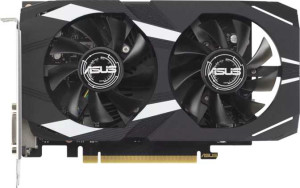
Asus Dual GeForce RTX 3050 OC Edition 6GB