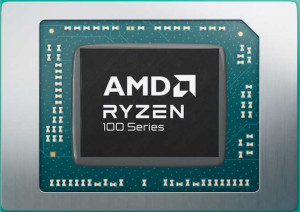
The AMD Ryzen 5 150 is compatible with both laptop and desktop platforms and is built on a 6nm semiconductor process, keeping power consumption at a rated TDP of 45W with a maximum operating temperature of 95°C. The processor includes integrated graphics and fully supports 64-bit computing. Connectivity is handled through PCIe 4.0, offering a reasonably modern interface for storage and expansion devices.
The processor runs six cores at a base speed of 3.3 GHz across all cores, totaling 12 threads, and can reach a turbo clock speed of 4.55 GHz when conditions allow. The clock multiplier sits at 33, though the multiplier is locked, meaning manual overclocking through that route is not available. Cache is structured across three levels — 512 KB of L1, 3 MB of L2 at 0.5 MB per core, and 16 MB of L3 at approximately 2.67 MB per core — providing a reasonable amount of fast-access memory for the core count. The chip does not use big.LITTLE heterogeneous core architecture, meaning all six cores share the same design.
The integrated graphics solution is the Radeon 660M, running at a base clock of 1500 MHz with a turbo frequency of 1900 MHz. It features 384 shading units, 24 texture mapping units (TMUs), and 16 render output units (ROPs), and is capable of driving up to four displays simultaneously. API support covers DirectX 12, OpenGL 4.6, and OpenCL 2.2, providing a broad range of compatibility for general computing and light graphical workloads.
The processor supports DDR5 memory at speeds of up to 4800 MHz across two channels, delivering a maximum memory bandwidth of 76.8 GB/s. System memory can be configured up to a ceiling of 64GB, and the processor also supports ECC memory, which provides basic error detection and correction for applications where data integrity is a priority.
The processor supports multithreading, allowing each physical core to handle two threads simultaneously for more efficient workload distribution. It includes the NX bit for hardware-level memory protection against certain classes of malicious code execution. Instruction set support covers a broad range including AVX2, FMA3, and AES, alongside MMX, F16C, AVX, SSE 4.1, and SSE 4.2, enabling compatibility with a wide variety of optimized software routines.