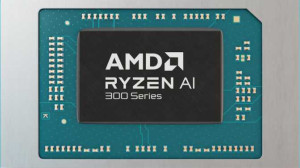
The AMD Ryzen 9 8940HX is designed for both laptop and desktop platforms, giving it a degree of deployment flexibility uncommon among mobile-oriented processors. It is built on a 5nm semiconductor process and carries a Thermal Design Power (TDP) of 55W, with a maximum operating temperature of 100°C. The chip supports 64-bit computing and includes integrated graphics, while its PCIe 5.0 interface ensures compatibility with current-generation expansion and storage devices.
The Ryzen 9 8940HX features 16 cores running at a base clock of 2.4GHz, supporting 32 threads in total, with a turbo clock speed reaching 5.3GHz and a clock multiplier of 24. The processor does not use big.LITTLE heterogeneous core architecture, meaning all cores share the same design. An unlocked multiplier provides tuning headroom within compatible platforms. Cache is organized across three levels: 1024KB of L1, 16MB of L2 at 1MB per core, and 64MB of L3 at 4MB per core, offering a substantial pool of fast on-chip memory to reduce latency for frequently accessed data.
In PassMark testing, the Ryzen 9 8940HX achieves a multi-threaded score of 51,227, reflecting its capacity across all 16 cores and 32 threads. The single-threaded result of 3,860 provides a reference point for workloads that rely primarily on per-core throughput rather than parallelism.
The Ryzen 9 8940HX includes an integrated Radeon 610M GPU, operating at a base clock of 400MHz and boosting up to 2200MHz. It is built around 2 execution units, housing 128 shading units, 8 texture mapping units (TMUs), and 4 render output units (ROPs). The GPU supports up to four displays simultaneously and is compatible with DirectX 12, OpenGL 4.6, and OpenCL 2.1, covering a broad range of graphics and compute workloads within its scope.
The Ryzen 9 8940HX supports DDR5 memory at speeds up to 5200MHz across a dual-channel configuration, with a maximum capacity of 64GB. ECC memory is not supported, which is a common characteristic of consumer-oriented processors in this segment.
The Ryzen 9 8940HX supports multithreading and includes the NX bit for hardware-level execution protection. Its instruction set support spans MMX, SSE 4.1, SSE 4.2, AVX, AVX2, F16C, FMA3, and AES, covering a wide range of workloads from legacy compatibility to floating-point acceleration and hardware-accelerated encryption.